Stay connected with BizTech Community—follow us on Instagram and Facebook for the latest news and reviews delivered straight to you.
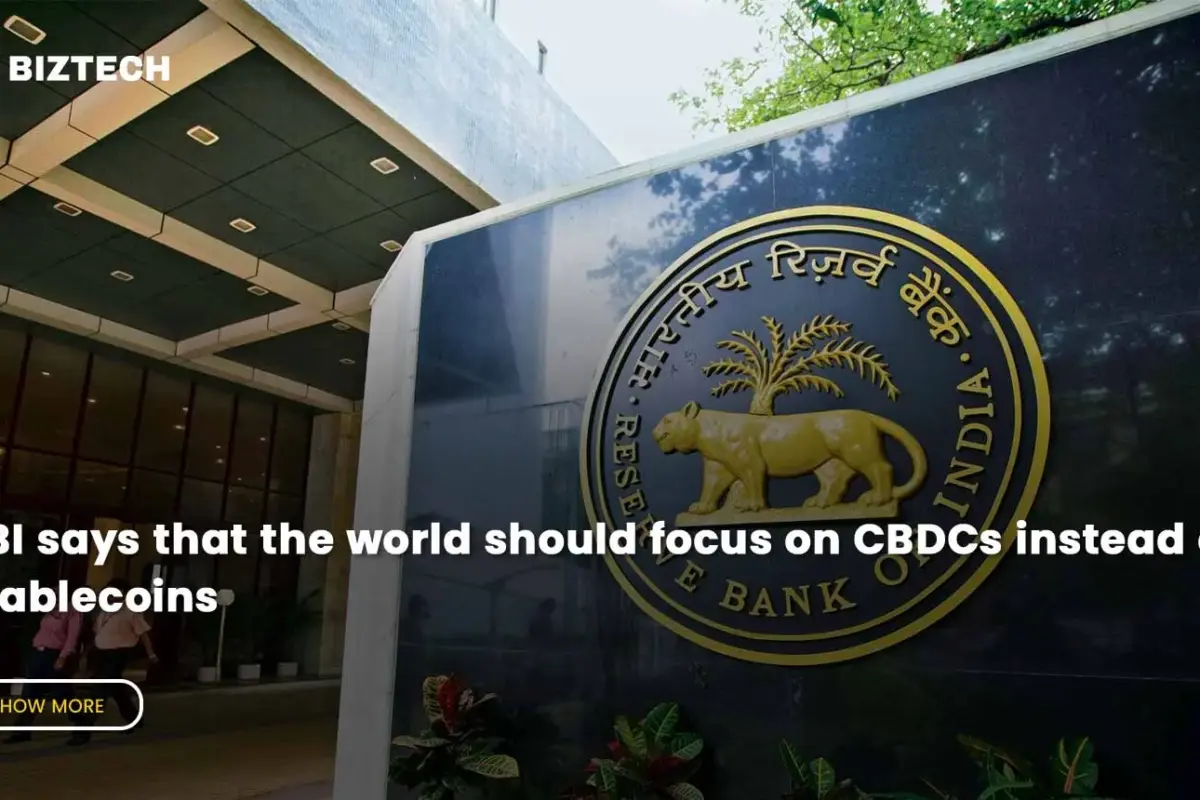
India’s central bank has made it clear that it wants sovereign digital currencies. It has asked governments all over the world to put central bank digital currencies (CBDCs) ahead of stablecoins generated by private companies. The Reserve Bank of India (RBI) said in its December 2025 Financial Stability Report, which came out on December 17, that only central bank money can safeguard the “singleness of money” and the financial system’s integrity.
Read also: Trump Appoints Indian-Origin Sriram Krishnan as Senior AI Policy Advisor
The study is one of the strongest formal pronouncements so far from a major central bank in favor of public-sector digital money as the best way to move forward. It comes as the global stablecoin market gets close to $310 billion in valuation and other places are still looking into their own retail CBDC initiatives.
There is no doubt about the RBI’s stance. The bank agrees that both CBDCs and stablecoins can make things more efficient, programmable, and settle quickly, but it says that only digital money issued by a central bank is safe and credible. The report says, “The RBI therefore strongly advocates that countries should prioritize central bank digital currencies over privately issued stablecoins to maintain trust in money, preserve financial stability and design next generation payments infrastructure that is faster, cheaper and secure.”
The central bank lists a number of unique dangers that come with private stablecoins:
- The chance of destabilizing runs when the market is under stress
- Putting most of the reserves in private businesses instead than public ones
- Competing private currencies breaking apart monetary systems
- Problems in making sure that regulatory oversight is the same in various areas
The RBI, on the other hand, sees CBDCs as digital versions of currency that are legal tender issued directly by the central bank, fully backed by sovereign credit, and free from the danger of commercial counterparty. The paper stresses that a well-designed retail CBDC might offer all the benefits of stablecoins without the financial stability issues that come with private issuers.
Global CBDC Landscape Remains gradual
Despite Interest CBDC adoption has been gradual around the world, even though there have been years of research and pilot initiatives. The Atlantic Council’s CBDC Tracker says that as of late 2025, just three places have completely launched retail CBDCs: Nigeria (eNaira), the Bahamas (Sand Dollar), and Jamaica (Jam-Dex). There are 49 countries that are currently running pilot programs, 20 that are still developing the idea, and 36 that are actively looking into it.
Some well-known initiatives have run into problems with delays or scaling:- The digital yuan (e-CNY) from China has handled a lot of transactions in domestic pilots, but it hasn’t been widely used around the world yet.
- The European Central Bank is still working on its digital euro project, which is not anticipated to start until 2028 or 2029.
- The U.S. Federal Reserve hasn’t promised to make a retail CBDC yet. Instead, it’s working on private stablecoin regulation and wholesale settlement systems.
The RBI’s most recent statement is in line with a growing number of central banks that believe public digital money is necessary to protect monetary sovereignty in a world where private digital currencies are becoming more and more common.
The Situation in India and How Policies Have Changed
India has been very careful with how it handles digital currency. The RBI has been against private cryptocurrencies, but it has also been working on its own CBDC pilot. The digital rupee (e₹) has been tested in phases since late 2022. It has mostly been utilized for wholesale and retail purposes, with controlled distribution through institutions that are part of the program.
The most recent stability assessment backs up this desire for national power. The RBI says that while it is aware of the technological capabilities of private stablecoins, enabling non-bank companies to issue them widely could open up new ways for financial stability concerns to proliferate. The paper particularly mentions the possibility of destabilizing runs during times of market stress, using the 2022 TerraUSD crash as an example from the past.
The Indian government has also said that it is open to regulated stablecoin operations. The Economic Survey 2025-2026 said that rules for stablecoins are being thought about, but the RBI still wants a stricter approach. In 2026, India’s digital asset framework will probably be shaped by the conflict between policies that encourage innovation and the central bank’s conservative approach.
Conclusion
The fact that South Korea’s stablecoin law is taking longer to pass and that the RBI is still being careful shows that the world is still very unsure about private digital currencies. In many places, innovation is still moving faster than regulation, but central banks are speaking out more and more about keeping their role as issuers of the ultimate settlement asset.
For India in particular, there will probably still be arguments in 2026 about how to find the right balance between control and innovation. The digital rupee experiment will grow, giving us more information on how it works in the real world and how well it works. At the same time, the rules for private crypto assets will keep changing, and these changes may be affected by events in other countries.
The RBI is clear about its stance: public digital money should come before private options. The global digital payments landscape will be shaped for years to come by whether other major economies agree with these ideas and whether they can make CBDCs work on a large scale.