Stay connected with BizTech Community—follow us on Instagram and Facebook for the latest news and reviews delivered straight to you.
OpenAI has officially stopped making Sora, their innovative text-to-video AI program. This is a big change in the company’s product strategy less than two years after it was eagerly anticipated. The Sora team announced the decision on March 25, 2026, via an X post. This ends one of the most talked-about AI tools of the generative era: a platform that could make very lifelike video clips from basic text instructions.
The developers sent a direct and somewhat sad letter thanking users for their creativity, shared work, and community building around Sora, knowing that the announcement would probably disappoint a lot of people:
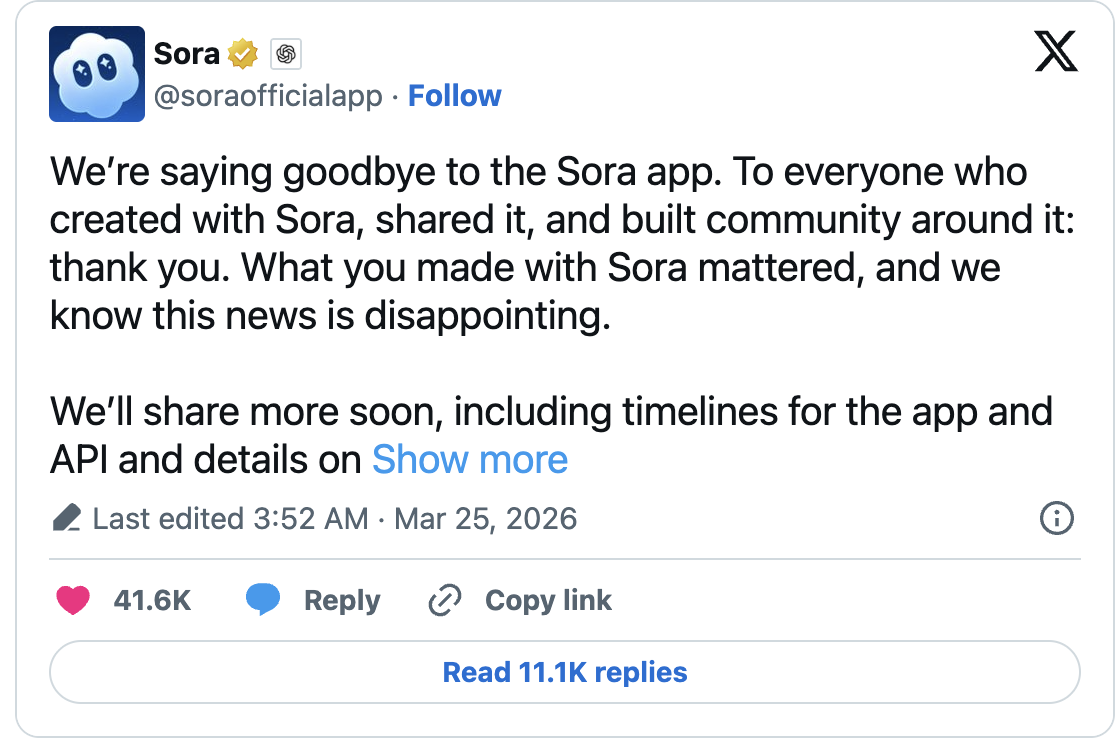
“We are no longer supporting the Sora app. Thank you to everyone who made it, shared it, and built a community around it. We know this news may be disheartening, but what you produced with Sora was important.
The shutdown also means the end of a big content deal with Disney that was said to be worth $1 billion (about Rp16.8 trillion). The cooperation let people make videos with famous Disney characters like Mickey Mouse and Yoda from Star Wars. This made Sora seem like it may change Hollywood and the entertainment industry as a whole.
Changing the focus to more useful AI uses
OpenAI said that the main reason for stopping Sora was that they needed to focus on “technologies that deliver real-world impact,” according to a BBC story. The corporation is moving resources toward robotics and agentic AI systems, which are self-driving robots that can do complicated physical and digital tasks with little help from people.
A representative from the company said:
“We want to make technology that really makes a difference, like AI systems that can work on their own with little supervision.”
This change in strategy is part of a larger trend in the sector. In 2024 and 2025, generative video captivated the public’s imagination. However, many organisations are now debating whether consumer-facing creative tools are worth the time and money compared to enterprise-grade or physically embodied AI solutions.
All Sora services, including as the consumer app and the web-based professional platform, are no longer available. People won’t be allowed to make new videos anymore, but OpenAI hasn’t said what will happen to old recordings or user data yet.
Disney’s Thoughtful Reaction
Disney responded in a professional way, saying it respects OpenAI’s choice and will keep looking into AI technology with other partners while making sure to preserve its intellectual property. People were really interested in the relationship because it could have been a way to connect Silicon Valley and Hollywood, especially because there are still disputes going on about how AI could affect creative professions and copyright.
The end of the Disney deal takes away a well-known example that has helped make Sora seem more real in mainstream entertainment. It also shows how hard it is to add generative AI technologies to existing content pipelines, where legal, creative, and quality-control issues are still big problems.
Sora’s business performance was not what was expected
Sora had a lot of buzz when it first came out, and its technological features were great, but it had trouble turning that buzz into long-term sales. According to Sensor Tower data, the app only made roughly $1.4 million in net revenue from in-app purchases around the world while it was still operational. OpenAI’s main product, ChatGPT, made about $1.9 billion in the same amount of time.
Sora’s low monetisation shows a bigger problem in the generative AI space: making useful tools for consumers is one thing; turning them into successful, scalable businesses is another. Sora probably couldn’t make much money because to high computing costs, daily usage limits, and competition from free or cheaper options.
Henry Ajder, an industry expert who specialises in AI and deepfakes, said that the closure shows that OpenAI needs to use its resources more effectively:
“Since the market was losing interest and OpenAI wasn’t making any money, the company probably decided not to keep spending money on a project that wasn’t making them much money.”
Concerns about copyright violations and how they can hurt creative industries also played a factor in the decision, as generative video technologies are still facing legal challenges and public reaction over how they use training data.
More and more people are competing in AI video generation
Sora’s departure comes at a time when the AI video market is becoming more and more competitive. Chinese platform Seedance got a lot of attention after making videos with Hollywood-style characters that seemed very lifelike. This shows that technology is moving quickly across borders. Runway, Pika, and Kling are some of the other players who keep improving their models, usually by lowering prices or making fewer rules.
OpenAI probably decided to stop making consumer videos and focus on areas with clearer business value and longer-term strategic importance because of this competitive pressure, high operational costs, and unclear monetisation options.
OpenAI’s New Focus: Robotics and Agentic AI
OpenAI is now focusing on more ambitious AI applications that are based in the real world after Sora’s shutdown. The business has shown a lot of interest in robotics, which are systems that can see, think, and act in the actual environment. Technologies that were first built for Sora’s video production abilities, especially those that had to do with making motion look real and keeping things consistent over time, are likely to be used again to train robots that are smarter and more adaptable.
The transition to agentic AI—autonomous systems that can plan and carry out multi-step activities with little help from people—is a natural progression from generative tools. Text-to-video caught the public’s attention, but practical agents that can manage complicated processes, physical manipulation, or activities that combine digital and physical elements are thought to have a much bigger long-term economic impact.
OpenAI has validated that the image generating features in ChatGPT will continue to work normally, which is very important.
Conclusion
OpenAI’s choice to stop Sora after less than two years shows how hard it is to grow generative AI products in a market that is very competitive and requires a lot of resources. The tool got a lot of attention across the world for being able to turn text into realistic video, but it didn’t do as well in sales as the business had hoped. As a result, they decided to focus on robotics, agentic systems, and other applications that could have a bigger influence in the real world.
The end of the high-profile Disney cooperation makes it even clearer how hard it is to use powerful generative techniques in established creative fields. OpenAI is moving toward more autonomous and physically embodied AI, but the whole business is still trying to figure out how to make money, protect copyright, improve computational efficiency, and create long-term value.
Sora’s short but important time as a consumer AI video generator will be recognised as a turning point. However, its closure may speed up the growth of the industry by forcing companies to focus less on viral features and more on innovations that are long-lasting and have a positive impact on society and the economy.
The day when OpenAI’s AI movie was easy to find and of great quality is over for now. The big concern for the industry is whether the next generation of AI apps will be more profitable and whether the creative communities that have formed around tools like Sora can find new homes as technology changes so quickly.
Read Also: OpenAI Unveils GPT-5.4 Mini and Nano to Power Faster, Cheaper AI Applications