
Stay connected with BizTech Community—follow us on Instagram and Facebook for the latest news and reviews delivered straight to you.
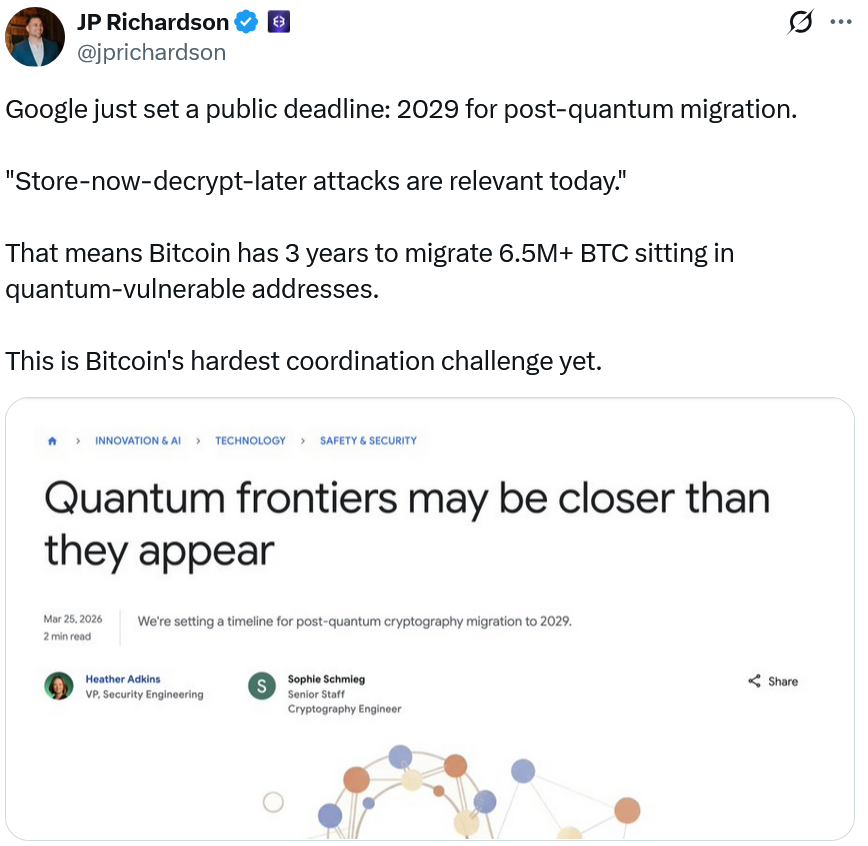
Google has given its most urgent warning yet about the growing threat of quantum computing to present cryptographic systems. It has set a precise deadline of 2029 for completing its own post-quantum cryptography (PQC) migration across all of its goods and services. The March 26, 2026, release shows that the corporation thinks “quantum frontiers” are coming faster than most people in the sector thought they would.
In a long blog post and some technical updates, Google talked about how quickly quantum hardware and error-correction techniques are improving. They also gave new estimates of how quickly a quantum computer that is strong enough to break today’s public-key encryption standards. The business clearly said that quantum computers will be a “significant threat” to encryption and digital signatures. If migration isn’t finished in time, this could put the security of authentication systems, encrypted communications, and digital assets at risk.
Google said it was important for them to set a good example by saying:
“It’s our job to provide a good example and share a challenging timeframe. We hope that by doing this, we can make things clearer and more urgent so that digital transformations happen faster, not just for Google but for the whole industry.
This is the first time Google has publicly set a timeline for the entire rollout of PQC. The goal for 2029 is much more ambitious than many earlier projections for “Q-Day,” which is the date at which quantum computers may theoretically break widely used encryption methods like RSA and ECC.
The Willow Quantum Shows How Quickly Things Are Moving
The warning comes as Google keeps working on its own quantum devices. The company’s Willow processor, which now has 105 qubits, is thought to be one of the most powerful superconducting quantum processors ever made. Willow is still a long way from being able to crack modern encryption, but the speed at which the number of qubits, coherence times, and error correction are getting better has made Google raise its risk estimations.
Google’s internal modelling currently shows that the resources needed to run Shor’s algorithm, which can factor big numbers and solve discrete logarithms, are running out faster than they thought they would. This has sped up the company’s plan to protect its own systems and consumer data.
The crypto industry is also under risk from quantum technology
The effects on the cryptocurrency industry are very bad. Elliptic curve cryptography (ECC) is used by Bitcoin, Ethereum, and most other major blockchains to produce digital signatures and keys. In principle, a quantum computer that is powerful enough could get private keys from public keys, especially for addresses where the public key has previously been made public (like spent outputs or reused addresses).
The Ethereum Foundation quickly reacted to Google’s news by starting a special “Post-Quantum Ethereum” resource center on March 25, 2026. The goal of the project is to secure the network’s billions of dollars in value by 2029 by adding quantum-resistant solutions at the protocol level. More enhancements will come later to the execution layer.
Developers on Solana took precautions ahead of time. In January 2025, they built a vault that is resistant to quantum attacks. It uses a complicated hash-based signature method called Winternitz One-Time Signatures to produce new keys for each transaction. But this protection isn’t available to everyone on the network; users have to deliberately shift their money into these special vaults to get the extra security.
People in the Bitcoin ecosystem still don’t agree on the problem. Adam Back, the CEO of Blockstream, has always said that quantum concerns are exaggerated and that real harm won’t come for decades, thus there is no need for immediate response.
On the other hand, security researcher Ethan Heilman and others have suggested Bitcoin Improvement Proposal 360 (BIP-360), which adds a new output type called Pay-to-Merkle-Root to mitigate against short-exposure quantum attacks.
Heilman thinks that it might take up to seven years to fully implement the changes because any upgrade that changes the consensus must go through a thorough procedure.
Why 2029 Is Important for Crypto Security
Google’s target of 2029 is important since it is very close to the deadlines that several blockchain initiatives are presently using to get ready for post-quantum computing. The fact that these timetables are coming together implies that the industry is starting to see quantum risk as a real issue in the near future instead of something that is only a theoretical problem.
The public key has been made public for the addresses that hold the most vulnerable Bitcoin. This is mostly true for classic P2PK and certain early P2PKH outputs. Modern address formats, like Taproot, only show the public key when you spend it, which keeps unspent coins safer. Still, the whole ecosystem will eventually need to switch to quantum-resistant signature techniques to keep things safe in the long run.
There are three main types of post-quantum cryptography solutions that are being looked at across blockchains:
- Signatures based on hashes (like XMSS and SPHINCS+)
- Lattice-based systems, notably Dilithium and Falcon, which have been authorised by NIST
- Options that are code-based or multivariate
Each has its own pros and cons when it comes to signature size, verification speed, and how hard it is to set up. Bitcoin developers have always preferred improvements that are safe and well-thought-out, which is why the discussion moves more slowly than on chains like Ethereum and Solana, which move more quickly.
Get Ready, Don’t Panic
Google’s declaration is both a warning and a call to action. No one thinks that a quantum computer that is useful for cryptography will appear tomorrow, but the fact that less resources are needed indicates that the time for safe migration is running out. If organisations, like blockchain networks, don’t get ready in time, they might not be ready when the threat becomes real.
The message for the cryptocurrency industry is clear: quantum resistance needs to go from being a theory to strategising how to put it into action. Wallets, exchanges, and protocol developers should start telling their users to use quantum-safe address forms wherever they can. They should also promote research into more efficient post-quantum signature techniques.
There is no need to panic, though. Quantum technology isn’t anywhere near the size it needs to be to pose a real threat to Bitcoin or Ethereum. The 2029 objective gives the industry a good amount of time to plan changes without putting existing systems at risk.
Google’s leadership on this subject, along with similar work from the Ethereum Foundation, Solana developers, and Bitcoin enhancement suggestions, shows that the community is starting to take quantum danger seriously. The next step is to turn awareness into coordinated, backward-compatible upgrades that keep networks safe without breaking them up or making the user experience worse.
The contest between hardware improvements and cryptography migration will shape one of the most crucial security transitions in the history of digital systems as quantum computing continues to move quickly. Google’s deadline of 2029 is a clear standard that the rest of the crypto industry should pay attention to.
Read Also: Wife allegedly steals husband’s $172 million Bitcoin by secretly recording the seed phrase