Stay connected with BizTech Community—follow us on Instagram and Facebook for the latest news and reviews delivered straight to you.
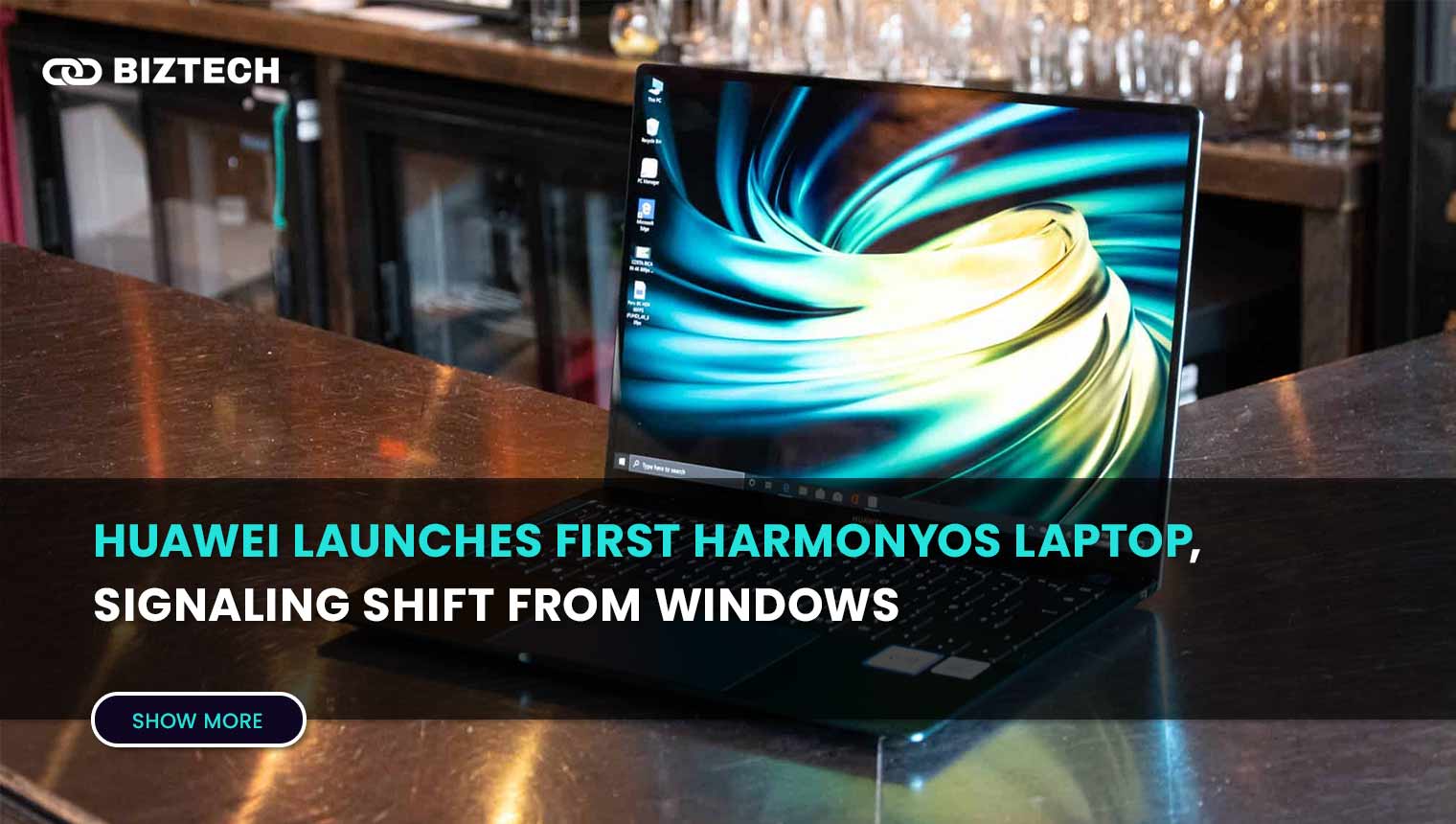
Huawei Technologies has officially unveiled its first personal computer powered entirely by its self-developed operating system, HarmonyOS, marking a major milestone in the company’s push for software independence. The device, which will be launched on May 19, comes after Huawei’s Windows license expired in March, prompting the company to fully transition to HarmonyOS for its PC lineup.

The new laptop runs HarmonyOS 5, also known as HarmonyOS Next, and is designed to integrate advanced AI features with a unified ecosystem spanning smartphones, tablets, TVs, and now computers. Huawei’s president of tablets and PCs, Zhu Dongdong, introduced the device during a closed-door event in Shenzhen, where he declared that the company had “fully entered the era of HarmonyOS.”
HarmonyOS PC: Architecture and Ecosystem
Huawei has rebuilt HarmonyOS for PCs from the ground up, focusing on three key pillars: HarmonyOS Base, Ecosystem, and Experience.
- HarmonyOS Base includes the Harmony kernel, Ark Engine, StarShield security, ArkTS, ArkUI, and the DevEco development suite. These components ensure high-performance computing tailored to Huawei’s hardware.
- HarmonyOS Ecosystem features over 150 exclusive PC applications and more than 2,000 compatible mobile apps. Popular Chinese platforms like WPS Office, DingTalk, RedNote, Bilibili, and Feishu are fully supported.
- HarmonyOS Experience supports more than 1,000 external devices across 20 categories, with compatibility certifications for 250+ non-standard devices, including printers and scanners.
User Interface and AI Integration
Visually, the new HarmonyOS PC interface merges mobile and desktop elements. A Dock-style shortcut bar at the bottom mimics macOS, while the home screen features a flexible arrangement of app icons, cards, and folders.

The laptop will ship with Huawei’s AI assistant, Celia, which can create presentations, summarize meeting notes, and retrieve content from local documents using third-party software. Huawei says this is part of a broader effort to enhance productivity and streamline smart office experiences.
Performance, Graphics, and Security
The PC uses the Ark graphics engine, designed to deliver a smoother and more stable visual experience. Features include:
- High Frame Rate Rendering: Focused performance on the active window to maintain responsiveness during multitasking.
- Pixel-Level Occlusion Culling: Optimizes system resources by rendering only visible portions of on-screen elements.
For security, Huawei introduces the StarShield architecture, which provides real-time data protection and device security. The HarmonyOS PC also supports Nearlink’s precise meter-level positioning for device recovery in case of loss or theft.
A Strategic Response to US Tech Sanctions
HarmonyOS has become a symbol of China’s resilience in the face of US sanctions, which barred Huawei from accessing Google’s Android and Microsoft Windows for its devices. The company has been developing HarmonyOS since 2015, and recent versions have powered smartphones like the Mate 70 and foldable Pura X.
According to Counterpoint Research, HarmonyOS achieved a 19% share of China’s smartphone market from October to December 2024, surpassing Apple’s iOS (17%) for the fourth consecutive quarter. Android remains the dominant OS with a 64% share.
Huawei’s move to bring HarmonyOS to PCs marks a strategic pivot in its post-sanctions era. By consolidating its software ecosystem across device categories and integrating AI-driven productivity tools, Huawei is positioning itself as a self-reliant tech leader—no longer dependent on US-made operating systems.
The HarmonyOS-powered laptop will officially debut on May 19, with support for over 2,000 applications and a focus on enterprise, education, and personal productivity.