Stay connected with BizTech Community—follow us on Instagram and Facebook for the latest news and reviews delivered straight to you.
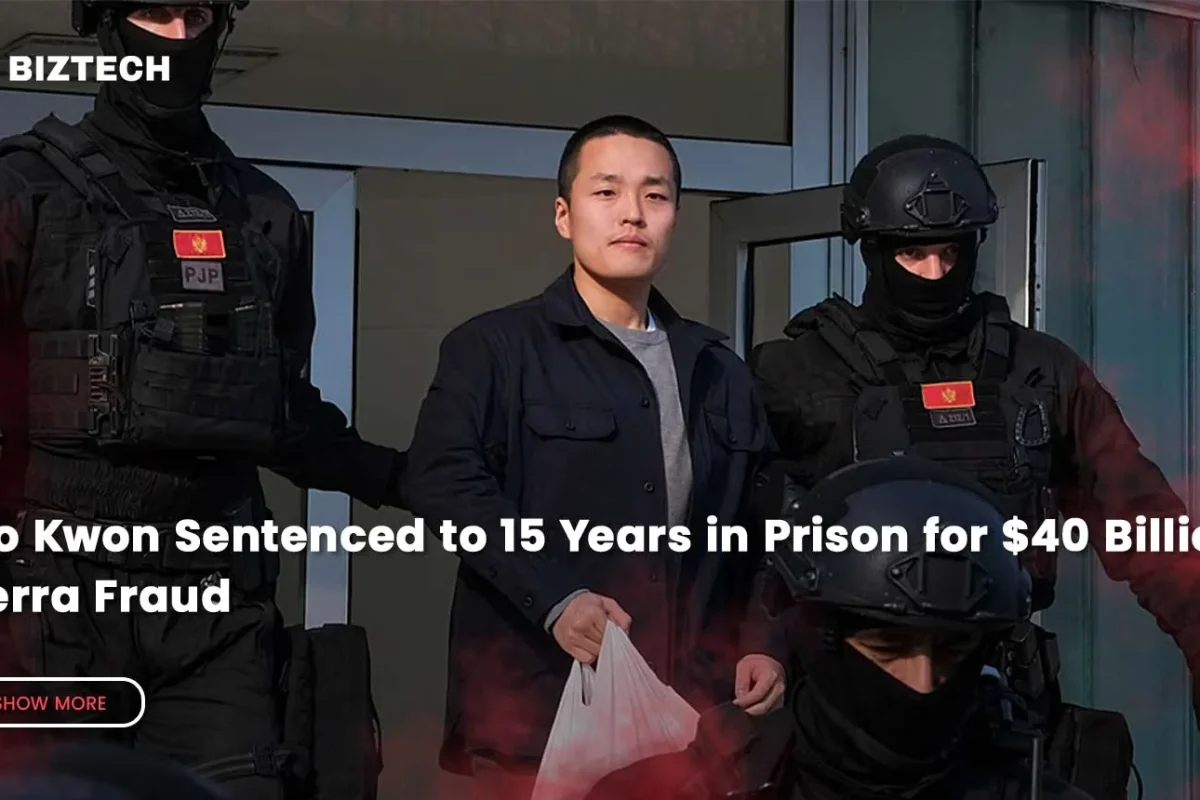
On December 12, 2025, a U.S. District Court in New York sentenced Do Kwon, the co-founder of Terraform Labs, to 15 years in federal prison. This delivered a strong message of accountability to the cryptocurrency sector. Judge Paul A. Engelmayer in Manhattan made the decision after Kwon pleaded guilty in August to conspiracy to commit fraud and wire fraud in connection with the Terra ecosystem’s catastrophic collapse in 2022, which cost investors some $40 billion. The judge called the case a “epic fraud” of unprecedented scale and went beyond the prosecutors’ 12-year recommendation, stressing the huge damage it caused to millions of people and businesses around the world. This sentencing is a turning point in the regulatory history of cryptocurrency, coming after high-profile cases like Sam Bankman-Fried’s 25-year imprisonment. It also highlights the dangers of allowing algorithmic stablecoins to grow without any rules.
The Path to Sentencing: From Plea to Verdict
Kwon’s legal troubles have been long-lasting and global. He was sent back to Montenegro in late 2024 after being arrested in March 2023 on charges of using a fake passport. If found guilty, he could have faced up to 135 years in prison. In August, a plea deal cut this down to two counts: conspiracy and wire fraud. The maximum sentence was 25 years. Prosecutors wanted 12 years because Kwon used complicated lies to make the values of TerraUSD (UST) and Luna go up before they crashed in May 2022. Defense lawyers claimed for five years that the acts were meant to stabilize the protocol and not to make money for themselves.
Judge Engelmayer turned against mercy, saying the deception was “eye-popping” in size and damage. More than 300 letters from victims told of lives that had been ruined: lost retirement savings, homes foreclosed, and families that had fallen apart. One Ukrainian investor lost $200,000 in life savings, and others talked of how their divorces and their children’s education came to a standstill. “This wasn’t just money; it was the future of real people,” the judge said, comparing Kwon’s power to that of a “cult leader” who took advantage of trust.
In yellow prison clothes, Kwon said he was sorry: “I’ve thought about what I could have done differently every waking moment.” Hearing the accounts of the victims has been really upsetting. He lost more than $19 million in profits, including Terraform interests.
The Terra Collapse: A $40 Billion Disaster
Terraform Labs, which started in 2018, promised a new algorithmic stablecoin: UST kept its $1 peg through arbitrage with Luna, without needing traditional reserves. Kwon sold it as decentralized and able to earn interest through Anchor Protocol’s 20% APY, which brought in billions. At its highest point, the ecosystem was worth more than $50 billion.
The death spiral started in May 2022 when UST lost its peg and Luna hyperinflated to lower supply. Then both coins crashed, with UST going to pennies and Luna going to almost zero in just a few days. The $40 billion loss set off a chain reaction that led to the bankruptcies of Three Arrows Capital, Voyager, and Celsius, and finally to the collapse of FTX in November. Prosecutors said that Kwon hid the 2021 depegs that trading companies supported and made up Chai payment integrations to make it look like people were using them.
In 2024, Terraform and Kwon settled with the SEC for $4.55 billion. Kwon paid $80 million out of his own pocket and was banned from using crypto for life. The company went out of business soon after.
The Judge’s Reasoning and What It Means for the Future
Engelmayer’s 15-year sentence, which is three years longer than what prosecutors wanted, shows how big the fraud was: Billions squandered, markets shaken up, and faith lost. He said, “Not many frauds have done this much damage.” Kwon’s use of fake passports to fly to Serbia and subsequently Montenegro, as well as his post-collapse PR claiming responsibility, were both taken into account.
The sentencing makes people more responsible for crypto: it shows the risks of algorithmic stablecoins, and authorities are looking into making peg requirements tougher under GENIUS Act extensions. Institutional caution may go up, but clarity might bring in money. Bitcoin ETFs have $175 billion in assets even if they are volatile.
Kwon might face charges in South Korea if he transfers after half of his term, which could add decades. His situation is now a cautionary tale together with Bankman-Fried and Zhao: Justice meets pride.
Conclusion
Do Kwon’s 15-year sentence for running Terra’s $40 billion fraud ends a dark chapter, bringing justice to millions of people who were hurt and showing that crypto is becoming more mature under the law. The story goes from “epic fraud” to regret, and it warns builders that if they don’t have ethics, they will fail. As markets bounce back and Bitcoin looks to hit $150,000 on indications from the dovish Fed, the sector learns that trust is earned, not coded.