
Stay connected with BizTech Community—follow us on Instagram and Facebook for the latest news and reviews delivered straight to you.
Argentine banks are carefully but significantly trying out blockchain technology by using JPMorgan’s JPM Coin for internal settlement operations. Local news sources say that a consortium of banks has started testing the institutional deposit token to make interbank reconciliations faster and easier, even though the country’s central bank has severe rules about giving crypto services to regular customers.
iProUP was the first to report on this development, which is one of the more interesting examples of traditional banking infrastructure in Latin America trying out blockchain rails while still having to deal with rigorous rules. Banco CMF is confirmed as a participant through its new corporate subsidiary QORP, which is collaborating with JPMorgan on the MVP (minimum viable product) phase.
Pilot Focuses on Back-End Efficiency, Not Client-Facing Services
In the first phase, the banks who are taking part are combining the services that are available to see whether they can speed up the settlement and reconciliation processes. It’s important to note that no real money is being moved during these experiments. Transactions still go through regular systems, but blockchain technology is only used to keep track of and confirm operations.
Maximiliano Cohn, the Chief Information Officer at Banco CMF, told local news that the pilot’s goal is to find out if it will make operations run more smoothly. Banco Galicia, BIND, and Banco Comafi are some of the other big banks in Argentina that are said to be thinking about joining the program in later phases.
This way of testing things inside the bank lets them look into the benefits of blockchain without breaking any rules set by the Banco Central de la República Argentina (BCRA). The central bank still doesn’t allow most crypto-related services to clients, but it doesn’t say that using distributed ledger technology to better internal operations is against the law.
JPM Coin: A Deposit Token for Institutions
JPM Coin is a deposit token from JPMorgan that is only available to institutional clients. It acts as a digital version of cash deposits at the bank, making it possible for participating institutions to send money faster, programmatically, and more openly. JPM Coin works in a regulated environment that is supported by JPMorgan’s balance sheet and regulatory scrutiny. This is different from public stablecoins.
In November 2025, the bank made JPM Coin available to institutional clients after a successful proof of concept on Coinbase’s Base layer-2 network. In January 2026, JPMorgan joined the Canton Network with Digital Asset, which gave the token more features and made it even better for settling transactions between different institutions.
JPM Coin is a useful tool for Argentine banks to upgrade their back-office operations while staying within the law. The pilot is part of a larger trend around the world where traditional banks are using blockchain to make things more efficient without completely accepting public cryptocurrencies.
Argentina’s Complex Regulatory Environment
The central bank of Argentina has been careful with bitcoin. Latin America has one of the fastest rates of crypto adoption in the world, but regulators have been hesitant to let banks offer direct crypto services to customers. This is because of high inflation, currency regulations, and an unstable economy.
This presents a peculiar situation: businesses and customers in Argentina have resorted to crypto as a way to protect their money and make payments, yet official banking channels are still limited. The JPM Coin pilot is a medium ground. It uses blockchain technology to make things better inside the company without putting itself directly at risk of volatile public cryptocurrencies.
The BCRA is currently reviewing its rules regarding crypto services. Any easing could make it easier for more people to use it, but for now, banks are being careful within the current rules.
The Rise of Crypto Activity in Latin America
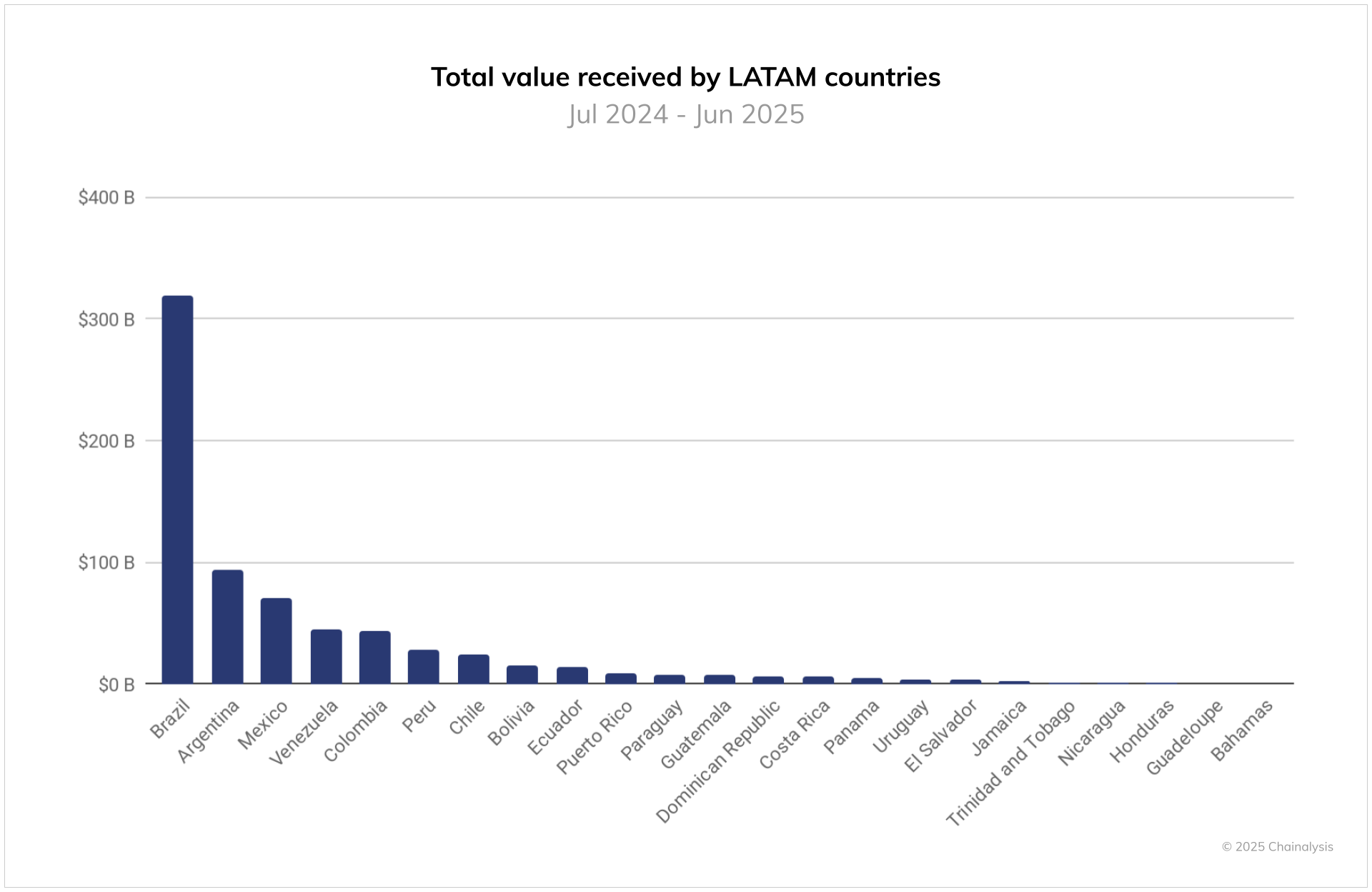
The Argentine pilot happens at the same time as crypto is growing quickly all around Latin America. Chainalysis’ 2025 Geography of Crypto Report says that the area saw around $1.5 trillion in on-chain transactions between mid-2022 and mid-2025. The most activity happened in December 2024, when it reached $87.7 billion.
Brazil is still well ahead of the rest of the area, making for almost a third of all activity. The next biggest markets are Argentina and Mexico. In a lot of cases, people in these nations have had to use crypto since it helps protect against inflation, makes it easier to send money, and is an alternative to traditional banking systems that are hard to get to.
This setting makes Argentina a very intriguing place to explore institutional blockchain solutions. As the country’s economy changes, banks who can successfully combine efficient settlement technology with compliance with rules may have an advantage over their competitors.
What this means for traditional banking and the merging of blockchain
The JPM Coin pilot in Argentina shows a bigger trend around the world: established banks are more and more eager to use blockchain technology to make their operations more efficient while staying away from the unpredictable public crypto markets.
This “blockchain without Bitcoin” method lets organizations get benefits like faster settlement, more transparency, and lower reconciliation costs without having to deal with the reputational or regulatory issues that come with directly using cryptocurrencies.
By spreading JPM Coin into places like Argentina, JPMorgan shows that the coin might be used as a cross-border institutional tool. As other banks join similar experiments, the groundwork for a more linked global financial system built on permissioned blockchain rails could start to take shape.
Problems and the Way Forward
Even if the pilot went well, there are still a lot of problems to solve. There may be less room for a wider deployment in Argentina because of uncertainties about regulations. Integrating old financial systems with blockchain technology also needs to be done carefully to make sure it is safe and reliable.
Also, the success of these kinds of projects will depend on whether they bring about measurable advantages in cost, time, and efficiency that make the investment worth it. If the Argentine pilot shows demonstrable benefits, it might lead to similar ventures in other parts of Latin America and beyond.
For the crypto business, changes like this are small steps forward, but they are still very essential. Even if public blockchains and decentralized finance are still coming up with new ideas quickly, traditional institutions are discreetly creating the links that could someday bring more money into the ecosystem.
As Argentina and other developing countries deal with economic problems, blockchain-based settlement solutions may become more and more vital for updating financial systems. The JPM Coin pilot is a tiny but important move in that direction. It could change how traditional banks use digital asset technology in the future.
Read Also: Binance joins the Mastercard Crypto Partner Programme to connect with payments around the world