Stay connected with BizTech Community—follow us on Instagram and Facebook for the latest news and reviews delivered straight to you.
The Strait of Hormuz has long been the world’s most important geopolitical chokepoint. A huge amount of the world’s oil passes through this tiny passage. For years, having control of this canal has been a major source of influence in the Middle East. But in early 2026, when tensions around the world reached a breaking point, a new factor entered the maritime conflict that doesn’t involve traditional financial infrastructure at all.
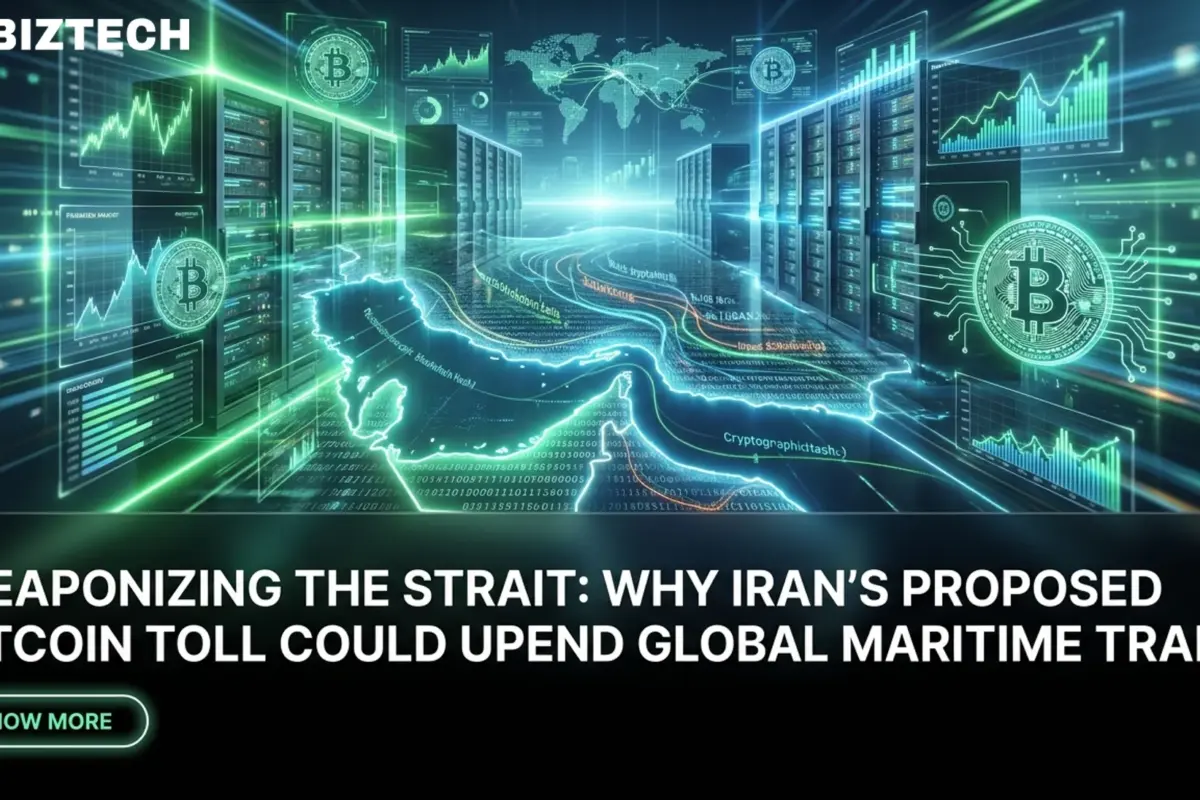
According to reports, Iranian officials are getting ready to put a cryptocurrency toll on ships that pass through the Strait. This is a mix of military strategy and decentralized finance. The plan comes at a time when there is a shaky two-week ceasefire between Tehran and the administration of US President Donald Trump. It says that some ships must pay a transit fee of $1 per barrel of oil.
What’s the catch? You can only pay the toll in Bitcoin
This proposal would be a turning point in the history of digital assets if it were put into place. It changes Bitcoin from a corporate reserve asset and retail hedge into an active weapon for sovereign geopolitical leverage, which fundamentally threatens the US dollar’s supremacy in global oil transit.
How a Sovereign Crypto Tariff Works
The suggested framework for the Strait of Hormuz is very specific and well thought out. Hamid Hosseini, a spokesman for Iran’s Oil, Gas, and Petrochemical Products Exporters’ Union, told the Financial Times that not all ships will be punished. Empty oil tankers will be able to pass through for free.
But ships that are completely loaded will have to pay the $1 per barrel Bitcoin fee. The way this payment works shows exactly why Iran is using blockchain technology.
The Iranian government wants to check each ship that comes into the country to make sure it isn’t carrying weapons and to check its cargo. Once the ship is cleared, the people that run it get an email with payment instructions. Operators have a very small window of time—just “a few seconds”—to broadcast the Bitcoin transaction.
This very short time limit is not a problem for the administration; it is a feature that takes advantage of Bitcoin’s ability to withstand censorship. Iran wants to finish the deal as soon as possible on the blockchain so that Western banking authorities or spy agencies can’t track, freeze, or take the money because of strict international sanctions. Routing traditional fiat through the SWIFT network would take days and be noticed right away. A Bitcoin transaction, on the other hand, merely needs an internet connection and a private key. It doesn’t have to go through any central bank.
The Geopolitical Chessboard and the Ceasefire
To understand why this is happening now, you need to look at how much worse the military situation got before it. A series of severe US-Israel bombings against Iranian assets in February and March 2026 made it almost impossible for commercial traffic to get through the Strait. International shipping companies stopped working because they were afraid about collateral damage and rising insurance costs. This cut off a key supply source.
The following diplomatic scramble led President Trump to announce a breakthrough on his Truth Social platform: a two-week halt to hostilities to allow for the “complete, immediate, and safe opening of the Strait of Hormuz.”
But the stories from Washington and Tehran quickly went in different directions. The US called the ceasefire a win for de-escalation, but Iranian state television showed a 10-point list of demands given to the US president. Iran’s stringent control over the canal and its demand for an end to economic sanctions were the most important of these requirements.
The Bitcoin toll seems to be Iran’s way of keeping control while also getting rid of the sanctions it wishes to get rid of. It is an ambitious move to see if the world’s need for oil is stronger than its promise to cut off Tehran’s financial support.
Oil Prices Go Up and Bitcoin Prices Go Up
The instability has caused the financial markets to react furiously. The Strait’s possible disruption, together with rising military tensions, sent crude oil prices above $100 per barrel for the first time in four years. This energy shock puts a lot of stress on the world economy, which has been trying to keep inflation stable for the past two years.
At the same time, the cryptocurrency markets have been very unstable. Bitcoin’s price swung sharply between $65,000 and $75,000 as the threat of a larger battle grew. But the news of the truce, and specifically the idea that Iran would need Bitcoin to move oil, has been a strong stimulus.
Bitcoin quickly went back up to $72,000 and is now trading close to $74,343. This price movement tells two stories: investors are looking for a secure place to put their money in the midst of global upheaval, and traders are pricing in the abrupt, forced buy-pressure that would happen if shipping companies had to hold and spend BTC to convey their goods.
Iran’s Crypto Playbook: A Planned Escalation
If you’ve been following the connection between blockchain and global sanctions, Iran’s move is alarming but not surprising. The Islamic Republic has been steadily expanding its crypto infrastructure for years, even while the rial has lost value against the US dollar.
Before the start of open hostilities, blockchain intelligence businesses’ data showed that Iran was covertly building up digital assets to keep its economy going.
- Elliptic’s research from January said that the Iranian central bank has bought almost $500 million worth of Tether (USDT), a stablecoin tied to the US dollar, for use in international trade.
- More information from TRM Labs showed that a huge $3.7 billion in total crypto transactions went over Iranian infrastructure from January to July 2025.
In the past, countries that were under embargo used crypto passively, either by mining it for money or by trading stablecoins in secret. The Strait of Hormuz toll is a big change from passive evasion to active enforcement. Iran isn’t just using crypto to hide its money anymore; it’s making the rest of the world use crypto to do business in its own country.
The Danger to the Petrodollar Model
The broader consequences of this event are quite important. The petrodollar system has been in place since the 1970s, and it means that most of the world’s oil commerce is done in US dollars. This framework makes sure that the dollar is always in demand around the world and gives the US more power over global banking than any other country.
If Iran gets international shipping fleets to buy and move Bitcoin to move oil, it might be bad for US financial power. It shows, in real time and on a huge scale, that sovereign bodies can take important goods out of the dollar system on their own.
A $1 per barrel fee during a two-week truce may seem like a strange thing that only happens in one place, but it is really a proof-of-concept. If the geopolitical elite agrees to these terms just to keep the oil flowing, other countries who are under sanctions, like Russia or North Korea, will definitely take note.
We are seeing a big change in how the market works. Bitcoin was made to be digital cash that people could send to each other. It became an institutional reserve asset on Wall Street. The geopolitics of the Middle East are now putting its usefulness as an instrument for sovereign resistance to the test. This crypto toll may or may not go into force, and it may or may not be used as a negotiating chip in ongoing talks. Either way, the message is clear: the 21st century’s financial weapons are moving on-chain.
Read Also: Bitcoin Rises Above $72,000 as US-Iran Ceasefire Agreement Makes People Feel More Risky