Stay connected with BizTech Community—follow us on Instagram and Facebook for the latest news and reviews delivered straight to you.
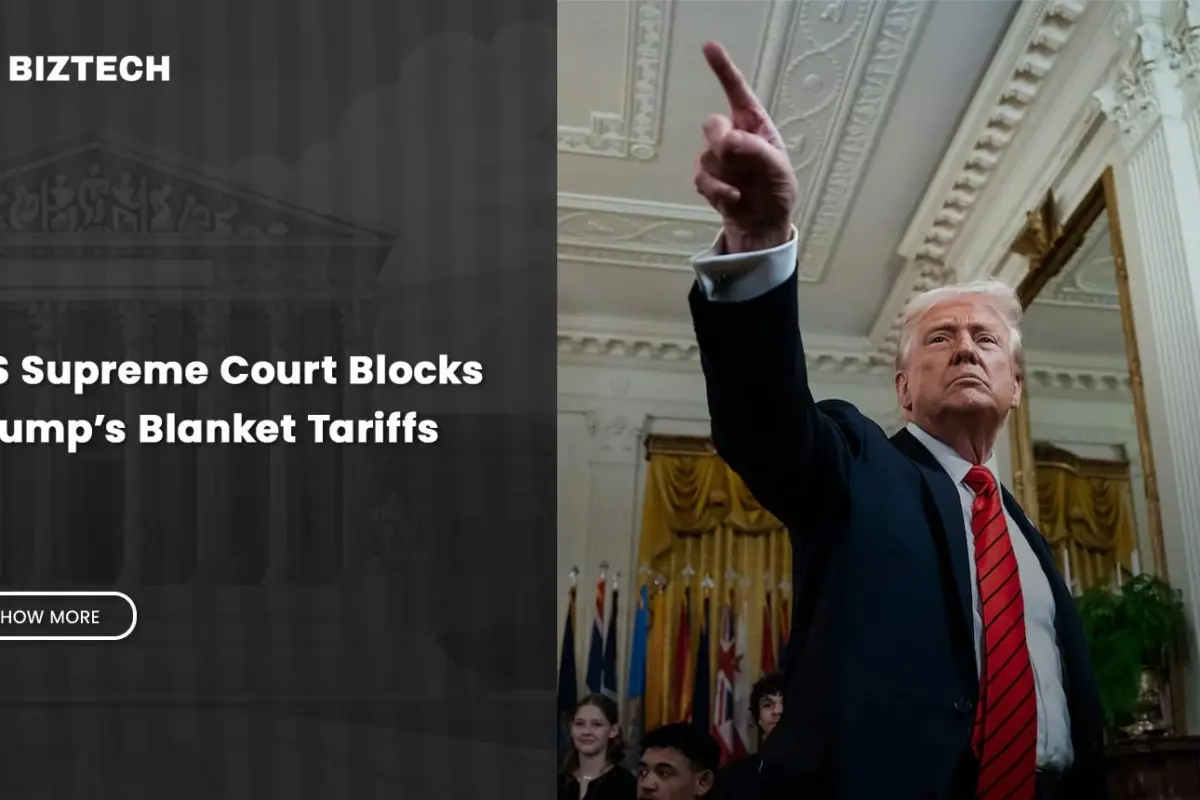
The Supreme Court of the United States has struck down President Donald Trump’s sweeping use of blanket tariffs. It ruled that the measures exceeded executive authority and invalidated a central pillar of his trade strategy.

In a decision delivered on Friday, the Court found that the administration’s broad invocation of national security powers to justify tariffs on a wide range of imports — including from close allies — required explicit congressional approval when not tied to specific, demonstrable threats. The ruling effectively nullifies tariffs that had covered hundreds of billions of dollars in goods, including steel, aluminium and consumer electronics.
Within hours of the verdict, Mr Trump escalated tensions by announcing a new 10 per cent “global tariff,” later signalling in social media posts that the rate could rise to 15 per cent. The swift response has deepened uncertainty in global markets and raised the prospect of renewed trade retaliation.
Legal Reasoning and Immediate Fallout
The Court’s majority opinion emphasised constitutional limits on executive power over trade, stating that national security provisions could not be applied indiscriminately to broad categories of imports from allies and adversaries alike. By requiring congressional oversight for sweeping tariff regimes, the judgment marks a significant reassertion of legislative authority in trade policy.
Countries affected by the earlier measures reacted positively. Canadian Prime Minister Justin Trudeau described the ruling as “a victory for fair trade,” while European officials said it removed long-standing uncertainty clouding transatlantic commerce. Businesses, however, now face complex legal and financial questions, including whether previously paid duties may be refunded and how retroactive enforcement will be handled.
The U.S. Chamber of Commerce characterised the situation as “murky,” warning that companies must navigate overlapping legal processes while preparing for the administration’s newly announced tariff plans.
Market Turbulence and Economic Risks
Financial markets responded with volatility. US equities fell by more than 1 per cent on Friday, with export-dependent sectors such as agriculture and heavy manufacturing leading the losses. Steel futures rose amid expectations of reduced foreign competition, while the dollar strengthened on safe-haven demand.
Economists warn that rising tariff measures could harm global growth. The International Monetary Fund recently forecasted global expansion of 3.3 per cent in 2026, but analysts caution that renewed trade barriers could reduce that forecast by as much as half a percentage point.
Higher import duties may also add inflationary pressure domestically, complicating the path for the Federal Reserve, which has only recently begun easing interest rates after a prolonged tightening cycle.
China’s Ministry of Commerce criticised the proposed global tariff as protectionist, hinting at countermeasures. Mexico and Canada signalled consultations under the USMCA framework, while the European Union has reportedly revived contingency plans targeting politically sensitive American exports.
Broader Geopolitical Implications
The ruling highlights broader fractures in the global trading system. Mr Trump’s tariff agenda has been framed as an effort to reshore manufacturing and protect American workers, but critics argue it risks alienating allies and burdening consumers with higher prices.
There are also environmental considerations. Tariffs on imported clean energy technologies, including solar panels, could slow deployment and complicate international commitments under climate accords aimed at achieving net-zero emissions by mid-century.

Meanwhile, corporations are accelerating supply chain diversification. Consultancy reports show a marked increase in near-shoring and “friend-shoring” strategies as firms seek to mitigate geopolitical risk.
A Constitutional Check — and an Uncertain Path Ahead
The Supreme Court’s intervention represents a rare and consequential judicial check on presidential trade authority. Yet the President’s rapid announcement of new tariffs signals that the legal battle may evolve into a political and legislative confrontation.
For global markets and policymakers alike, the message is clear: trade tensions remain a defining feature of the economic landscape. Whether the Court’s decision ushers in a recalibration of executive power or triggers a new chapter in tariff escalation will depend on how Congress, trading partners and the White House respond in the weeks ahead.
Read Also: Revived US-China Trade Tensions Rattle Global Markets Amid Tariff Escalations