Stay connected with BizTech Community—follow us on Instagram and Facebook for the latest news and reviews delivered straight to you.
On April 6, 2026, institutional demand for US spot Bitcoin ETFs rose sharply, bringing in a net $471 million. This was the biggest one-day inflow since February 25, when the funds brought in $507 million. The bounce comes after Bitcoin stayed stable in the $69,000–$70,000 level after testing lower supports earlier in the month. This shows that big investors are still confident in the market, even though it is still volatile.
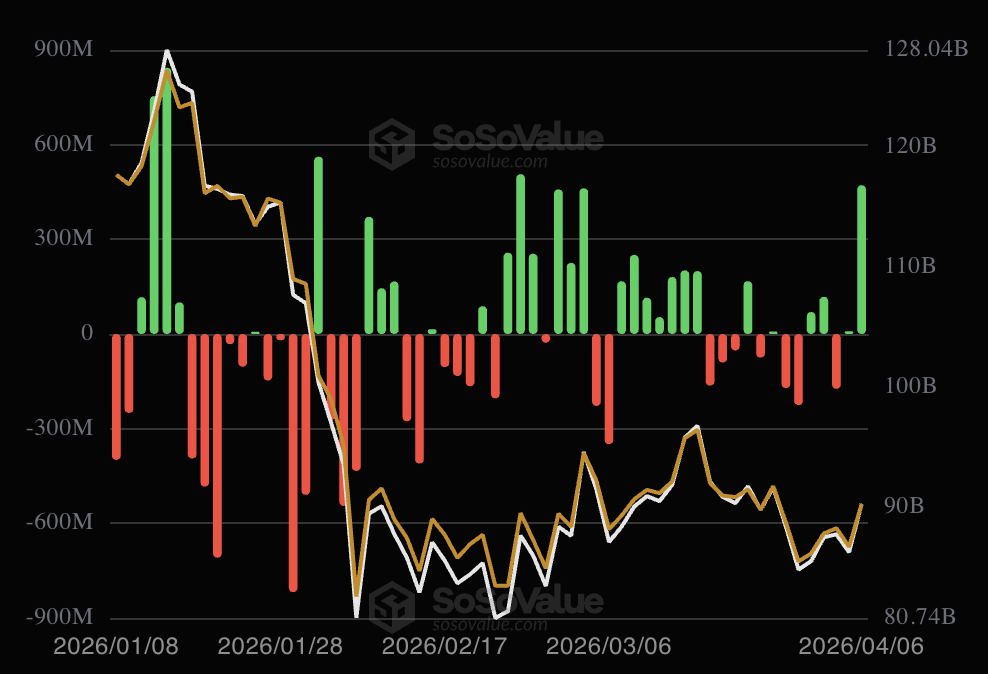
SoSoValue’s data shows that the April 6 inflow is a big change after a few weeks of rather quiet activity. In recent sessions, geopolitical tensions and macroeconomic uncertainty have made people feel bad, but the latest numbers show that institutional buyers see present price levels as a good moment to invest for the long term.
BlackRock and Fidelity Get Most of the Money Today
BlackRock’s iShares Bitcoin Trust (IBIT) once again came out on top, bringing in over $182 million . Fidelity’s Wise Origin Bitcoin Fund (FBTC) came in second with $147 million , while ARK 21Shares Bitcoin ETF (ARKB) came in third with $119 million. This was the best day for ARKB since July 2025.
These three big players were responsible for most of the day’s activity, which solidified their status as the leaders in the US Bitcoin ETF market. Arkham Intelligence’s on-chain analytics showed that net outflows from ETF issuers have dropped a lot in the preceding week. Issuers sold only $16.6 million worth of Bitcoin. ARKB was the biggest buyer during that time, buying about $34 million worth of Bitcoin.
Over the first three trading days of April, US spot Bitcoin ETFs brought in a total of around $307 million (Rp5.22 trillion) in net inflows. This has helped bring the total assets under management (AUM) for these products back above the $90 billion. This shows how important ETFs are becoming as a method for traditional capital to get into Bitcoin.
Ethereum ETFs are also starting to recover
The good trend didn’t only stop with Bitcoin. Ethereum ETFs had a strong recovery on the same day, bringing in $120 million. This helped make up for the $78 million that left the company in the last two days. But Ethereum products are still in a general downward trend, with net outflows of almost $770 million over the past three months.
The difference between Bitcoin and Ethereum ETFs still shows that investors have different goals. People are starting to regard Bitcoin as a fundamental investment and digital gold, while Ethereum’s value is still more tightly related to network activity, DeFi adoption, and hopes for future upgrades. The April 6 influx, on the other hand, shows that some money is starting to flow back into Ethereum after a protracted period of outflows.
On the other hand, ETFs that follow other altcoins didn’t move much. The XRP ETF didn’t get any money, while the Solana ETF only got a small amount, $247,000. This shows that for now, investors are still mostly interested in the two biggest cryptocurrencies. Other altcoins are still on the sidelines because the market is still uncertain.
What is making institutions interested again?
There are a few things that seem to be causing ETF inflows to rise again. Bitcoin’s price has stayed around $69,000 to $70,000 after hitting lower supports earlier this month. This makes it a good time for long-term investors to get in. Institutional investors, especially through ETFs, usually prefer periods of consolidation to times of excessive volatility.
The larger macro environment is also displaying signals of cautious optimism. The Federal Reserve has always said that its decisions are based on evidence, but recent statements from officials have eased expectations of big rate hikes. Geopolitical risks, especially those related to tensions between the US and Iran, have eased a little after rumors of possible negotiations to calm the situation. This has taken some of the immediate risk-off pressure off of the markets.
Metrics on the blockchain also support a positive opinion. As long-term holders take coins into self-custody, exchange balances keep going down. Whale accumulation patterns, on the other hand, stay the same. The fact that there is less selling pressure and steady institutional buying through ETFs makes Bitcoin’s price movement more likely to go up.
What This Means for the Crypto Market as a Whole
The restoration of robust ETF inflows is a good indication for the whole cryptocurrency market. Spot Bitcoin ETFs are one of the main ways that traditional money is entering the area. When money keeps coming in, it acts as a structural bid that keeps prices from going down and helps the market recover slowly.
This new round of purchases also shows how the US regulatory environment for digital assets is becoming more mature. The GENIUS Act and ongoing talks about the CLARITY Act have made things clearer for institutional investors, which has lowered uncertainty and led to bigger investments.
The little rise in ETF flows for Ethereum implies that some investors are starting to explore beyond Bitcoin for a wider range of investments. If this tendency keeps up, it could assist cryptocurrencies do better compared to Bitcoin, which has been going on for a long time.
But there are still problems to deal with. Geopolitical risks, possible changes in monetary policy, and ongoing macroeconomic headwinds might still cause times of volatility. Investors will be paying particular attention to new economic statistics and any other news from the Middle East to see how people feel about risk.
Institutional Support Is Still a Key Pillar
The $471 million that came in on April 6 is the best performance for Bitcoin ETFs in more than a month. This demonstrates that institutions still believe in Bitcoin as a long-term asset. With total AUM back above $90 billion, these products are still an important link between traditional banking and the bitcoin industry.
During this time of consolidation for Bitcoin, the behavior of ETF flows will be one of the most crucial things to keep an eye on. If the inflows keep coming, they could help the recovery last longer. If they stop, it could mean that institutional investors are becoming more careful again.
For now, the evidence shows that a reset is good. After weeks of little activity, the return of buying interest from big companies like BlackRock, Fidelity, and ARK shows that smart money still thinks there is value at these levels. A mix of macroeconomic changes, geopolitical stability, and a general willingness to take risks will determine if this leads to stronger price momentum in the coming weeks.
The April 6 inflow shows that Bitcoin’s institutional infrastructure is still strong and can handle a lot of money, even when things are uncertain. As the crypto market grows up, these movements will probably have a bigger and bigger effect on finding prices and long-term patterns.