Stay connected with BizTech Community—follow us on Instagram and Facebook for the latest news and reviews delivered straight to you.
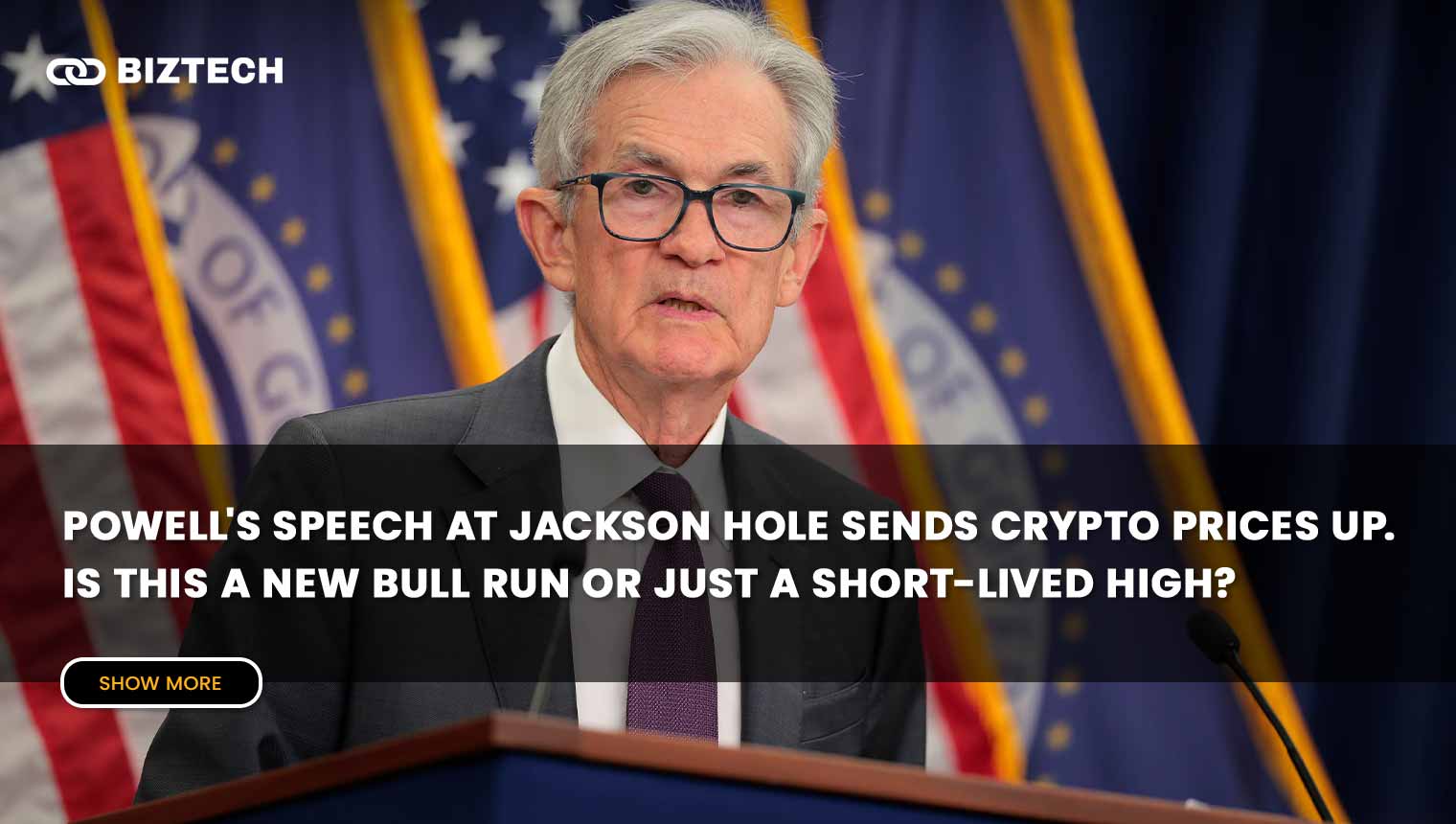
On a clear August morning in Jackson Hole, Wyoming, Federal Reserve Chair Jerome Powell took the stage at the Kansas City Fed’s annual economic symposium and gave a speech that threw the markets into a frenzy.
His comments on August 22, 2025, made it clear that interest rates are expected to go down soon, which sent stocks, bonds, and, most importantly, cryptocurrencies up. Bitcoin shot up to $116,500, Ethereum rose almost 15% to flirt with $4,860, and altcoins like Solana and XRP rode the wave with gains of more than 10%.
Powell’s dovish tone gave crypto investors a rush, but underneath the excitement comes a question: comes this the start of a long-term crypto bull run, or just a short-term high before the next dip? The answer isn’t easy because the economy is going in several directions.
A Dovish Signal in the Middle of Economic Crosswinds
The title of Powell’s speech, “Economic Outlook and Framework Review,” was a lesson in how to be cautiously hopeful. He said that the U.S. economy is strong, but he also pointed out that the risks are changing.

The Personal Consumption Expenditures (PCE) index showed that inflation was 2.6% in July, which is more than the Fed’s 2% target but much lower than the peaks after the pandemic. Core PCE, which doesn’t include food and energy prices that change a lot, was higher at 2.9%.
Powell said that prices for products had gone up 1.1% in the last year, which was a change from earlier drops. At the same time, inflation in housing services was slowing down.
Tariffs, which have become a bigger worry under President Trump’s policies, were mentioned as a possible cause of inflation. Powell said, though, that their effect might just be a short-term price rise instead of a long-term trend.
The job market, which used to be strong, is starting to show signs of weakness. Job growth has fallen to only 35,000 a month over the previous three months, down from 168,000 in 2024. Recent revisions cut 258,000 jobs from prior reports. Unemployment is still low at 4.2%, but it has “downside risks,” and layoffs are a concern.
Powell called the balance of the job market “curious” because immigration is slowing down and fewer people are participating. In the first half of 2025, GDP growth slowed to 1.2%, which is half the speed of the previous year. This is because consumers are spending less.
With this in mind, Powell said that the Fed’s tight stance, with rates at 4.25% to 4.5%, might soon change.
He stated, “The balance of risks seems to be changing,” and he stressed that judgments will depend on new information.
After the speech, the CME FedWatch tool showed a 91% chance of a quarter-point cut in September, up from 75% the day before. This made the markets think it was okay to go forward with the cut. The S&P 500 rose more than 1%, while bond yields fell, showing that people were feeling more risky.
Why Rate Cuts Are Important for Crypto’s Rocket Fuel
Powell’s statements were like a match to the crypto market. Bitcoin went up 2% from $111,658 earlier that day, when people were nervous before the speech, to $116,500. Ethereum led the way, rising 15% to almost $4,860 before closing at $4,240.
Altcoins were up next: Solana went up 2% to $203, while XRP went up to $3.03 after going down to $3.10.
MicroStrategy (MSTR) and Coinbase (COIN) equities both rose by more than 5% and 7%, respectively. The overall value of all cryptocurrencies rose to $4.07 trillion, while the amount of trading rose to $133 billion.
Why do speeches by the Federal Reserve have such a big effect on the crypto markets? It’s all about having enough money.
When interest rates go down, borrowing costs go down, which frees up money for riskier investments like cryptocurrency. When bonds and savings accounts pay less, investors look for bigger returns in markets that are changing quickly.
These changes are made even bigger by crypto’s high beta. Bitcoin went up from $10,000 to around $69,000 during the bull run from 2020 to 2021, which was caused by low interest rates and government spending.
Powell’s shift to cuts at Jackson Hole in 2024 caused a similar rally, and his speech in 2025 follows the same pattern. Analysts think there will be two to three cuts by the end of the year, which may put trillions into the markets. One X article said with confidence, “The Fed will start the money printers in Q4… trillions will flow into crypto.”
The market is becoming older, but there are still risks
The crypto market in 2025 is very different from how it was in the past. Bitcoin broke beyond $124,517 earlier this month because big companies like BlackRock and Fidelity have put $12 billion into Bitcoin ETFs this year alone.
Regulatory certainty, such as the SEC’s 2023 approval of spot ETFs, has made it easier for institutional investors to put money into the market.
Policies that support cryptocurrencies, including presidential directives that let digital assets into 401(k)s, have made the space even more legitimate. The fact that Ethereum’s DeFi ecosystem has $159 billion locked up shows how useful the sector is becoming.
But the rally’s strength makes me worry. Bitcoin’s 10% drop from its all-time high before the speech is similar to past cycles, and the $375 million in liquidations after the speech shows how risky it is to trade with too much leverage. Santiment’s research shows that talk about Fed rate cuts could mean too much optimism, which could lead to pullbacks.
Regulatory risks are still there— The SEC is still looking at altcoins, and there are still worries about the carbon footprint of Bitcoin mining.
Powell warned that tariffs could cause wage-price spirals, which would make the Fed’s job harder and make the market less excited if cuts are smaller or take longer.
The Street’s View: Bulls vs. Bears
Some analysts are bullish, while others are not. Tom Lee of Fundstrat said Powell’s tone was “dovish,” which is what people thought would happen in September. André Dragosch from Bitwise says that rate cuts will speed up the growth of the money supply, which is good for Bitcoin. Technical analysts are looking at $126,600 for Bitcoin and $5,000 for Ethereum. X traders have seen that Bitcoin has stayed strong above the $110,000–$112,000 support zone. If the $125,000 level of resistance cracks, some people even think it may go up to $150,000.
But skeptics say there will be volatility. Evercore ISI said that Powell’s calm tone could let down markets that were hoping for a 50-basis-point decrease. This could cause the stock market to drop by 7% to 15%, which could also bring down crypto. The labor market is weak, and inflation caused by tariffs makes things much more unclear. If the Fed decides to be careful and either delay or cut back on cuts, the crypto surge could stop. As one trader put it, “This is crypto; we’re just one tweet away from a 20% drop.”
What It Means for Investors
Powell’s speech shows how crypto has changed from a small-scale experiment to a worldwide asset class for the typical investor. Public firms currently own Bitcoin across 297 addresses, which shows that they are confident in the long future. But there is a lot of danger that comes with a lot of gain.
The September FOMC meeting will be very important. If rates go down, crypto might enter a “parabolic phase,” with altcoins possibly rising 10 to 50 times as money flows in.
But discipline is also important. Investors have lost money earlier on bets that were too big and trades that were based on fear of missing out. This rally’s strength advises caution.
Powell’s last address as Fed Chair at Jackson Hole, where he will step down in May 2026, is a turning point. His delicate balancing act, which includes dealing with political pressure from President Trump and economic headwinds, sets the scenario for a Q4 that will be full of opportunities but also very unstable.
For people who invest in cryptocurrencies, this is a reminder that central banks still have power in a world that is meant to be decentralized. “Powell says jump, and Bitcoin asks how high,” said one experienced trader on X. The Fed’s next steps and the market’s ability to stay calm will determine whether this jump leads to new heights or a painful landing.