
Stay connected with BizTech Community—follow us on Instagram and Facebook for the latest news and reviews delivered straight to you.
OpenClaw, an open-source AI agent framework that is growing quickly, has a strict “no crypto mention whatsoever” policy on its main Discord channel. Anyone who breaks this rule will be kicked out right away. Peter Steinberger, the founder of OpenClaw, made the rule public on February 8, 2026, after a user was banned for using Bitcoin block height as a timing mechanism in a discussion about multi-agent benchmarks. The event has sparked a discussion on the limits of technical talk in AI developer communities and the larger connection between AI and cryptocurrency ecosystems.
Steinberger said that when people join the server, they agree to follow its tight regulations, which say that they can’t talk about Bitcoin, cryptocurrencies, tokens, or anything else related to them. When the banned user commented about the incident on X, Steinberger responded personally, saying that the user had been banned and that they could have their access back if they emailed their Discord login. The conversation immediately rippled through the crypto and AI communities, showing how hard it is to balance free technical discussion with community moderation needs.
Read Also: 12 Malaysian police officers arrested in a $51,000 crypto extortion case
Where the Crypto Ban Came From
The policy goes back to a trademark fight and a rebranding effort that happened in late January 2026. Steinberger gave up the previous social media accounts and claimed new ones after getting a trademark notice for OpenClaw’s original moniker.
Scammers promptly took over the accounts that were left empty for a short time and started a fake Solana-based coin named $CLAWD. Within hours, the bogus token’s market cap shot up to over $16 million, but it fell by more than 90% once Steinberger openly denied any involvement.
Even though the developer clearly denied it, early buyers said he was behind a rug pull. Later, security experts found hundreds of OpenClaw instances online that were open to attack and dozens of malicious plug-ins, many of which were meant to attack crypto traders and wallet users. The event had a lasting effect on the people in charge of the project.
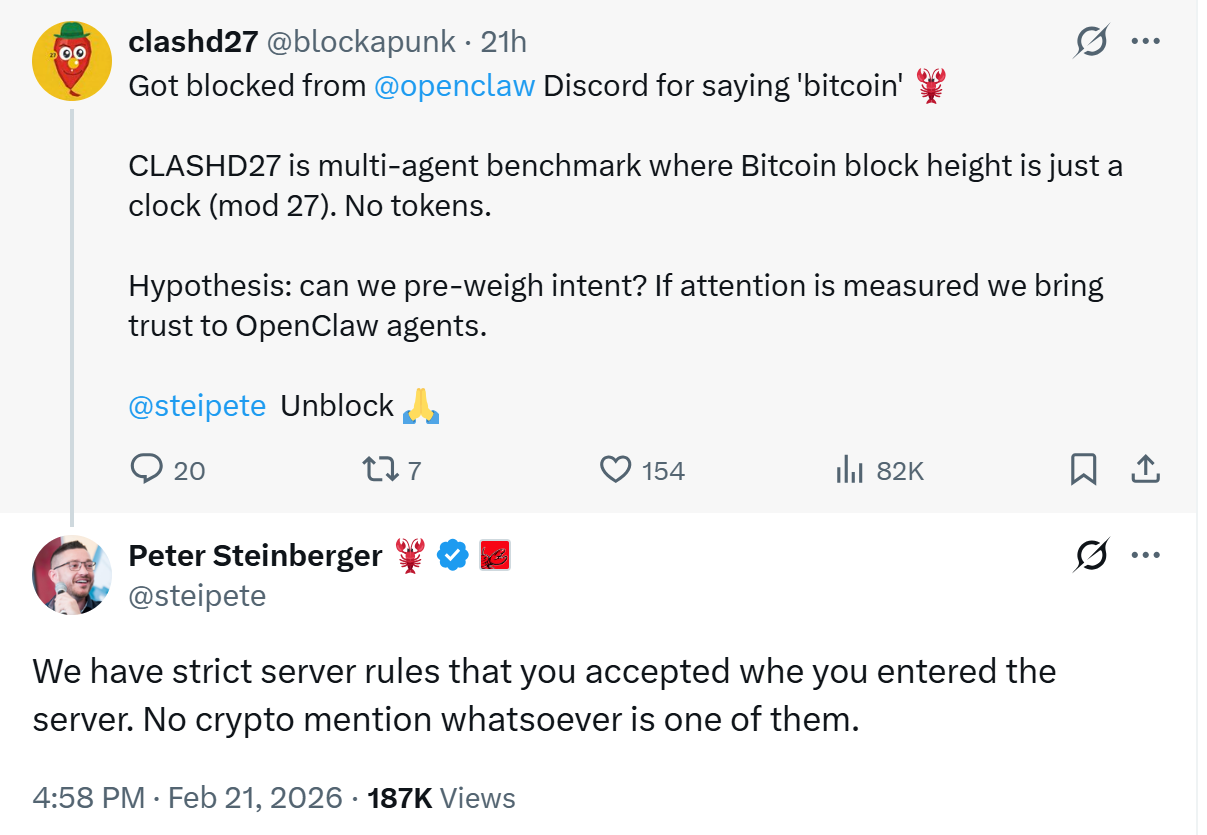
In response, Steinberger made it against the rules to talk about crypto on the official Discord. The restriction is meant to stop other impersonation schemes, keep community members safe from bad actors, and keep the focus on developing AI agents instead of speculating on tokens. The guideline has been closely followed, and even technical references to blockchain ideas or Bitcoin’s block height have been seen as infractions.
OpenClaw’s Quick Growth and Community Changes
OpenClaw has grown quite quickly since it was released in late January 2026. In just a few weeks, it got more than 200,000 GitHub stars. The platform lets developers make AI agents that can work on their own and accomplish complicated, multi-step tasks in a variety of fields. Thousands of people have contributed to it and started using it since it is open source, has a modular structure, and has an active community.
The Discord server is the main place for people to work together in real time, fix problems, and talk about new features. As it grew quickly, it faced problems like spam, discussions that weren’t related to the issue, and people trying to take over talks to promote their own tokens. The crypto restriction seems to be part of a larger effort to keep the signal-to-noise ratio high and keep the community safe from frauds that have hurt previous open-source projects that grew quickly.
Some developers have said that the rule is too strict, saying that blockchain timing mechanisms and decentralized coordination are valid technical topics. However, most seem to agree that the rule is necessary to protect the project from impersonation and malicious plug-ins, which have happened in the past.
Despite Discord’s rules, crypto companies are excited about AI agents.
The OpenClaw prohibition goes against the trend in the industry of combining bitcoin and artificial intelligence. More and more, executives in the industry see crypto infrastructure, especially stablecoins, as the best way for autonomous AI agents to make payments. Jeremy Allaire, the CEO of Circle, says that billions of agents will use stablecoins for small, everyday payments in the next few years. These payments will cover anything from service fees to data licensing and computation costs.
Coinbase just released “Agentic Wallets,” a system that lets AI bots hold wallets and automatically spend, earn, and trade crypto onchain. The solution is built on the AgentKit developer framework and uses the x402 payments protocol. It lets software agents handle DeFi positions, rebalance portfolios, pay for cloud resources, and take part in digital marketplaces without any help from people.
These changes show that more and more people think that AI agents are one of the best real-world uses for bitcoin. Stablecoins and blockchain rails are exactly what autonomous agents need: quick, cheap, programmable money that works 24/7 across borders. The OpenClaw Discord ban, which makes sense from a community management point of view, shows that there is still a cultural and operational gap between many AI developer communities and the crypto market.
What this means for the AI and crypto communities
The event makes people think about how open-source AI projects should deal with conversations regarding cryptocurrencies in general. On the one hand, crypto scams and attempts to impersonate people are serious threats to community members, especially in projects that are developing quickly and getting a lot of attention. But if you leave out whole areas of technology, including decentralized coordination, timing mechanisms, and incentive design, it could stifle innovation and cross-pollination between AI and blockchain research.
Decentralized coordination, incentive alignment, reputation systems, and economic primitives are some of the ideas that crypto has already made their way into many AI agent frameworks. For instance, if you banned talking about Bitcoin block height as a timing mechanism, you might accidentally stop people from having real technical conversations about consensus, finality, and temporal ordering in distributed systems.
It looks like the OpenClaw team chose the safety and focus of the community over free technical discussion. As the project grows, it will rely on how successfully alternate channels like GitHub problems, dedicated forums, or off-platform groups can handle technical discussions about crypto without putting participants at risk of scams.
Final Thoughts
The OpenClaw Discord’s rigorous “no crypto mention whatsoever” policy, which was confirmed by inventor Peter Steinberger, is a practical response to real security and impersonation threats that came up after a trademark dispute and a token scam. Some people have said that the rule makes it harder to have real technical conversations, but it shows how hard it is to keep open-source groups healthy when cryptocurrency frauds are still common.
The event shows both convergence and friction in the larger AI and crypto ecosystems. More and more, industry executives regard stablecoins and blockchain rails as necessary infrastructure for autonomous agents. However, many AI developer groups are still scared of crypto’s cultural baggage and security dangers. As AI agents progress from experimental frameworks to real-world use, it will be very important to find the correct balance between openness, safety, and technical inclusiveness.
As OpenClaw grows quickly, the decisions made by the project’s community management will probably have an impact on other AI platforms that are still in development. The conflict between keeping consumers safe from frauds and allowing free technical conversation is still not resolved, but it is becoming more crucial as artificial intelligence and cryptocurrency continue to develop.