Stay connected with BizTech Community—follow us on Instagram and Facebook for the latest news and reviews delivered straight to you.
For more than two decades, China has constructed an elaborate overland architecture — railways, pipelines, and port agreements — designed to solve a single, haunting vulnerability. Now, as American and Israeli airstrikes continue to rain down on Iran, analysts say Washington may be methodically dismantling that architecture, one strategic node at a time.
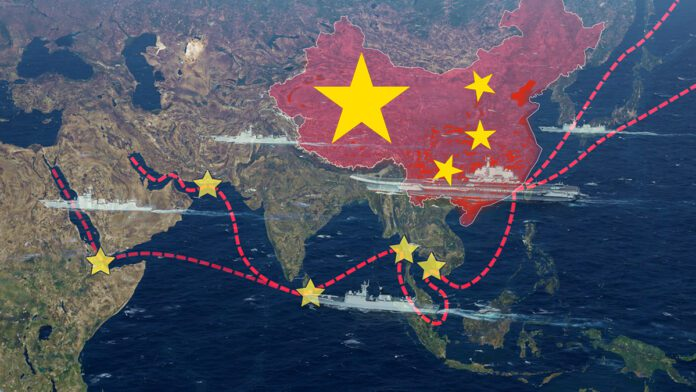
The vulnerability is known in Chinese strategic circles as the Malacca Dilemma. Roughly 80 per cent of China’s energy imports pass through the narrow Strait of Malacca, a chokepoint that the U.S. Navy could, in a crisis scenario, effectively seal. For Beijing’s long-term planners, that dependence represents an existential risk — a single maritime pressure point capable of strangling the world’s second-largest economy without a shot being fired.
China’s answer was the Belt and Road Initiative (BRI), a multi-trillion-dollar program of infrastructure investment across Eurasia. At the geographic and strategic core of that programme lies Iran — and therein, analysts argue, lies Beijing’s most acute current exposure.
The Keystone Of China’s Continental Fortress
Iran occupies a position of unusual strategic importance, sitting at the crossroads of Central Asia, South Asia, and the Middle East. For Beijing, it represents the critical bridge connecting Russian rail networks, South Asian markets, and European trade hubs — a corridor that theoretically allows Chinese goods and energy to move entirely beyond the reach of U.S. naval power.
Chinese companies have spent the better part of two decades embedding themselves in Iranian infrastructure. State-linked firms built the railway connecting Tehran to Hamadan, modernised the commercial ports of Chabahar and Bandar Abbas on the Persian Gulf, and developed the Azadegan and Yadavaran oil fields — two of Iran’s largest producing assets. The economic entanglement runs deep.
As recently as July 2025, Beijing signed a contract to electrify the 1,000-kilometre Sarakhs-Razi railway, which links the Turkmenistan border to Turkey. Iranian officials have described the route as “the safest and most economical link” between China and Europe — a corridor that would allow Beijing to bypass both the Strait of Malacca and the politically volatile maritime routes of the Indian Ocean.
That corridor is now under siege. With strikes targeting Iranian military and energy infrastructure, analysts warn that Beijing is watching years of strategic investment placed under direct threat — not necessarily through physical destruction, but through the destabilisation of the broader operating environment.
Energy Calculus: The Arithmetic Of Dependency
China is the world’s largest crude oil importer, and the scale of its Iranian dependency is considerable. Iran serves as China’s second-largest crude supplier after Saudi Arabia, accounting for approximately 13 per cent of China’s seaborne oil imports — much of it purchased at significant discounts made possible by Washington’s sanctions regime, which has rendered Iranian crude effectively unsaleable to Western refiners.
That discount structure has been a boon to Chinese manufacturers. Independent refiners in the eastern province of Shandong have built entire business models around discounted Iranian and Venezuelan crude. Venezuela, another heavily sanctioned state, directs more than half of its exports to Chinese buyers. Together, Iran and Venezuela supply an estimated 17 per cent of China’s total crude requirements, according to shipping data compiled by Kpler and Vortexa.
The exposure extends beyond supply volumes. More than half of all Chinese oil imports transit the Strait of Hormuz, the narrow waterway connecting the Persian Gulf to the Gulf of Oman. Following recent strikes, commercial shipping operators began diverting vessels away from the strait, and benchmark crude prices surged by more than 12 per cent within 48 hours — a direct transmission of Persian Gulf instability into Chinese industrial costs.
China maintains strategic petroleum reserves estimated at between 60 and 90 days of consumption. That buffer provides near-term insulation against supply shocks but offers little protection against a prolonged regional disruption — a scenario analysts consider increasingly plausible given the trajectory of the current conflict.
The Go Board, Not The Chessboard
To understand the strategic architecture of the U.S. approach to Iran, analysts argue that the relevant analogy is not Western chess — a game of piece capture and king elimination — but the ancient Chinese board game of Go, known in Mandarin as weiqi. In Go, the objective is not to destroy the opponent’s pieces but to surround territory, control key nodes, and deny the adversary room to manoeuvre.
Washington appears to have absorbed the lessons of Iraq and Libya with unusual clarity. Failed states in the heart of Eurasia, the thinking goes, do not serve American interests: they create geopolitical black holes that destabilise the transit routes. Washington itself might wish to leverage, generate refugee flows that destabilise allied governments, and provide ungoverned space for groups hostile to Western interests. Collapse, therefore, is not the objective.
The objective is what they term “strategic disciplining” — the application of sufficient military and economic pressure to force a fundamental reorientation of Iranian foreign policy without triggering state collapse. The desired end-state is a Tehran that remains in power, maintains order, but severs its strategic dependency on Beijing and returns to a posture of managed engagement with the Western-led international order.
This framework explains one of the more puzzling aspects of the Trump administration’s posture toward Iranian opposition figures. President Donald Trump has publicly expressed scepticism over Prince Reza Pahlavi’s capacity to consolidate authority in a post-Islamic Republic scenario — a departure from the position of many Iran hawks. The logic is coherent within the disciplining framework: Washington does not require a new government in Tehran. It requires the current government’s capitulation on strategically acceptable terms.
Beijing’s Strategic Dilemma
For Beijing, the unfolding situation presents an acute dilemma with few good options. China has invested heavily in Iranian infrastructure and counts on Iranian crude to sustain the competitive cost structure of its manufacturing sector. Abandoning those interests under American pressure would represent a significant strategic retreat and signal to other BRI partners that Chinese commitments are conditional on the security environment.
Yet active intervention to protect those interests carries its own risks. China maintains no meaningful military presence in the Persian Gulf, its power-projection capabilities in the Middle East remain limited, and a confrontation with the United States over Iranian interests would carry consequences extending well beyond the region — including for the delicate management of tensions over Taiwan and the South China Sea.
Beijing’s public response has been characteristically measured. Chinese foreign ministry spokespeople have called for dialogue and the protection of civilian infrastructure without articulating any concrete commitments. Behind the scenes, however, Chinese diplomatic channels are reported to be highly active, with officials in contact with both Iranian counterparts and back-channel intermediaries connected to Washington.
The Broader Stakes
The conflict over Iran is, at its deepest level, a contest over the future geography of global trade and energy flows — a struggle to determine whether Eurasia’s vast interior can be knit together into a Chinese-oriented economic order, or whether the United States can preserve the structural centrality of maritime routes it has policed for seven decades.
The outcome remains deeply uncertain. Iran’s strategic importance to China’s overland ambitions means Beijing has powerful incentives to resist any settlement that permanently forecloses its transit options. Washington’s awareness of those incentives may itself be part of the coercive logic — the pressure is designed to be felt precisely because the stakes are so high.
Read Also: Revived US-China Trade Tensions Rattle Global Markets Amid Tariff Escalations