Stay connected with BizTech Community—follow us on Instagram and Facebook for the latest news and reviews delivered straight to you.
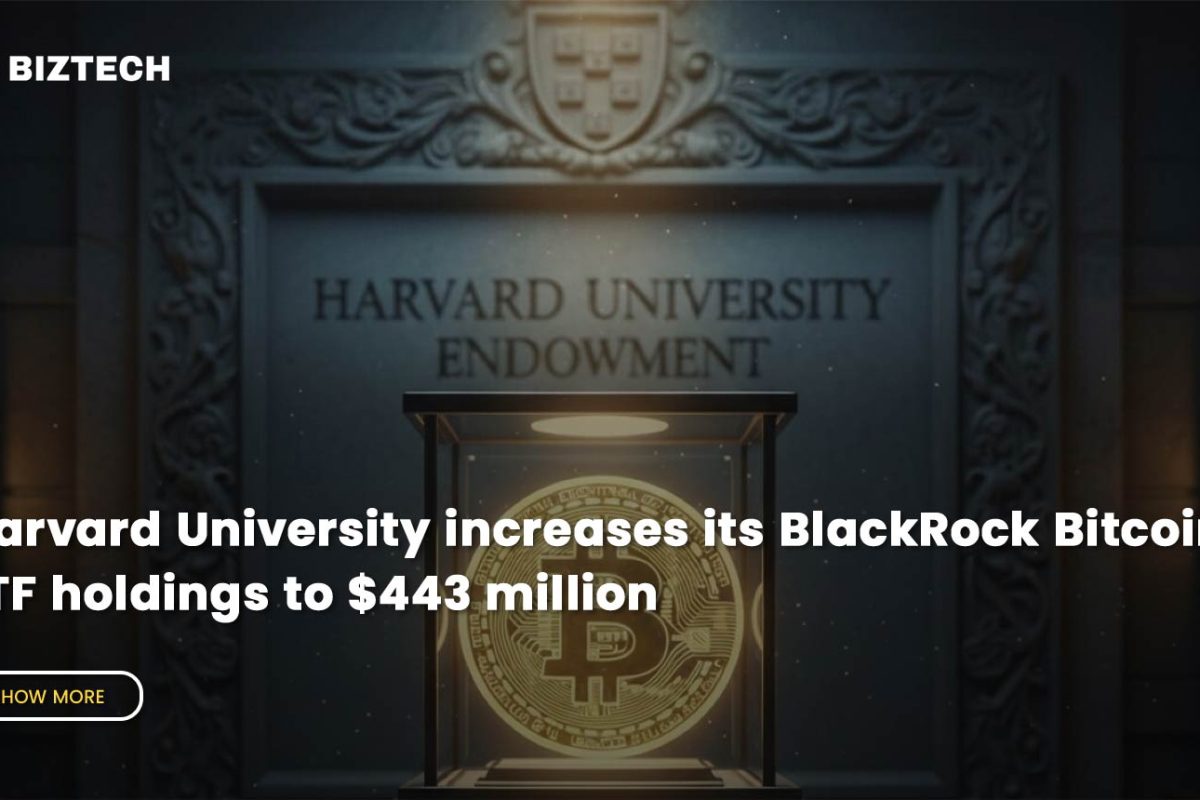
Harvard University has greatly increased its investment in BlackRock’s iShares Bitcoin Trust (IBIT). In just one quarter, it tripled its stake in the spot Bitcoin ETF. The Ivy League school’s bold move shows that top-tier endowments are becoming more confident in cryptocurrency as a viable asset class, even when the market is unstable.
According to a regulatory filing made public on November 14, 2025, Harvard Management Company, which manages the university’s $57 billion endowment, owned more than 6.8 million shares of IBIT as of September 30.
These shares were worth about $442.8 million. This is a huge jump from its original position of about 1.9 million shares worth $116.6 million in August, which is more than 250% higher.
A Rare Thing for Endowments
Eric Balchunas, an ETF analyst at Bloomberg, said that Harvard’s decision was “very unusual” for a university endowment because these types of institutions usually invest in ETFs very carefully. “It’s very rare, or hard, to get an endowment interested in buying an ETF, especially one like Harvard or Yale,” Balchunas wrote on X. “This is the best proof that an ETF can get.”
He went on to say that even though the amount is still small—about 1% of Harvard’s total endowment—it makes the university the 16th largest holder of IBIT in the world. The filing also showed that IBIT was Harvard’s best investment in the third quarter and the biggest addition to its portfolio during that time.
According to CoinMarketCap data, Bitcoin has been having a rough time lately, dropping below $100,000 last week before settling around $95,000. Even though there was a correction, Bitcoin’s performance this year is still strong, up more than 120% thanks to institutional investments and regulatory support like the U.S. GENIUS Act.
Changes in the broader portfolio
The university is getting more involved with Bitcoin as part of a larger plan to diversify. Harvard also bought more shares of big tech companies like Amazon, Meta Platforms, Microsoft, and Alphabet. It also bought a new $16.8 million stake in Klarna, a buy-now-pay-later fintech, and increased its stake in Taiwan Semiconductor Manufacturing Company (TSMC) by $59.1 million.
In the commodities market, Harvard nearly doubled its stake in the SPDR Gold Shares ETF (GLD), going from 333,000 shares worth $235.1 million in August to 661,391 shares worth $235.1 million now. This move is in line with a larger trend of institutions protecting themselves against inflation and geopolitical risks. Gold prices have gone up 25% this year, to about $2,650 per ounce.
These changes show how Harvard is carefully balancing high-growth tech and alternative assets in an uncertain economy. The endowment, which is one of the largest in the world, has a history of making unusual investments, such as in timberlands and venture capital. These investments have helped it earn an average of 8.2% per year over the past ten years.
ETF Flows
Harvard’s timing is interesting because the larger crypto market is sending mixed signals. SoSoValue data shows that global spot Bitcoin ETFs had net outflows of $1.11 billion in the week ending November 7. This was because prices fell due to worries about U.S. tariffs and a stronger dollar. Bitcoin briefly hit $92,900 before bouncing back, showing how sensitive the asset is to changes in the economy as a whole.
Even though the price went down, institutional interest is still strong. BlackRock’s IBIT, the largest spot Bitcoin ETF with more than $80 billion in assets under management, keeps getting new money, showing that it is a popular way to invest in crypto that is regulated. Harvard is now one of the top 20 holders, along with other endowments like the University of Pennsylvania, which revealed a $50 million stake in IBIT earlier this year.
This trend shows that conservative investors are starting to accept Bitcoin more. Bloomberg’s Balchunas said that university endowments like Harvard rarely invest in ETFs, and even less so in those that are linked to volatile assets like crypto. This move could make other schools, like Yale and Princeton, which manage $41 billion and $34 billion, respectively, do the same thing. This could free up billions more in institutional capital.
What this means for crypto adoption
Harvard’s increased investment in Bitcoin through IBIT shows that the asset has changed from a risky investment to a must-have in a portfolio. Endowments usually prefer low-volatility assets like bonds that pay 4–5% interest. This small allocation shows that they believe in Bitcoin’s long-term store-of-value story, especially since U.S. inflation is at 3.0% and there are concerns about fiat debasement.
BlackRock is thrilled, IBIT’s quick rise to $80 billion in assets under management (AUM) in less than two years is comparable to the growth of gold ETFs, making spot crypto products mainstream. But outflows show risks—tariffs could raise prices, making it harder for the Fed to cut rates and putting pressure on risk assets.
The effects of wider adoption are huge, Galaxy Research says that if other schools follow Harvard’s lead, crypto inflows could reach $500 billion by 2027. But volatility is still a problem; Bitcoin’s 25% drop in October shows how important it is to have different strategies.
Conclusion
BlackRock’s IBIT at Harvard University has grown by 250% to $442.8 million, which shows that institutional crypto is warming up. This makes it one of the top 20 holders among other tech and gold bets. Bitcoin is now stable at $95,000 after its correction. This Ivy League endorsement could lead to more endowment inflows, showing that ETFs are a good way for conservative investors to get into the market. But market outflows and macro risks show how unstable crypto is. Harvard’s move is risky, but it’s only 1% of its $57 billion fund. It’s a big step for the industry: Crypto’s rise from the fringes to the mainstream is speeding up.