Stay connected with BizTech Community—follow us on Instagram and Facebook for the latest news and reviews delivered straight to you.
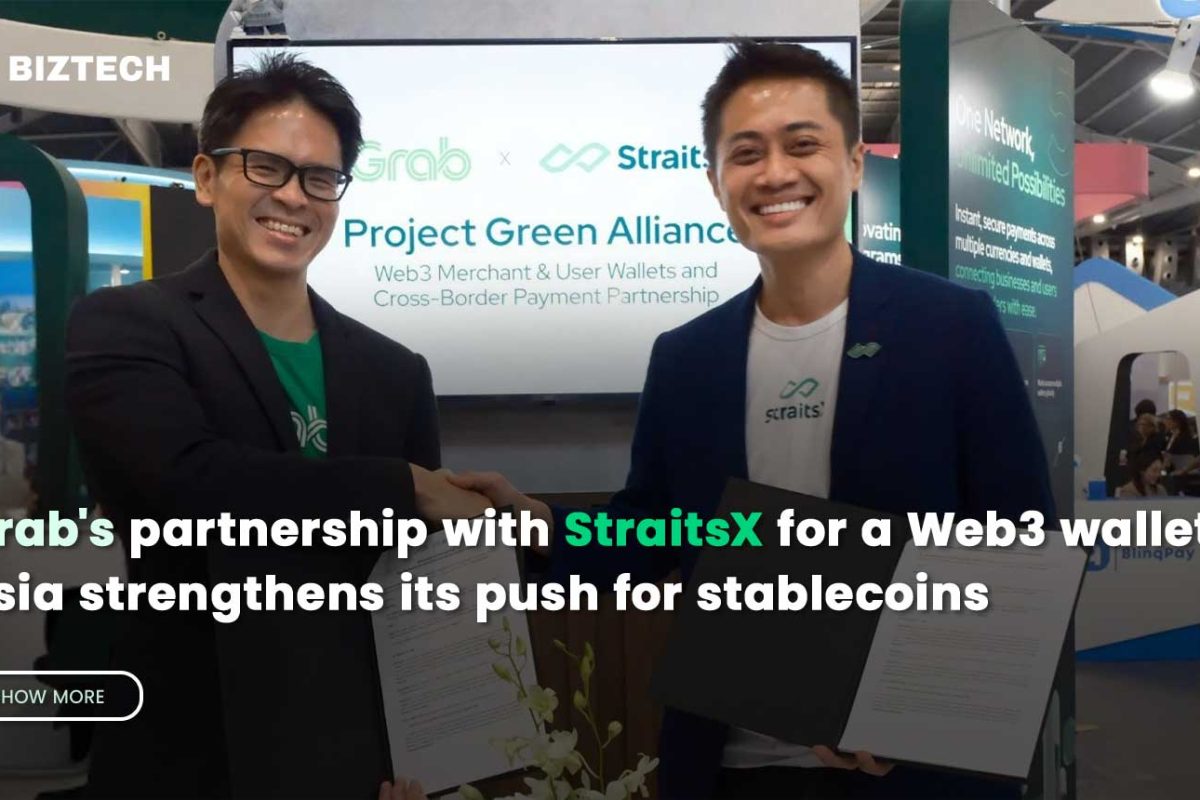
Grab, has partnered up with StraitsX, a company that provides infrastructure for stablecoins, to look into new ways to make digital payments. On November 18, 2025, the two businesses signed a Memorandum of Understanding (MoU) to work together on a stablecoin-based payment network that would cover major Asian markets and a Web3-connected wallet that would be built right into the Grab app.
Grab has been rapidly growing its financial services division since 2018, and today it serves over 300 million people through ride-hailing, food delivery, and fintech. This partnership is a big move for the company. StraitsX, a regulated digital asset company owned by Xfers Holdings, is an expert in issuing stablecoins and ensuring sure they are compliant. This makes the alliance a good fit for dealing with the fragmented payment landscape in Asia.
Adding Web3 Wallet
The main goal of the MoU is to build a wallet that works with Web3 inside the Grab ecosystem. This functionality will let anyone keep and manage stablecoins like XSGD (Singapore dollar-pegged) and XUSD (U.S. dollar-pegged), which StraitsX issues. The wallet would enable you set up programmable payments, which would let smart contracts handle transactions automatically, and it would make it easy to convert fiat to stablecoin right in the app.
The project makes it possible for merchants to accept stablecoin payments from customers in other countries without having to change their current systems. GrabPay retailers in Indonesia, Thailand, and the Philippines could get money from buyers all over the world using different Web3 wallets. All of this would be handled quickly on-chain. According to World Bank data, traditional cross-border transactions cost a lot of money—3% to 5%—and add up to $150 billion a year in Southeast Asia alone. This system hopes to cut down on those costs.
StraitsX’s infrastructure makes sure that it follows the rules by including built-in anti-money laundering (AML) and counter-terrorism financing (CTF) procedures. The partners have promised to do extensive risk assessments to find such weaknesses early on and protect users. “We’re putting a secure, compliant framework first from day one,” said a StraitsX representative in the joint announcement.
Network for Stablecoin Payments
The two people want to construct a regional payment network that uses stablecoins for settlement in addition to the wallet. This would make a single integration layer that would let merchants handle cross-border transactions in real time with clear exchange rates. Picture a Thai shop taking payments from an Indonesian customer in stablecoins linked to local currencies. There would be no delays or hidden costs like there are with older systems like SWIFT.
Tianwei Liu, the Co-Founder and CEO of StraitsX, said that the technology may change things: “Southeast Asia is one of the fastest-growing digital economies, but its payment systems are still broken and expensive.” We can construct a payment network that is faster, cheaper, and more open to everyone by combining Grab’s size with StraitsX’s stablecoin technology.
Kell Jay Lim, the head of Grab Financial, was also excited: “We see Web3 as a way to improve payments across borders while keeping the user experience the same.” We are pleased to work with StraitsX to make these solutions available to both consumers and businesses. This network would solve major problems in Asia’s $7.5 trillion stablecoin transaction volume, where high fees and sluggish settlements make it hard for e-commerce and remittances to work. By allowing customizable features like automated refunds or escrow, it might cut down on fraud and make supply chains easier for Grab’s merchant partners.
Strategic Setting
Grab’s move into stablecoins is an extension of its work with other cryptocurrencies. The company started taking crypto payments in Singapore in 2024 through collaborations with Circle for USDC. It has also tested Web3 features in Indonesia, such as giving drivers NFT prizes. Since 2022, StraitsX, which is supervised by the Monetary Authority of Singapore (MAS), has issued more than $1 billion in XSGD and XUSD. These currencies can be used in wallets like Trust and imToken.
The MoU fits with what is happening in the area: According to Google-Temasek, Southeast Asia’s digital economy will reach $1 trillion by 2030. However, payment fragmentation—different standards throughout Indonesia’s 18,000 islands or Thailand’s urban-rural divide—slows progress. Stablecoins provide a single path: Singapore’s MAS tests tokens tied to the SGD, while Indonesia’s OJK tests rupiah stablecoins using NDAChain.
This is similar to Visa’s four-stablecoin expansion and Mastercard’s $2 billion offer to buy Zerohash, as payment giants try to get a piece of the $150 trillion cross-border market. With 300 million customers and $15 billion in yearly GMV, Grab could make an extra $5 billion by 2028 by integrating Web3. This would happen through cheaper costs and additional offerings like yield-bearing wallets.
Problems to Come
There are still problems, The Monetary Authority of Singapore (MAS) supports stablecoins with 1:1 reserves. However, Indonesia’s OJK limits foreign ownership of exchanges to 49%, which makes it harder for businesses to operate across borders. The partners promise to put in place strong protections against AML/CTF threats, which have been used in earlier attacks as Ronin’s $625 million loss.
User education is one of the things that makes it hard to adopt: Bappebti says that only 18 million Indonesians own crypto, which is a small number given that most people don’t know anything about money. Alipay and WeChat Pay are tough competitors, but Grab has a big advantage because it has 80% of the ride-hailing industry.
Wider Effect
This alliance could change the face of fintech in Asia, Programmable wallets let Grab drivers make small payments or merchants be paid right away, cutting expenses by 3–5% and making it easier for the 70% of people in the region who don’t have a bank account to get money. As Liu of StraitsX imagines a “decentralized alternative,” it goes against centralized approaches and might take 10% of the $300 billion in regional remittances by 2027.
For crypto, it’s proof: Stablecoins go from being a way to make money to being useful, with $46 trillion in volume that rivals Visa. But the risks of centralization—like having 300 million users on one app—are similar to the problems with Web2. If Grab-StraitsX works, it might lead to Uber-PayPal hybrids, which would speed up the rise of Web3.