Stay connected with BizTech Community—follow us on Instagram and Facebook for the latest news and reviews delivered straight to you.
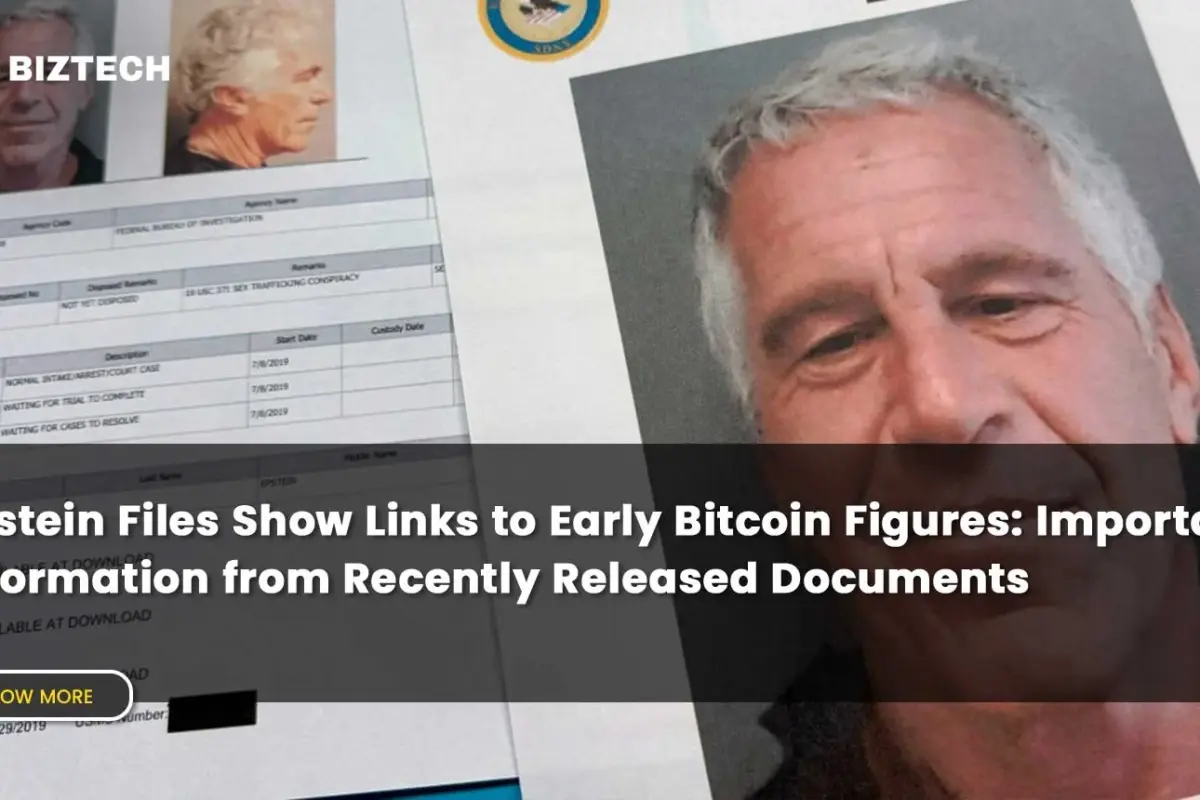
On January 30, 2026, more Jeffrey Epstein records were finally made public. They provide new light on how the late financier interacted with people and ideas in the early days of cryptocurrencies. Epstein wasn’t a big player in the crypto world, but the files—emails, meeting notes, and letters—show that he was very interested in Bitcoin’s early development, talked about the philosophy of digital currency, and even made tiny investments in related projects early on.
There is no proof in the Department of Justice’s statement that Epstein used Bitcoin for illegal purposes, and there are no wallet addresses or transactions linked to his unlawful operations. The documents, on the other hand, show that the person was rich, well-connected, and interested in new technologies. They also had ties with important people in banking, IT, and academia. Here are the most important crypto-related facts that have come to light thus far.
Who is Jeffrey Epstein?
Jeffrey Epstein is a former American financier who became widely known after being implicated in cases of sexual assault and human trafficking. He was first convicted in 2008 for sexually abusing minors, before being re-arrested in 2019 on broader federal charges.
Epstein was known to have an extensive social and financial network, including politicians, businesspeople, academics, and global technology elites. He died in August 2019 while in federal custody, with the cause of death officially declared a suicide, although it continues to spark public controversy.
The release of the latest documents by the U.S. Department of Justice aims to open Epstein’s correspondence and internal records, without implying any new legal wrongdoing on the part of the individuals named therein.
Interest in Bitcoin in 2011
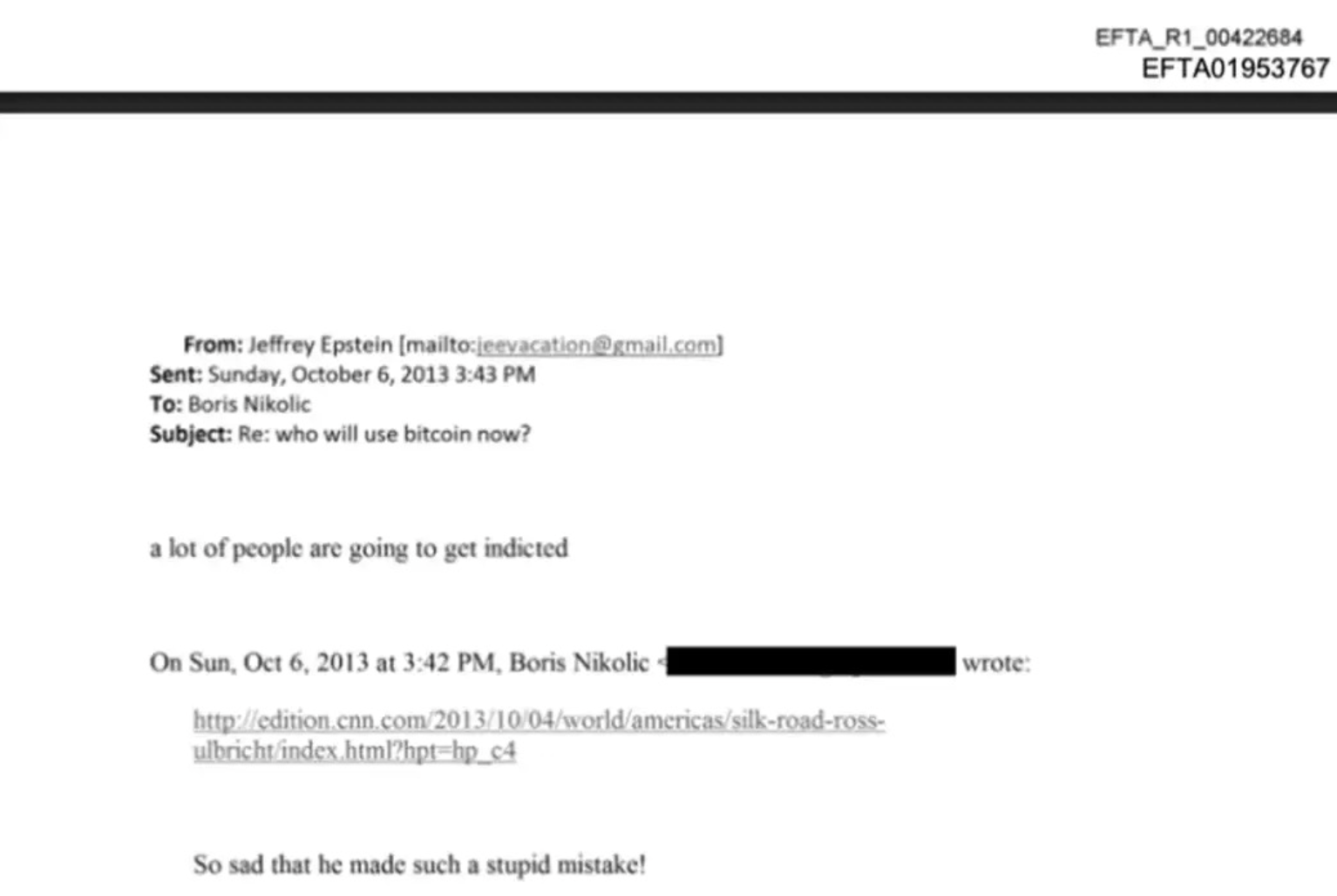
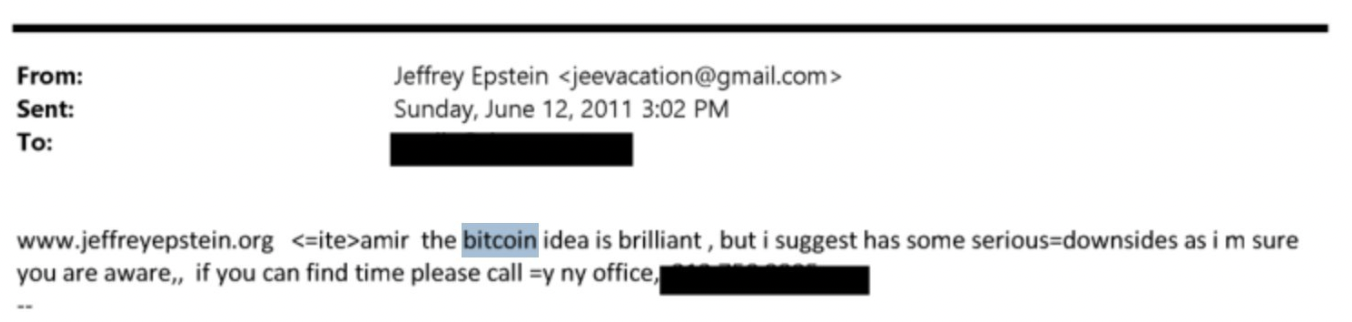
Epstein started keeping an eye on Bitcoin when it was still new. He called the idea “brilliant” in an email on June 12, 2011, when Bitcoin was momentarily worth roughly $30 before falling back. However, he also pointed out various flaws and risks that he saw. The mail was sent to Boris Nikolic, who used to be a tech advisor to Bill Gates.
Epstein brought up the Silk Road case and Ross Ulbricht’s arrest in another email later that year, using it as an example of how Bitcoin isn’t a completely private way to pay. These notes reveal that he was aware of both the technical promise and the legal and regulatory problems from the start.
Ideas for a “Sharia Dollar” and Digital Currency (2016)
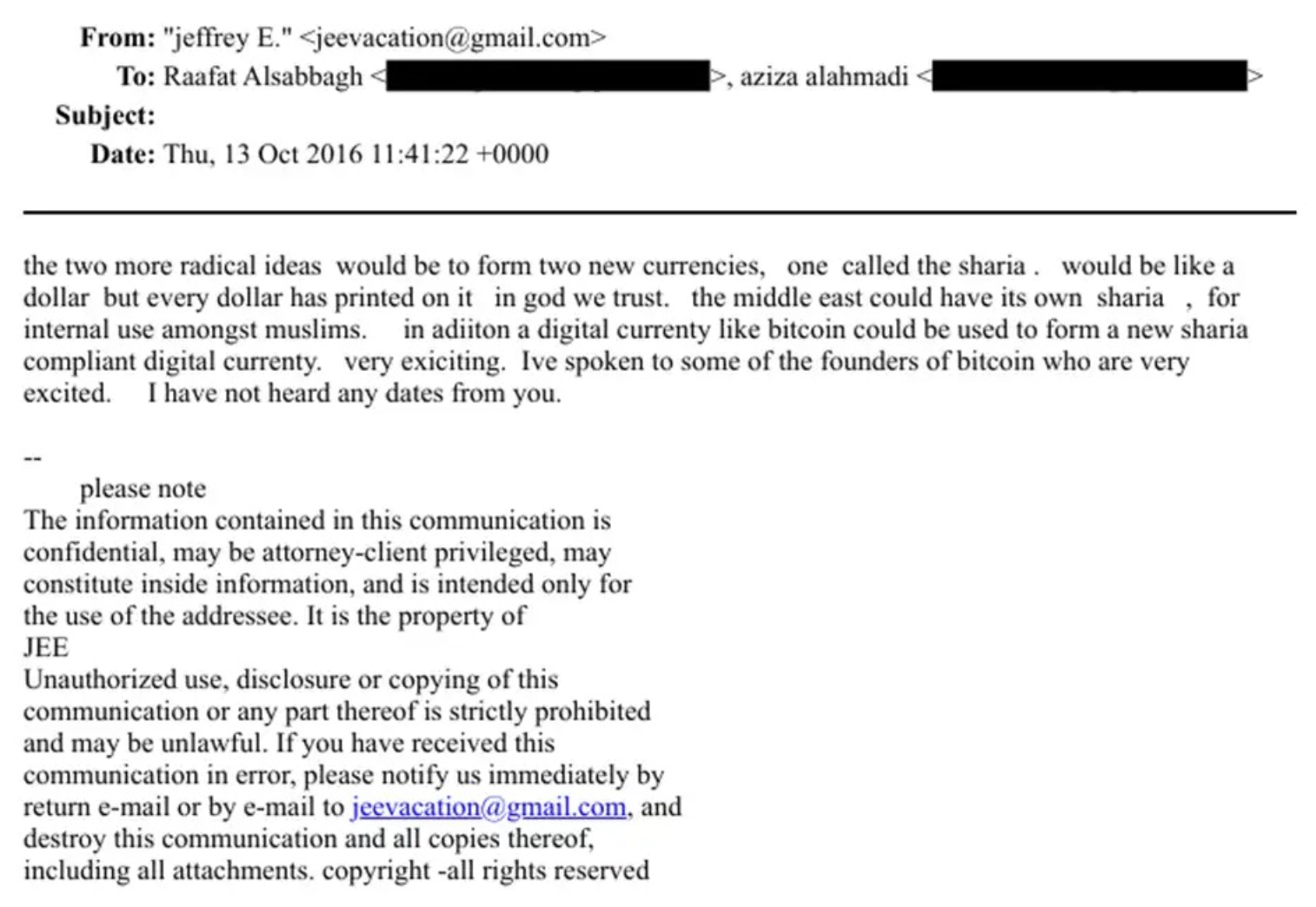
Epstein sent two proposals for digital currencies to advisors of the royal families of Saudi Arabia and the UAE in October 2016. One was a “Sharia Dollar,” while the other was a digital currency based on Bitcoin that followed Islamic banking rules.
Epstein also said in the same email thread that he had talked to “some of the founders of Bitcoin” who were excited about the idea. There is no more proof of those conversations, and Epstein was never publicly tied to a currency like that. The plan seems to have stayed at the idea stage.
Letters to Peter Thiel (2014)
One of the most solid pieces of evidence is that Epstein took part in a $18 million fundraising round for Blockstream in 2014. Blockstream was an early infrastructure startup that worked on Bitcoin sidechains and scaling solutions. He put up a small amount of money, about $50,000, through a fund run by Joi Ito, who was then the director of the MIT Media Lab.
Later, Blockstream CEO Adam Back said that the investment was only for that first round and that any linked holdings had been sold off because of worries about a possible conflict of interest. The business does not have any ongoing financial or operational ties to Epstein or his estate.
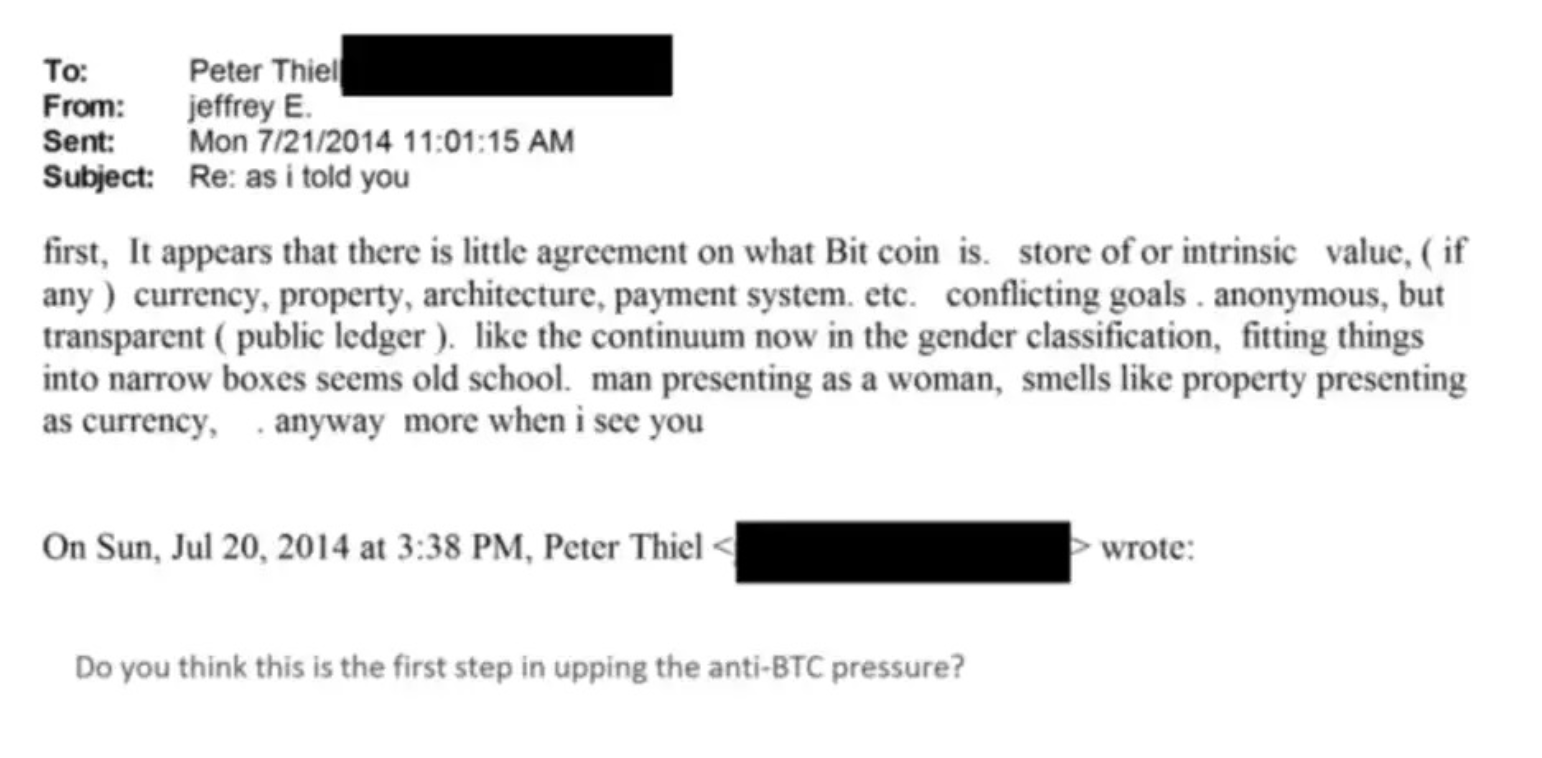
Epstein and billionaire Peter Thiel talked about Bitcoin’s identity over email in July 2014. Was it a currency, a store of value, or a new kind of digital property? The talk stayed philosophical and didn’t lead to any documented investment or partnership. Thiel’s people say there is no proof that he ever went to Epstein’s private island or had any personal relationships with him other than writing to him from time to time.
Michael Saylor and Kevin Warsh are mentioned?
Michael Saylor’s name comes up indirectly in third-party emails from 2010, long before Saylor became a well-known supporter of Bitcoin through MicroStrategy. There is no proof that Saylor and Epstein talked directly about bitcoin.
Kevin Warsh, who used to be the Governor of the Federal Reserve and is running for Fed Chair in 2026, is mentioned in Epstein’s event invitation records from 2010. The mention is just for administrative purposes and does not mean that the person was involved in Epstein’s crimes.
Read also: The First Fed Chair Who Supports Bitcoin? Who is Kevin Warsh?
Reference to the Coinbase and Neutrino Controversy (2019)
An email from March 2019 talks about the debate over Coinbase’s purchase of Neutrino, an analytics company whose founders had worked on surveillance techniques before. The email also briefly talks about XRP in the context of Coinbase’s larger problems with governance and ethics. The information in the article does not show that Epstein had anything to do with Coinbase, Ripple, or the Neutrino case.
The Department of Justice has made it clear that the data that were made public do not include any wallet addresses, blockchain transactions, or any proof that Epstein utilized Bitcoin or any other cryptocurrency for illegal activities like money laundering or extortion. It seems that he was more interested in ideas and opportunities than in doing things.
Broader Context and Things to Remember
The Epstein archives don’t show that there is a secret crypto genius. Instead, they indicate a rich, well-connected person who followed Bitcoin’s early growth, talked about ideas, made a minor investment in an infrastructure business, and got information on the industry through his large network.
The documents teach the crypto community two essential things:
People who weren’t directly involved in elite financial circles were already paying attention to Bitcoin in 2011, long before it became popular with institutions.
Epstein’s records don’t show any criminal crypto activity, which helps separate legitimate technology interest from illegal use. This is still a critical distinction in light of current regulatory and public perception issues.
The revelation hasn’t caused big price changes in Bitcoin or linked assets as of early February 2026. The most obvious change in the market has been more talk on the historical overlap between traditional banking elites and early blockchain development on X and crypto media.
The Epstein files probably won’t have a big effect on the direction of Bitcoin. In a way, they are a footnote in history: one of the most contentious people of the early 21st century was quietly watching the development of the world’s first decentralized digital currency and even taking part in it in a modest way.