
Stay connected with BizTech Community—follow us on Instagram and Facebook for the latest news and reviews delivered straight to you.

Bitcoin is undergoing a significant correction, dropping from its peak of about $126,000 in October 2025 to the $60,000–$65,000 range in early February 2026. The dip, which was more than 50% from the cycle high, wiped out much of the gains since late 2024 and put significant pressure on the altcoin market as a whole.
Ethereum dropped to almost $1,700 before bouncing back to $1,898. Other cryptocurrencies, including XRP and Solana, lost between 14% and 15% of their value per day. The total value of the crypto market fell to over $2.25 trillion, a 8% drop in one day at the height of the move.
Read Also: Bitcoin’s price drop makes IBIT dollar-weighted returns negative for the first time
There were a lot of liquidations during the sell-off. According to CoinGlass, $2.71 billion in holdings were liquidated in 24 hours, with long positions making up $2.28 billion of the amount. Bitcoin and Ethereum were the main ones, with long liquidations of $1.20 billion and $456 million, respectively. Over 591,000 traders were affected, and the biggest liquidation happened on Binance, where a BTC/USDT position worth $12.02 million was closed.
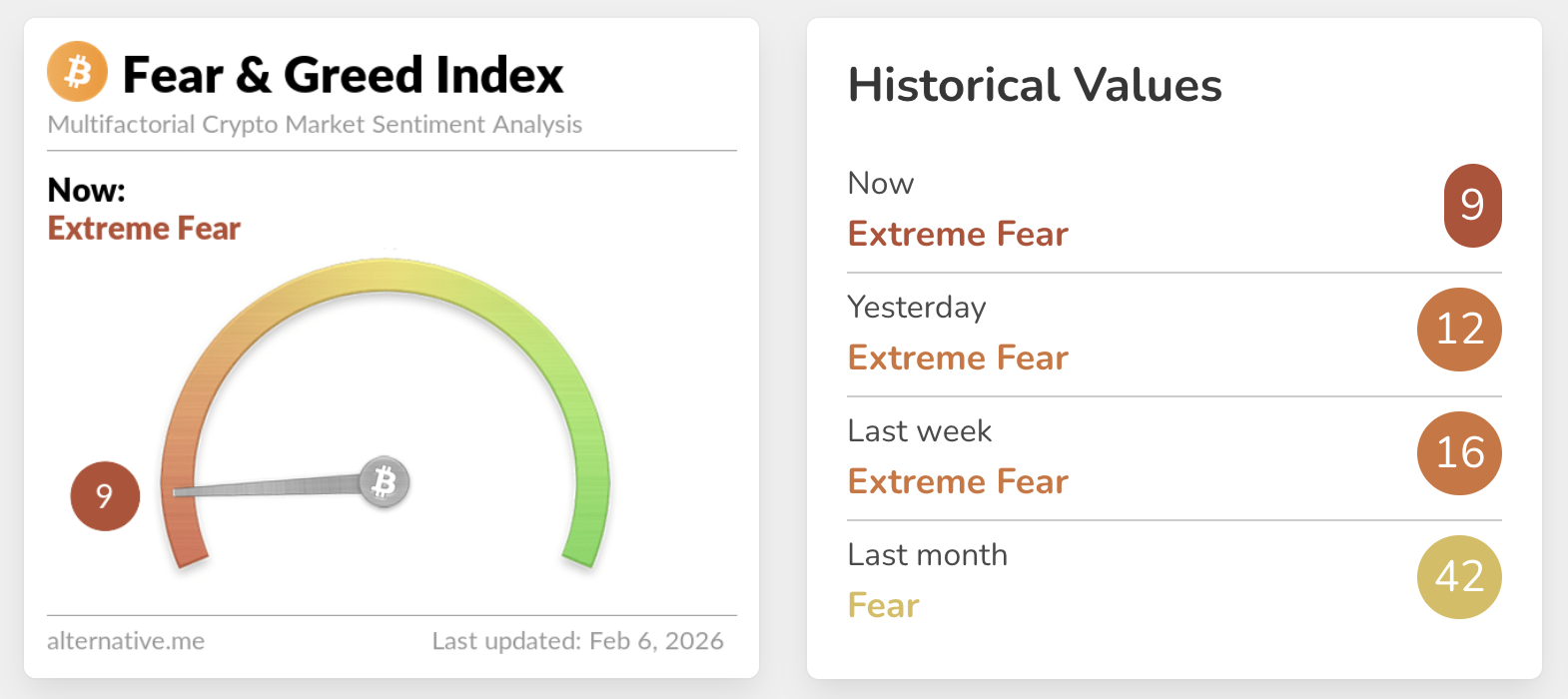
The Crypto Fear & Greed Index dropped to 9, its lowest point since the FTX crash in November 2022. This shows that the market is quite afraid. Analysts have had to rethink the risks and possible support zones in the near future because of this mix of price movement, liquidations, and emotion.
Reasons for the Downtrend
There are a number of variables that have all had a role in the current drop. Macroeconomic pressures are still the most important. Even if the Federal Reserve cut rates three times in 2025, policy is still conservative and based on evidence. Inflation in services that won’t go away and strong job numbers have lowered hopes for dramatic lowering in early 2026. The recent government shutdown made important job market information even later, which added to the uncertainty.
Geopolitical events and suggested tariff plans have also made riskier assets less valuable. The U.S. fight with Venezuela and continued trade problems have made stocks and cryptocurrencies less risky. Bitcoin has followed the rest of the market down as it has become more closely linked to growth-sensitive stocks during times of tighter liquidity.
The move has been made stronger by the market structure. High leverage in perpetual futures markets and low liquidity on weekends made it easy for quick cascade liquidations to happen. Once big long positions were stopped out, prices were able to drop even more since there weren’t enough bids to keep them from falling.
A Technical Point of View
Bitcoin has dropped below a number of important levels that used to act as support. The $69,000 area, which was the highest point of the 2021 cycle, has now been lost for good. There has been a lot of demand in the past between $58,000 and $69,000, as seen by high transaction volume clusters and the 200-week moving average near $58,000. If the correction gets worse, these levels could provide real support.
Some Analysts have talked about the worst-case scenario in which Bitcoin may hit $38,000 in the following few months. The prediction is based on how cycles have behaved in the past. In previous bear markets, prices fell by 76% to 93% from cycle highs. Stifel thinks that the lower limit is a possible 70% drop from the October peak, taking into account that each cycle’s corrections get less severe with time. People see this as a tail-risk situation instead of the base case because macro mood has been poor for a long time and there haven’t been any big rebound catalysts.
On-chain analytics show a combination of things. Exchange balances have kept going down, which means that long-term holders are not aggressively selling. Funding rates, on the other hand, stay high at certain times, which means there is still a lot of leverage that could cause more losses if sentiment gets worse.
What Could Start a Change?
A number of things could change the way things are right now:
Communication from the Federal Reserve, any sign of more easing or a stop in the runoff of the balance sheet would make people feel better about risk.
If geopolitical tensions ease and trade relations between the U.S. and China stabilise, or if other hot regions calm down, people may be less afraid to take risks.
ETF flows: steady inflows into spot Bitcoin ETFs would provide a structural bid, as in prior periods of consolidation.
Technical confirmation — A clear break over $100,000 with increasing volume would probably mean that the bearish thesis is no longer credible and that short covering would begin.
The risks of going down are still high until these catalysts show up. The $58,000–$69,000 range has historically had the strongest demand, but if it doesn’t hold, it could push Stifel toward its more extreme $38,000 target.
Conclusion
Bitcoin’s drop from $126,000 to the $60,000–$65,000 area is due to a mix of big-picture problems, geopolitical uncertainties, and fundamental market reasons. The pressure to liquidate has been very high, with $2.71 billion lost in just one day and people feeling very scared. Even though it hurts, historical patterns show that such drawdowns often occur before recovery phases when the right conditions are met.
The $58,000–$69,000 zone has the most historical support, and on-chain demand clusters behind it. Stifel’s $38,000 tail-risk scenario remains plausible, but it is not the most likely. Traders should keep a close eye on what the Fed says, ETF flows, and news about world events. In the short term, keeping your money safe and managing your risks carefully remain the most important things to do until there is clear bullish evidence.