
Stay connected with BizTech Community—follow us on Instagram and Facebook for the latest news and reviews delivered straight to you.
In the past few weeks, stablecoin outflows from centralized exchanges have slowed down a lot. In the past month, they only dropped to $2 billion, which is a big difference from the $8.4 billion that left at the start of the current bear market in late 2025. According to CryptoQuant on February 4, 2026, the slowdown means that investors are not leaving the cryptocurrency market in large numbers, but are instead focusing on the most liquid platforms, with Binance becoming the main custodian of stablecoin reserves.
Nick Pitto, who is in charge of marketing at CryptoQuant, said that the data shows a phase of consolidation instead of surrender. Pitto said, “Capital isn’t rushing out of crypto right now; it’s consolidating, especially on Binance.” “The trend would only turn bullish again if reserves started to grow again or if money started to flow into risky assets.” This explanation fits with how the market as a whole is acting: even if Bitcoin is still correcting from its October 2025 high of over $126,000, stablecoin balances on exchanges have not fallen, which means that many people are holding onto their coins instead of totally cashing them out.
Read Also: Bitcoin stays above $90,000 even as tensions between the U.S. and Venezuela are rising
Binance’s Huge Control Over Stablecoin Reserves
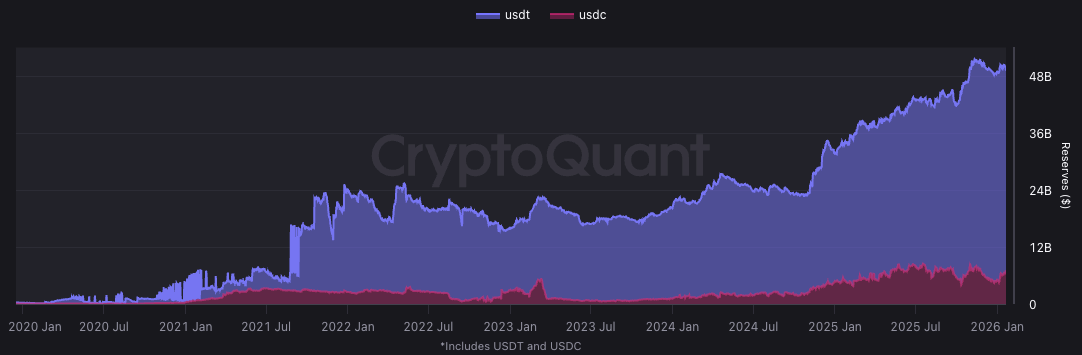
Binance now has $47.5 billion in the two biggest stablecoins, Tether’s USDT and Circle’s USDC. This is 65% of the total USDT and USDC supply on centralized exchanges. This concentration has grown a lot in the last year. For example, Binance’s stablecoin reserves went up 31% from $35.9 billion in early 2025 to the current level. USDT makes up most of that total, with $42.3 billion in holdings. USDC holdings, on the other hand, are only $5.2 billion.
When you look at other big platforms, the difference is really clear. With $9.5 billion (13% of CEX stablecoin reserves), OKX comes in second. Coinbase comes in third with $5.9 billion (8%), and Bybit comes in fourth with $4 billion (6%). The discrepancy shows that Binance has a structural edge in liquidity, especially for USDT, which is still the most popular dollar-pegged stablecoin in the world, with a market valuation of more than $187 billion.
Binance’s USDT reserves grew by 36% from one year to the next, while USDC balances were mostly the same. This difference shows that Tether is still the most popular trading pair and cross-border traffic, especially in emerging markets where USDT is used as a dollar substitute.
What Slowing Outflows Mean for Market Mood
One of the few good signs in an otherwise dismal market is that stablecoin outflows have slowed down. Heavy redemptions usually happen before deeper corrections, when investors sell off risky assets and look for protection in fiat. The fact that outflows have slowed to $2 billion over the past month, even though Bitcoin is down more than 44% from its cycle high, implies that panic selling has calmed down and that investors are parking their money instead of fleeing.
CryptoQuant sees this as proof of consolidation: big holders and institutions are keeping their exposure through the most liquid venue instead than pulling out completely. This kind of conduct commonly happens before recovery phases, when parked liquidity can quickly move back into risk assets when mood changes.
But the company is still wary of announcing a bottom. Last week, CryptoQuant said again that Bitcoin’s realized price support, which is the total cost base of all coins in circulation, is around $55,000 and has not yet been tested in a meaningful way. The company said, “Bitcoin’s ultimate bear market bottom is around $55,000 today,” stressing that there is still a lot of room for prices to fall before they start to rise again.
Bitcoin was trading at about $68,107 at the time of writing. This is a drop of 1.3% in the last 24 hours. The asset is still consolidating in a wide range between $60,000 and $75,000, and sentiment indicators are still very negative. The Crypto Fear & Greed Index has been in the “extreme fear” range for weeks, with readings in the low 20s.
Factors in Institutions and Structures
Binance’s large proportion of stablecoin liquidity shows both its market power and its strategic position. The exchange has the most powerful derivatives suite, the deepest order books for most trading pairings, and the most fiat on-ramps and off-ramps. When the market is down, traders and institutions flock to the platform with the most liquidity and the least slippage, which strengthens Binance’s position even more.
This concentration has both pros and cons. Deep liquidity on a single venue might help keep things stable during times of stress. On the other hand, it increases the danger of counterparty concentration: any operational, regulatory, or security problem at Binance might have a big effect on the whole system.
The amount of stablecoins held by exchanges is a good way to measure market liquidity and investor interest. When reserves go up, it usually means that capital is getting ready to invest in risky assets. When they diminish quickly, it often means that bigger drops are coming. The recent stabilization, with outflows falling to $2 billion a month, shows that the market is in a digesting phase rather than outright capitulation.
What Could Change the Trend in the Future
There are a few things that could change the current pattern of consolidation and turn stablecoin reserves into new buying pressure:
- Macro improvement — Clearer signs that the Federal Reserve would keep easing or stop running off its balance sheet would make people feel better about risk and encourage them to put their money back into crypto.
- Clear rules — Progress on the delayed CLARITY Act or further implementation of the GENIUS Act could make institutions feel more confident.
- Technical confirmation — A big rise above $100,000 with rising volume would probably cause short covering and bring in capital that has been sitting on the sidelines.
- ETF and corporate flows — If spot Bitcoin ETFs keep getting money and corporate treasuries keep buying, that would create a structural bid.
The market is still open to more negative pressure until these catalysts show up. CryptoQuant’s warning that Bitcoin’s realized price support near $55,000 has not yet been tested serves as a caution that there could be a lot of volatility in the future.
Conclusion
The significant drop in stablecoin outflows to $2 billion a month, together with Binance’s 65% share of CEX USDT and USDC reserves, suggests that people are not leaving but rather consolidating. Capital isn’t leaving crypto completely; it’s just focusing on the most liquid and reliable venue while things are still up in the air.
This is what happens in a late-stage bear market: fewer people are involved, liquidity is lower, and people move to better assets within the ecosystem. Binance’s huge proportion of stablecoin reserves strengthens its role as the main liquidity center. At the same time, the overall stabilization of outflows shows that panic selling has calmed down.
The most important question for traders and investors is whether this period of consolidation will end with more accumulation or more capitulation. CryptoQuant’s estimate that Bitcoin’s final bear-market bottom is around $55,000 shows that there is still a chance of a drop. But the fact that institutional ETF inflows and corporate treasury holdings keep going up gives a counterbalancing bid.
Stablecoin reserves on exchanges will continue to be one of the most essential things to observe as the market goes through this difficult time. If inflows start up again or even stay the same, it would mean that capital is getting ready to move again when the mood improves. Until then, being careful and managing risk carefully is still the best thing to do.