Stay connected with BizTech Community—follow us on Instagram and Facebook for the latest news and reviews delivered straight to you.
Stethoscopes equipped with artificial intelligence (AI) could soon help doctors detect life-threatening heart conditions in seconds, according to a major UK study.

Researchers from Imperial College London and Imperial College Healthcare NHS Trust found that the AI devices dramatically improved early detection rates for heart failure, heart valve disease, and abnormal heart rhythms—conditions often missed until they become emergencies.
A 200-Year-Old Tool, Reinvented
The traditional stethoscope, invented in 1816, has long been a staple of medical practice. However, the new AI-enabled version, manufactured by the US firm Eko Health, replaces the standard chest piece with a small device roughly the size of a playing card.
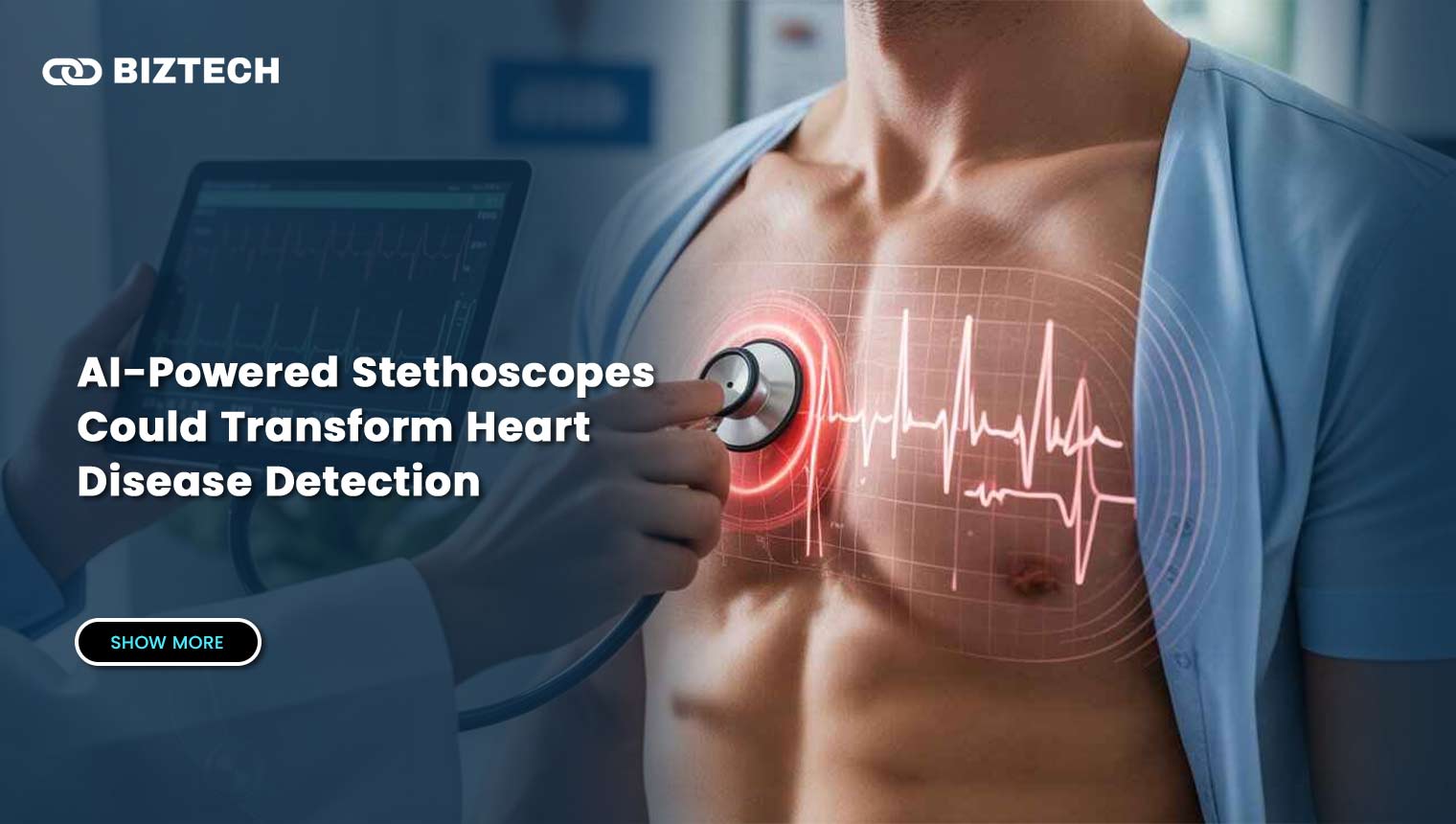
Placed on a patient’s chest, the stethoscope simultaneously records the electrical activity of the heart (ECG) and the sound of blood flow. This data is then uploaded to the cloud, where AI is trained on the analyses of tens of thousands of patients. Results are sent to a smartphone, flagging whether a patient may be at risk of serious heart disease.
Study of 12,000 Patients Shows Striking Results
The trial, presented at the European Society of Cardiology congress in Madrid, involved 12,725 patients across 96 GP surgeries. Their outcomes were compared with patients from 109 GP practices where the AI stethoscopes were not used.
Key findings:
- Heart failure was 2.33 times more likely to be detected within 12 months.
- Atrial fibrillation (AF), often symptomless but a major stroke risk, was 3.45 times more detectable.
- Heart valve disease was 1.92 times more likely to be diagnosed.
Dr Mihir Kelshiker, a member of the research team, said:
“Most people with heart failure are only diagnosed when they arrive in A&E seriously ill. This trial shows that AI-enabled stethoscopes could change that—giving GPs a quick, simple tool to spot problems earlier.”
‘A Game-Changer for Early Diagnosis’
Experts say the technology could revolutionise heart care by catching diseases in their earliest stages.
Dr Sonya Babu-Narayan, clinical director at the British Heart Foundation, called the development an “elegant example” of modernising a centuries-old device.
“So often this condition is only diagnosed at an advanced stage when patients attend the hospital as an emergency. Given an earlier diagnosis, people can access the treatment they need to help them live well for longer.”
Dr Patrik Bachtiger, of Imperial’s National Heart and Lung Institute, added:
“The design of the stethoscope has been unchanged for 200 years—until now.”
Read also: AI-Driven PanEcho Tool Enhances Echocardiogram Accuracy
Next Steps: From Trials to GP Practices
The stethoscopes are now set to be rolled out in GP practices across south London, Sussex, and Wales. Researchers believe the technology could be integrated into routine check-ups, especially for patients presenting with symptoms such as breathlessness, fatigue, or swollen legs—common signs of heart failure.

If adopted widely, the innovation could not only save lives but also ease the burden on emergency departments by enabling earlier treatment.