Stay connected with BizTech Community—follow us on Instagram and Facebook for the latest news and reviews delivered straight to you.
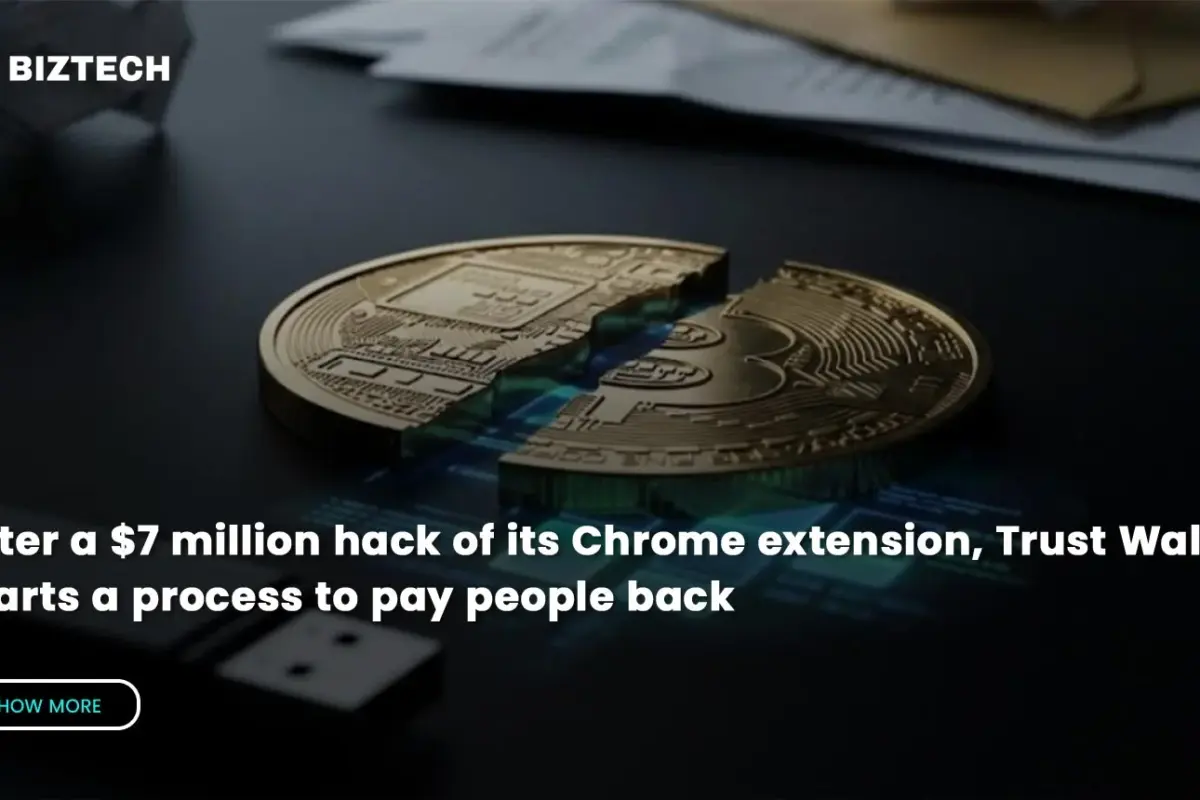
Users who were affected by the December 2025 Chrome extension exploit that took about $7 million can now get their money back through Trust Wallet’s official compensation program.
The news, which was made on December 26, 2025, is a proactive move by the Binance-owned wallet provider to regain trust after one of the biggest security breaches that affected crypto users who use browsers in a long time.
The vulnerability affected version 2.68 of the Chrome extension and included malicious code that stole seed phrases from wallets on several blockchains, such as Bitcoin, Ethereum, and Solana. Trust Wallet has confirmed that the flaw came from an API key for the Chrome Web Store that was exposed. This let attackers publish a bad update without triggering internal release safeguards. The business fixed the problem by releasing version 2.69 on December 25. However, anybody who used the bad version before the change are still at risk.
Read also: USDT Freeze Could Shake Market: Crypto Insider
The attack’s scope and on-chain tracing were explained in detail by security companies PeckShield and SlowMist. PeckShield said that more than $4 million of the stolen money was swiftly moved through centralized exchanges including ChangeNOW, FixedFloat, and KuCoin. At the time of the investigation, almost $2.8 million was still in wallets controlled by the attackers. SlowMist kept an eye on the money laundering process: The attacker changed the whole amount of USDT to DAI within 30 minutes (taking advantage of USDT’s centralized freeze feature as a risk) and then changed the DAI to about 16,690 ETH. Most of the ETH (16,680) was then put into Tornado Cash, which made it much harder to track.
The attack hit hundreds of wallets, and the total losses were close to $7 million. Lookonchain pointed out one well-known incidence in which a victim lost 49,999,950 USDT after submitting a 50 USDT test transaction to their own address. The main transfer was then sent to a poisoned address. The fraudster had already sent small amounts of money to the victim’s wallet, which made the false address look like it had been used recently and made it more likely that someone would make a copy-paste mistake.
Trust Wallet has made it clear that the problem only affected the Chrome extension and not the mobile app, browser extensions on other platforms, or any of the core wallet infrastructure.
Eligibility and the Process for Getting Paid
People who were affected by the exploit can now file claims through Trust Wallet’s official support site. The information you need to provide is:
- The email address that goes with the wallet
- Country of residence
- Address of the affected wallet
- The address where the attacker gets the money
- Transaction hash(es) that show the illegal transfer
Trust Wallet has promised to pay back all verifiable losses. The business has said that every claim will be carefully checked to make sure that no fake ones are submitted. Trust Wallet has issued stern cautions against phony compensation forms, phishing sites, and impersonators taking advantage of the situation to safeguard consumers from secondary scams.
The compensation program is one of the biggest voluntary reimbursement programs for a wallet provider in the history of cryptocurrency. It follows what other platforms have done before, like the partial recovery in the May 2024 $71 million wrapped Bitcoin robbery, which was made possible by exchanges and security organizations working together to negotiate returns.
Browser Extensions Have Bigger Security Effects
The Trust Wallet scandal has once again shown how unsafe browser extensions can be, especially those that deal with seed phrases or private keys. Chrome Web Store API key breaches have been a common way for supply chain hacks to happen. This lets bad actors release fake updates that don’t go through the review process.
Security experts have been saying for a long time that extensions are a high-risk attack surface since they have more rights and can access user data directly. In this scenario, the bad malware used JavaScript to attack seed phrase input fields by adding it to the wallet interface.
The tragedy has led to increased requests for better security policies in the supply chain:
- Code signing by several parties is required for extension updates.
- More strict review processes for expansions that deal with money data
- More high-value users are using hardware wallet integrations.
Trust Wallet has already put in place emergency measures and is said to be working with Google to make Chrome Web Store security protocols better.
Effect on the Market and Users
The theft happened while the market was very unstable, with Bitcoin fluctuating between $100,000 and $120,000 and a lot of leveraged positions being sold off. The stolen sum ($7 million) isn’t that big compared to other significant exchange thefts, but it has had a big effect on regular customers. Browser-based wallets are still popular for easy access, especially in new areas where people use both mobile and desktop computers.
The incident has also brought up old discussions regarding the best ways to keep your own things safe:
- Never copy and paste addresses from your recent transaction history.
- Always check full addresses one character at a time.
- Use QR code scanning or bookmarking to get destination addresses.
- If you have a lot of money, think about using a hardware wallet.
Lookonchain and SlowMist are still keeping an eye on the stolen money, but it is unlikely that they will be able to get it all back because it moved so quickly through Tornado Cash.
Conclusion
Trust Wallet’s promise to fully compensate the $7 million Chrome extension hack shows that the company is responsible, which is something that people often say is lacking in the industry. The event shows that browser extensions still have security holes in their supply chains, but the company’s quick action and openness may help keep users’ trust.
The event reminds us that ease often comes with costs for the larger crypto economy. Wallet providers are still trying to find the right balance between usability and security. Users need to be very careful about verifying their transactions, especially when dealing with large amounts.
It may be hard to get back the stolen money, but the lessons are clear: in crypto, trust is built through both technology and openness. People will probably remember Trust Wallet’s efforts in this situation as a good way to respond to a failure that could have been avoided but was expensive.