Stay connected with BizTech Community—follow us on Instagram and Facebook for the latest news and reviews delivered straight to you.
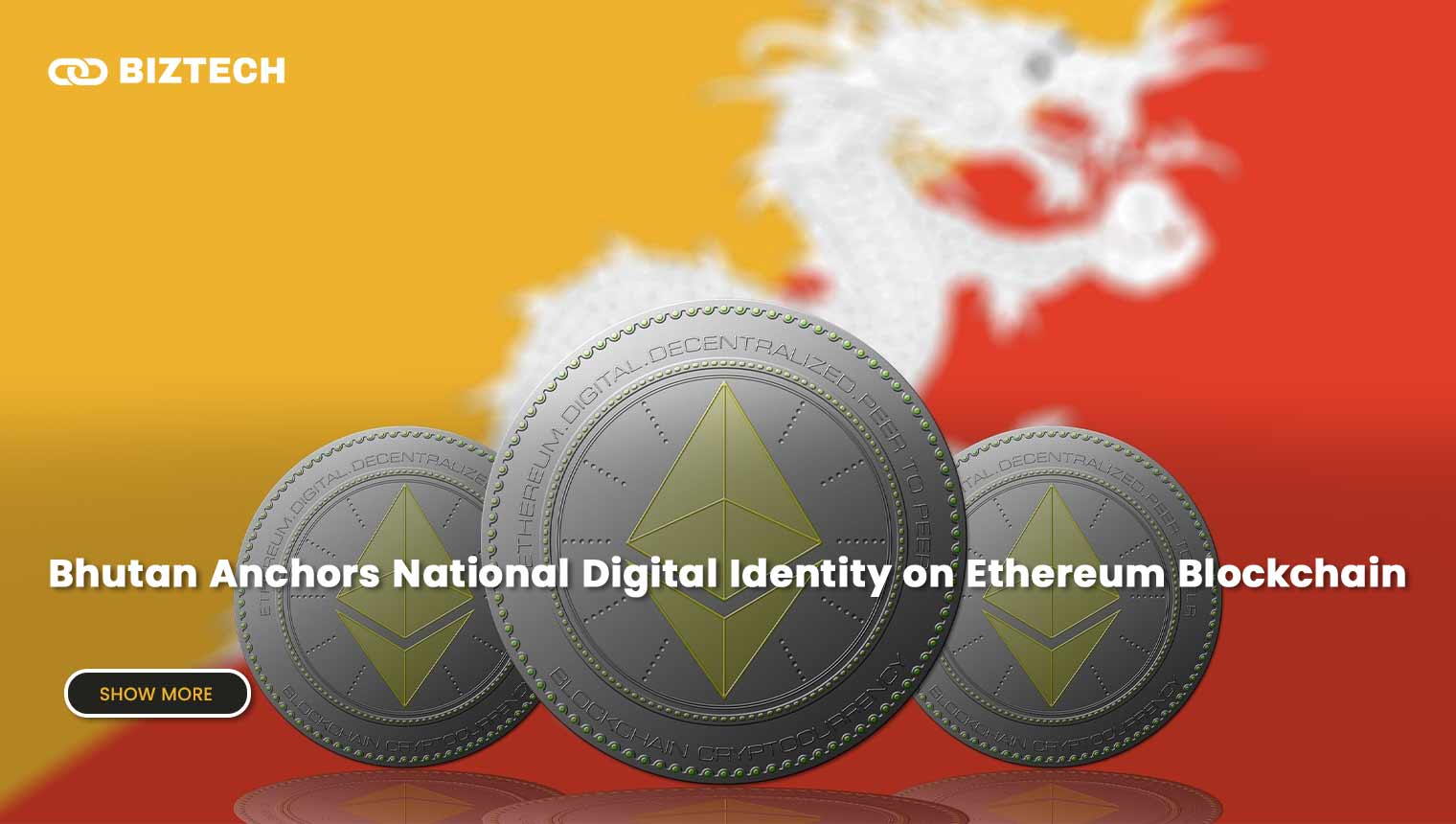
The Kingdom of Bhutan has become the first country in the world to base its national digital identity system on the Ethereum blockchain. This is a breakthrough mix of Himalayan culture with cutting-edge blockchain technology.
On October 13, 2025, this move away from Polygon was announced. It is a big step toward self-sovereign identity (SSI), giving almost 800,000 people the power to safely and openly handle their own data.
Aya Miyaguchi, the president of the Ethereum Foundation, called the launch a “historic milestone” on X. She was there with co-founder Vitalik Buterin, Bhutanese Prime Minister Tshering Tobgay, and Crown Prince Jigme Namgyel Wangchuk. She stressed how important it is for creating a “more open and secure digital future.”
Bhutan is not just improving security by using Ethereum’s decentralized infrastructure and zero-knowledge proofs (ZKPs), but it is also providing an example for how to rule the world in the Web3 era.
This move shows how blockchain is growing from a financial instrument to a basic public service. It combines Bhutan’s Gross National Happiness ideology with Ethereum’s open innovation mindset. Other nations, like Brazil and Vietnam, are also looking into similar pilots.
A Royal and Tech Elite Event
The presentation took place in Thimphu with a mix of traditional and modern elements that were suited for Bhutan. Traditional prayer flags flew next to holographic Ethereum logos, and Tobgay and the Crown Prince joined Buterin and Miyaguchi in a ceremony that represented the country’s digital sovereignty. “This is more than just technology; it’s a promise to give our people control over their own data,” Tobgay said, pointing out how the system fits with Bhutan’s Gross National Happiness (GNH) statistic by putting fair and moral digital access first.
Miyaguchi’s X thread captured the moment: “Bhutan is celebrating a historic milestone today: it is the first country to base its national digital identity system on Ethereum.” His Royal Highness was there for the launch event, and @VitalikButerin and I were proud to represent the Ethereum community. Buterin agreed, saying that there is a “deep resonance” between Bhutan and Ethereum since both think that plans for the future must be based on strong values. GovTech Secretary Jigme Tenzing and local crypto pioneers were at the event, which included demonstrations of ZKP-verified credentials for services like voting and healthcare. This showed how Ethereum can be used to create identity that can’t be changed and keeps privacy.
Bhutan has used blockchain technology earlier. The National Digital Identity (NDI) was the world’s first SSI system when it launched in late 2023. It started on Hyperledger Indy and then moved to Polygon in August 2024 to make it more scalable. The Ethereum pivot, which is almost done for core infrastructure and will be fully migrated by the first quarter of 2026, makes it a public, permissionless network. According to Miyaguchi, this is a “world-first” that allows for worldwide interoperability without centralized gatekeepers.
How Bhutan’s digital identity has changed over time
Bhutan’s NDI journey shows a planned move toward autonomy. It started on Hyperledger Indy for permissioned control during the COVID-19 pandemic to make remote services easier to utilize, but it ran into problems with scalability as more people started using it. Polygon’s 2024 integration increased throughput to 65,000 TPS, allowing 800,000 citizens to get valid credentials without giving up their personal information.
Ethereum’s arrival fixes Polygon’s problems with centralization while keeping its security: ZKPs let you prove your age or where you live without giving out your full ID, which cuts down on fraud in elections and subsidies. Tenzing told Bhutan Broadcasting Service that “moving to Ethereum makes our digital identity even safer.” He said that the network’s proof-of-stake consensus and large developer community make it perfect for national-scale resilience. The move, which was helped by a hackathon in June 2025 that produced 13 prototypes, works with Bhutan’s Digital Drukyul program to connect NDI to e-governance tools for easy verification across borders.
This puts Bhutan ahead of its peers: Brazil’s PIX-integrated SSI trial serves 215 million people but is still centralized. Vietnam’s NDAChain, which started in July 2025, focuses on tokenized assets instead of identification. Estonia’s e-Residency, which started in 2014, uses its own blockchain. Bhutan’s public Ethereum choice makes it easier for people all around the world to access Ethereum’s 4,000+ dApps.
Bhutan’s Wider Acceptance of Cryptocurrencies
Bhutan’s Ethereum bet is part of a larger crypto strategy that combines sustainability and independence. The monarchy ranks fifth in the world for Bitcoin holdings, with 11,286 BTC valued $1.31 billion (as of October 17, 2025, at $116,000/BTC). It mines utilizing hydroelectric power from its Himalayan rivers, which produces 1.5% of the world’s hashrate while releasing no carbon, according to BitcoinTreasuries. The money goes to GNH projects including education and healthcare, which shows that “green Bitcoin” is a national policy.
In early 2025, the Gelephu Mindfulness City, a 1,000 sq km special economic zone, added BTC, ETH, and BNB to its reserves. At the same time, a crypto tourism system that works with Binance lets people pay for eco-treks. “Buterin tweeted after the start that “Bhutan’s Bitcoin mining is a paradigm for renewable crypto,” linking it to Ethereum’s switch to proof-of-stake.
Some people say that public blockchains are more likely to be hacked (like the $625 million breach of Ronin in 2022), although Bhutan’s ZKP layer and Ethereum’s audited contracts make this less likely. Privacy proponents like that SSI gives users control, but requiring services to use it creates equality concerns in rural areas.
Conclusion
Bhutan’s move to Ethereum for its NDI—celebrated by Buterin, Miyaguchi, and royalty—marks the start of a new era of sovereign digital identification. By the first quarter of 2026, 800,000 citizens will be able to use ZKPs and SSI. It’s a masterpiece in progressive decentralization, with Polygon’s scalability and Ethereum’s immutability. The kingdom has 11,286 BTC in reserves and is good at green mining. It challenges centralized IDs around the world and inspires pilots in Brazil and Vietnam, showing that blockchain is ready for national trust. This is the best way to administer crypto: clear, safe, and focused on people. As Bhutan leads, the world watches. Could Ethereum become the main currency for digital countries?