Stay connected with BizTech Community—follow us on Instagram and Facebook for the latest news and reviews delivered straight to you.
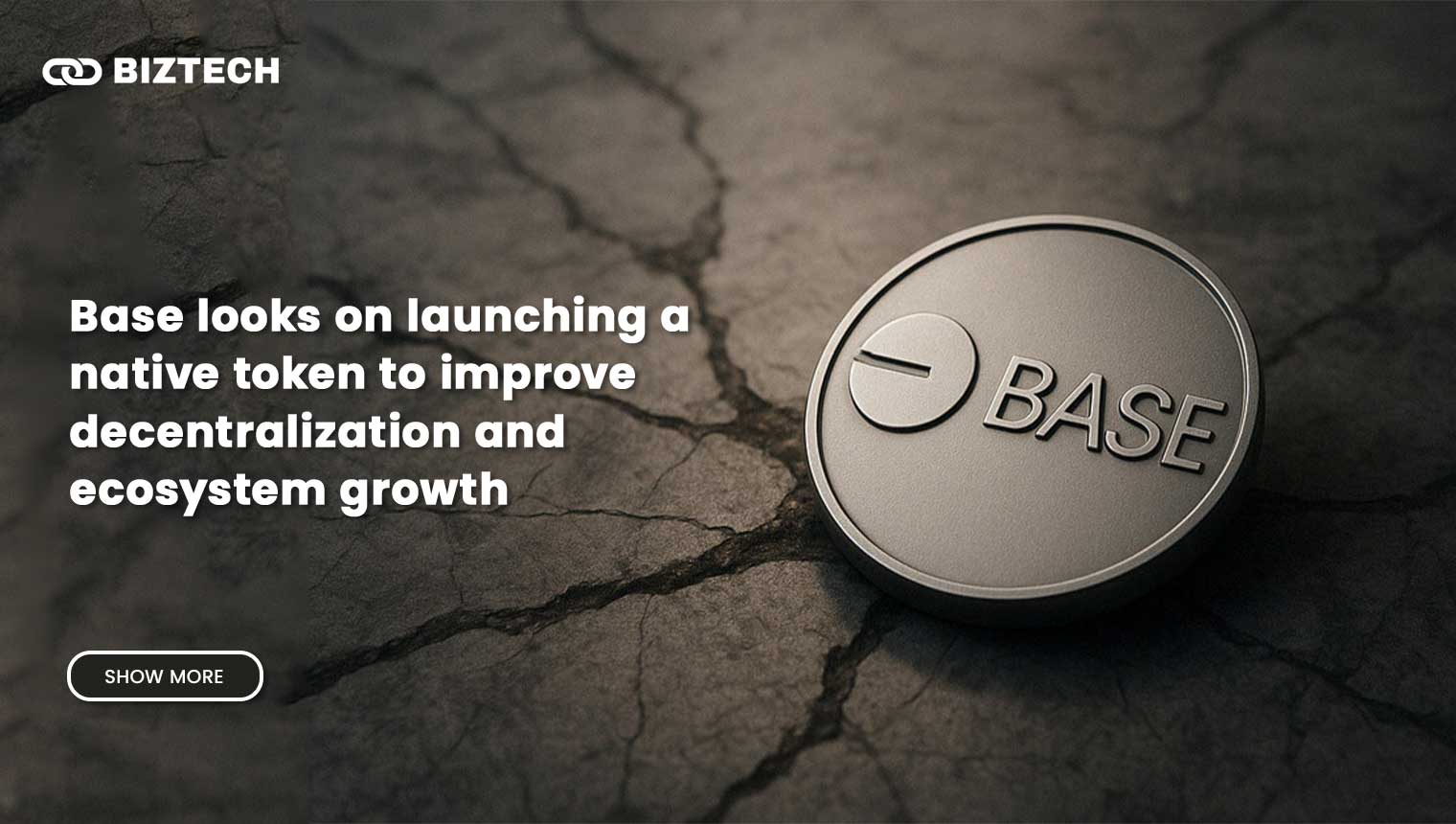
Coinbase’s Ethereum Layer-2 network, Base, is thinking about adding a native currency. This might speed up its attempts to become more decentralized and give developers and innovators more power in its ecosystem. This exploration was announced on September 15, 2025, during the BaseCamp 2025 event in Stowe, Vermont. It shows that Base has grown into one of Ethereum’s most active scaling solutions, moving away from its previous stance opposing token issue.
Since its start in 2023, Base has focused on establishing a safe, low-cost, developer-friendly chain that doesn’t need a token to work. It has achieved transactions that take less than a second and cost less than a cent, and it has grown into an open-stack ecosystem. Base now wants to create a token to encourage open governance and innovation. This might lead to additional rewards for early adopters, such airdrops. In the past year, there have been over 20.8 million monthly active addresses and $5 billion in total value locked (TVL), with $1.7 billion added in 2025 alone. This action, which is still in its early stages, fits with the crypto-friendly regulatory environment in the U.S. under President Trump. It could also be a symptom of a bigger trend among Layer-2s looking for long-term growth.
Base’s Changing View on Tokenization
Base’s official announcement on September 15 made it clear that a token was never necessary for its main goal. However, the network is now “exploring” one to help with more open governance and ecosystem growth. “When we started Base, we knew what our goals were: to make a secure, low-cost, and developer-friendly chain and ecosystem.” The company said, “Launching a token wasn’t necessary to reach those goals, and we wanted to focus on the core product.” But now that Base has reached important goals, including becoming Ethereum’s most popular Layer-2, it might be time to add tokens to encourage more people to join.
This announcement, which Base inventor Jesse Pollak initially hinted at at BaseCamp 2025, goes against what was said before. In November 2024, Pollak complimented initiatives like Hyperliquid by putting product development ahead of token incentives. He said that Base had “no plans” for a token. Now, the project is still in the exploratory stages, therefore there are no information about the design, governance mechanics, or launch timetable. Pollak said that any token would have to follow three rules: it would have to be based on Ethereum, it would have to follow U.S. laws and work with policymakers, and it would have to be open and honest with the community.
Base said, “If we ever do move forward with a token, it will be based on principles and values and in line with our long-term mission: to build a global economy that encourages innovation, creativity, and freedom.” This careful strategy lowers the dangers that come with launching tokens, like the SEC’s investigation of Coinbase, especially since Coinbase has a history of using conservative legal techniques. Some Layer-2s utilize their own coins for gas fees, but Base would keep using ETH, which is in line with its Ethereum concept.
Base’s Fast Growth and Place in the Market
Base is a Layer-2 built on Optimism and launched in 2023 by Coinbase. It handles transactions off-chain for efficiency before settling on Ethereum’s mainnet. This means reduced fees and faster speeds without sacrificing security. Token Terminal data shows that it is the most popular, with 20.8 million active addresses per month over the previous 12 months. This is more than competitors like Arbitrum and Optimism. Base is the second largest Ethereum Layer-2 by TVL, with $5 billion. It is behind Arbitrum’s $10 billion+, but it has the most daily transactions and developer activity.
This expansion has been natural, thanks to Coinbase’s large user base and partnerships like the Base app beta, which makes on-chain interactions easier. The network’s concentration on “Onchain Summer” projects, which involve working with brands like Coca-Cola and Atari, has brought millions of new users to Base, making it a doorway for mainstream adoption. A native token might encourage this even more, maybe by giving prizes for staking, voting on governance, or airdrops to active users and builders, like what has worked on Arbitrum (ARB) and Optimism (OP).
New Features and Integrations Across Ecosystems
BaseCamp 2025 showed out improvements to make it easier for developers to work together and make tools. Pollak announced an open-source bridge to Solana that lets assets move between the two ecosystems without any problems. It also lets users access Solana’s $12.7 billion TVL for more liquidity. “Base is meant to be a bridge, not an island.” We want to make the ecosystem stronger by making it open and connected. Pollak said, “Interoperability is the key to making the world economy better.”
Base Batches 002 will come out on September 29, 2025, and will give new developers money, advice, and a way to get their games out to the public. The Base app beta will get upgrades to make it easier to use, and the new Base Build dashboard will give builders options for statistics and making money. These fit with Base’s “superchain” goals since they work with other OP Stack chains to create a single pool of liquidity and governance.
The Solana bridge, in particular, solves a major problem with blockchain fragmentation, which might bring Solana’s fast DeFi users to Base’s Ethereum-secured environment. This push between chains could increase the amount of TVL coming in, especially since Base’s daily fees are above $1 million, which is about the same as Ethereum’s Layer-1 charges at their highest.
What this means for the crypto market
A Base token could help the ecosystem expand by giving over control of Coinbase and letting the community make upgrades and reward people who take part. This is similar to how OP’s token increased Optimism’s TVL by 300% after it was released. There has already been a lot of activity around airdrops. After the announcement, Base ecosystem tokens including AERO (+9%), ZORA (+15%), and DEGEN (+10%) all rose, while BTC and ETH fell marginally. A successful cryptocurrency might raise the value of Coinbase’s (COIN) stock, since Base is responsible for a lot of trading activity.
But there are still problems. Regulatory alignment is very important. Pollak said that Coinbase’s “conservative” legal team has changed since the Trump administration took a pro-crypto attitude, but SEC oversight is still a problem. Base has done well without a token because of the quality of its products. If you hurry one, it could have problems with dilution or centralization. The effects on the market as a whole include more competition on Layer 2, which might speed up Ethereum’s scaling conflicts and help ETH holders by increasing demand.
Conclusion
Base’s exploration of a native token is a strategic move that balances its product-first approach with the requirement for decentralized governance to keep expansion going.
The project shows that Base wants to be the leader in Ethereum’s Layer-2 space, from Jesse Pollak’s BaseCamp unveiling to promises of Ethereum integrity and following the rules. With the Solana bridge and tools like Base Batches 002 coming soon, Base is ready to connect ecosystems and give builders more power.
This could lead to new Layer-2 innovations in the crypto market, which would increase acceptance and liquidity. However, success will depend on clear execution. As Base grows up, its token decision could change how centralized companies like Coinbase help Web3’s open future, which would be useful for the industry’s continuous growth.