Stay connected with BizTech Community—follow us on Instagram and Facebook for the latest news and reviews delivered straight to you.
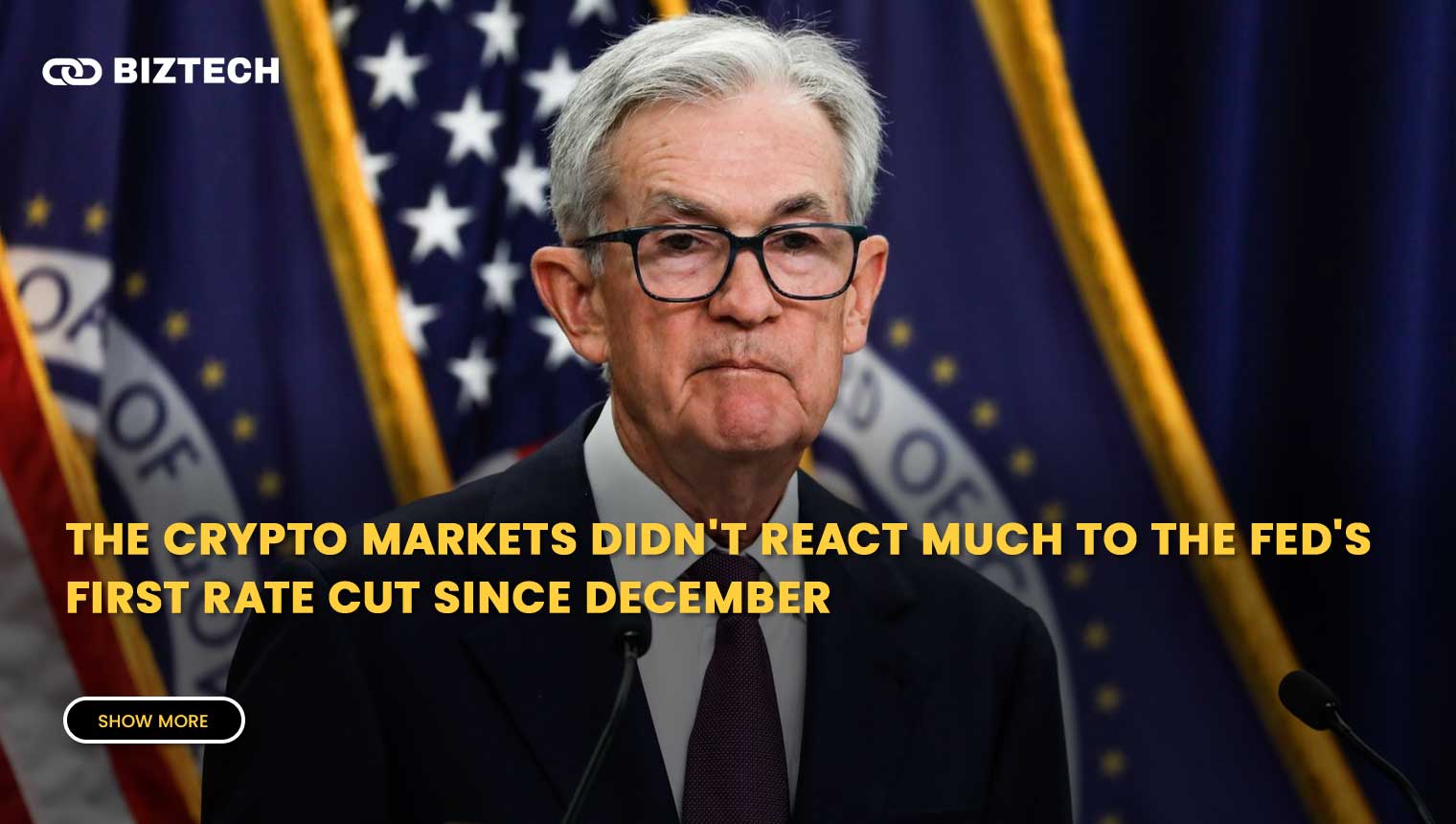
The cryptocurrency market didn’t respond strongly to the Federal Reserve’s long-awaited interest rate cut on September 17, 2025. The expected spike didn’t happen, even though the policy change was dovish. Bitcoin stayed between $115,000 and $117,000 for a few hours after the announcement, while Ether moved about a little but didn’t break out in a big way.
The Federal Open Market Committee (FOMC) cut the federal funds rate by 25 basis points to a target range of 4.00% to 4.25%. This was the first cut since December 2024, when inflation was slowing down and the job market was showing signs of weakness. CME FedWatch Tool data showed that the markets had already priced in the move with a 90% chance.
However, economists say that the absence of volatility shows that the market is mature and is processing expectations instead of acting on them right away. This incident shows how the relationship between macroeconomic policy and digital assets is changing. Right now, things are flat, but there could be long-term benefits for risk-on investments like crypto.
Changes in the market right away
When the FOMC delivered its statement at 2:00 p.m. EST, Bitcoin was trading about $115,500, according to Coinbase data. This was close to its recent highs but below the all-time high of $124,000 set in August. BTC fell below $115,000 in the hours that followed as many took profits, but by 7:00 p.m. EST it had risen to about $117,000, a net gain of roughly 1.5%. This was not the huge rally that some people had hoped for. Trading activity went up a little on major exchanges, and the CME’s spot BTC futures open interest reached $16.7 billion, which shows that institutions are hedging rather than purchasing aggressively.
The second-largest cryptocurrency by market valuation, Ether (ETH), followed this pattern of low activity. ETH started at about $4,600 when the announcement was made, but it dropped to $4,430 after an hour. By evening, it had risen to $4,620, a 0.4% net gain in low liquidity. Altcoins had conflicting results: Solana (SOL) rose 2% to $185, while XRP fell 0.5% to $0.62. This was due to changes in the sector, not a general rise in crypto. After the announcement, the total value of all cryptocurrencies in the world was $4.14 trillion, which was only 0.8% higher than the day before. This shows that there wasn’t a big rise.
Analysts say the lack of reaction is due to expectations that were already priced in
People who watch the market quickly explained the lack of response by saying that the cut was expected. Julio Moreno, head of research at the on-chain analytics firm CryptoQuant, told Decrypt over Telegram: “Today, there wasn’t much volatility because the Fed’s interest rate decision had been expected for a long time. The market was seeing a 25bps cut with a 90% chance.” This fits with CME FedWatch data, which showed a 93% chance before the meeting, leaving little potential for momentum based on surprises.
Brian Huang, who co-founded the fintech company Glidera, said the same thing in an email: “Crypto markets had already priced in today’s rate cut, so BTC and ETH are flat on the day.” He said that even though the first reaction was neutral, the signal of cutting liquidity might help the market slowly go up. In the same way, @SevenWinse on X saw BTC drop below $115,000 after the announcement, but they pointed out that futures interest was a bullish undercurrent during a lull in spot trade.
Even though the cut was flat, a few of experts called it clearly good. Qin En Looi, managing partner at the venture capital firm Onigiri, said in an email: “The Fed’s rate cut today is a good sign that liquidity is back on the table, which will boost sentiment in the short term.” Moreno went on to say that it “could mark the start of a rally into Q4 as the Fed guidance was for more interest rate cuts this year,” referring to the dot plot’s prediction of up to 50 more basis points by the end of the year.
The Fed’s Most Important Role in Crypto’s Future
Analysts stressed the Federal Reserve’s big influence in defining the future of cryptocurrencies, even as the sector is trying to become more independent. Doug Colkitt, a founding contributor to the liquidity protocol Fogo, said in an email, “When Powell blinks, risk assets breathe, and Bitcoin breathes deeper than most.” He did say, though, that “the sad but unavoidable truth is that the market is still addicted to Fed signals, even though crypto was made to get away from them.”
Thomas Perfumo, a global economist at Kraken, said, “The Federal Reserve and the markets seem to agree on the expected path of rate cuts through late 2025 and into 2026. This is a backdrop that is still generally good for risk assets, including crypto.”
He stressed that macroeconomic factors like employment and inflation data will determine future performance. These indications could show if smaller 25 basis point cuts are enough or if more drastic easing is needed.
Greg Magadini, who is in charge of derivatives at Amberdata, talked about what institutions are worried about: “I still think the Fed’s independence is the biggest factor in asset prices, especially Gold and Bitcoin.”
This independence is still in doubt, especially as we get closer to 2026 when a new Fed Chairman will take office. Political influences, including President Trump’s public critiques of Fed Chair Jerome Powell during the press conference after the meeting, added to the story of possible volatility.
Colkitt combined this big-picture view with crypto’s own drivers: “If the Fed keeps going in a dovish direction, expect more money to flow into crypto’s higher-beta plays.” But let’s be clear: macro is the wind, and crypto innovation is what makes things go. “Rate cuts might start the next leg, but real adoption is what keeps it going over time.” There is reason to be hopeful based on past events. After rate cuts in 2000, Bitcoin averaged 14% gains in stocks one year later, and crypto often did better during periods of easing.
Conclusion
The Federal Reserve dropped rates by 25 basis points on September 17, 2025. This had a small effect on the crypto markets, with Bitcoin and Ether not moving much because everyone knew it was going to happen. There were no immediate spikes—BTC stayed around $116,000 and ETH stayed around $4,600—but this news makes the liquidity climate more favorable for Q4, which might lead to rallies in risk assets like digital currencies.
Analysts are nevertheless optimistic about the long term, saying that forecasts for more easing through 2026 are in line with each other. However, it is important to keep an eye on inflation, employment, and the Fed’s independence. This means that cryptocurrencies are becoming a more stable asset class that doesn’t react as quickly to news but is still tied to central bank signals. Innovation and acceptance will ultimately decide how long they can keep growing, even when the economy is doing well.