Stay connected with BizTech Community—follow us on Instagram and Facebook for the latest news and reviews delivered straight to you.
Bitcoin and Ethereum, two of the most important cryptocurrencies, are trading in conservative ranges.
But privacy coins, a sector that hasn’t gotten much attention in a long time, are back in the spotlight. These digital assets, which were particularly designed to hide transaction details and keep users anonymous, are having an amazing rally that goes against the general market mood and makes people rethink their place in the future of digital banking.
This isn’t just a small bump; it’s a full-fledged comeback, fueled by a strong mix of new technology, rising social anxiety, and changing rules.
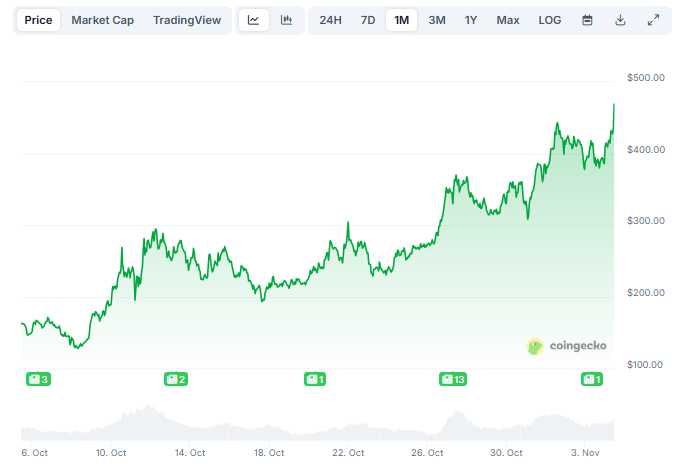
Zcash (ZEC) is at the front of this charge. In the last month, it has gone up an amazing 185%, going from about $132 to a monthly high of $466. This meteoric performance has been so impressive that it has knocked Monero (XMR), the long-time king of anonymity, off its throne as the largest privacy coin by market capitalization.
With a market cap of almost $7.6 billion, Zcash is already well ahead of Monero, which has a market size of $6.2 billion. But the momentum isn’t just with one token. There is a strong revival in the whole privacy sector.
Dash (DASH) went up by an even bigger 273%, and Decred (DCR) went up by a strong 85%. The total market value of the privacy coin category has reached $25.6 billion, which is a clear evidence that investors are once again very interested in the promise of financial anonymity.
This strong rebound isn’t happening on its own. It is the direct outcome of multiple variables that are all connected and have come together to make the value of privacy coins more important than ever. We will now look at the five main factors that are driving this surprising and strong recovery.
1. More and More People Are Worried in the Digital Age
As the demand for privacy coins grows, so does the amount of digital surveillance and data harvesting going on around the world. The European Union’s controversial proposed “Chat Control” law, which critics say could effectively end digital encryption by forcing platforms to scan private messages, and tech giants like Meta facing intense backlash for using European user data to train its AI models are just two examples of how personal digital privacy is being pushed to its limits.
In the US, there is still no strong federal privacy law, and the way states protect data is still a hodgepodge of rules.
This developing contradiction is making a strong and compelling story for both investors and privacy advocates: the “private sphere” of the digital world is getting smaller at an alarming rate.
In this world where things are becoming more open, privacy coins are being looked at again, not as rare tools for hiding, but as important weapons for “financial self-defense.” They show that people can safely and pseudonymously do business without needing the authorization or authority of a central bank, government, or company. As more people learn about these problems, the idea of an asset class made just to fight them becomes more appealing.
2. Zero-Knowledge Proofs Go Mainstream
The main technology behind current privacy coins has changed a lot, going from a little-known cryptographic idea to a key part of blockchain development. Zero-knowledge proofs (ZK-proofs) are at the center of this revolution.
The new way of using cryptography lets one person prove to another that a statement is true without giving up any other information. This means that a network can check the validity of a transaction without revealing the sender’s address, the receiver’s address, or the amount of money that was sent.
The most important distinction now is that ZK-technology is no longer only used in small privacy projects. It is now a key part of big Ethereum scaling solutions like zk-rollups (for example, zkSync and Starknet).
This widespread use has led to huge amounts of money being put into research and development, which has made ZK-proofs faster, more scalable, and easier to use. The complicated privacy features that used to be thought of as annoying and expensive to run are now getting simpler. A growth implies that the strong privacy that was only available with specific currencies may now be more easily used throughout the ecosystem, giving the whole sector more credibility and technological validity.
3. From Crime to Compliance and Programmable Privacy
For a long time, the main story around privacy coins was wrongly tied to illegal activity on the dark web. The idea caused a lot of problems, such as getting delisted from big exchanges like Binance and Kraken. But now there is a planned and purposeful twist in the story.
Developers and initiatives are working hard to find a way to balance the need for privacy with the needs of regulators. One idea is “programmable privacy.”
A model to protects user data by default, but it also has built-in ways for someone to get access to it under certain, legally-justified conditions. Think of it as a digital safe that no one can open, but there can be a judicial key that is open to everyone and can be checked. Technologies like ZK-proofs are a big part of this.
They let you provide information selectively without breaking the privacy assurances of the whole system. This more complex and comprehensive approach is making projects that focus on privacy more appealing to institutions and forward-thinking regulators who understand that privacy and legality can go hand in hand.
4. People are upset with crypto’s own openness
There is a deep irony behind this privacy coin rally: the cryptocurrency ecosystem itself has become a place where people are watched all the time. Almost all centralized exchanges require strong Know-Your-Customer (KYC) procedures, which connect real-world identities to blockchain addresses.
In addition, a multi-billion dollar industry of blockchain analytics companies (like Chainalysis and Elliptic) has grown up that specializes in following and revealing the identities of those who make transactions on public ledgers like Bitcoin and Ethereum.
For a lot of people in the crypto community, this reality goes against the core cypherpunk values of financial freedom and privacy. This attitude has grown stronger as governments, like the U.S. Department of the Treasury, have been looking into using AI techniques to track crypto transactions under the GENIUS Act. As a result, privacy coins are making a strong comeback in the counterculture. People perceive them as a safe place to go to get some financial privacy back from the system that was intended to give it to them, without having to leave the digital asset realm completely.
5. Privacy as a Basic Layer
Lastly, it seems that the recent rally is more than just a short-term speculative frenzy. It shows that more and more people in the sector are realizing that privacy isn’t just a perk; it’s a key part of the digital economy’s future. The focus is changing from just launching anonymous coins to creating strong, scalable privacy systems that offer real economic benefits.
Thought leaders like Carter Feldman, CEO of Psy Protocol, have said that the goal is to move toward a form of “privacy by default,” where transactions are protected without consumers having to change complicated settings. This view sees the technology behind coins like Zcash as the most important part of the next generation of the internet, or Web3.
There will be a huge need for technologies that can work without revealing private information, from private DeFi transactions and verifiable digital IDs to AI that can compute on sealed data. In this context, today’s privacy coins are more than just assets; they are the first steps and testing grounds for the privacy infrastructure that will be needed in the future.
Conclusion
The strong comeback of privacy coins is a complicated event that can’t be written off as just market speculation. It is a direct, logical answer to the growing global monitoring, a confirmation of cutting-edge cryptographic technology, a strategic shift toward a more compliant future, and a philosophical stand for the fundamental principles of the crypto revolution. As the barriers between our real and digital lives continue to blur, the need for instruments that defend people’s rights will only get stronger. The market is now saying that anonymity, which was once thought to be a thing of the past for crypto, may be one of its most important and valuable futures.