
Stay connected with BizTech Community—follow us on Instagram and Facebook for the latest news and reviews delivered straight to you.
Vietnam has made a big step toward making its cryptocurrency market official by starting the first phase of licensing for digital asset exchanges as part of its five-year pilot program.
On January 21, 2026, the State Securities Commission (SSC) said that applications for regulated crypto trading platforms are now open. This is the first step in the framework set up by Resolution No. 05/2025/NQ-CP.
The action comes after the Digital Technology Industry Law was passed in Vietnam in June 2025. This law made it permissible to recognize crypto assets. After that, there were resolutions that set up the pilot framework. About 17 million Vietnamese people are currently trading cryptocurrencies, largely on offshore platforms.
The government wants to bring this activity onshore, collect taxes, protect investors better, and make digital assets a part of the national financial system.
Read also: South Korea to delay crypto taxation until 2027
High Capital Threshold Sets Strict Entry Bar The conditions for getting a license are very strict. To be considered, applicants must show that they have at least VND 10 trillion (about $400 million or Rp6.4 trillion) in charter capital, which must be fully paid in cash or approved assets.
Foreign ownership is limited to 49%, therefore Vietnamese legal entities will always have the most control.
Other requirements include the structure of the organization, its human resources, its technical infrastructure, and its compliance processes, which must be in line with anti-money laundering and counter-terrorism funding standards.
These limits are much higher than those in Singapore and Hong Kong, which are in the same region. In those places, licensed digital asset platforms don’t need as much capital, but they are closely watched all the time. Vietnam’s approach is based on a planned strategy of controlled entry: limit the number of operators, make sure they have enough money, and lower the chance of platforms that don’t have enough money failing under pressure.
Domestic banks are already interested in the high bar. Sources close to the Ministry of Finance said that at least ten securities and banking businesses have said they plan to apply. In 2022, SSI Securities started up its digital asset business, SSI Digital.
It works with Tether, U2U Network, and Amazon Web Services. VIX Securities has put money into making a local exchange platform, and Techcombank and VPBank have set up the infrastructure they need to run it while they wait for final regulatory permission.
Remitano, a regional exchange that has been in Vietnam since 2014, saw this as a long-term good indicator for the ecosystem. A company spokesman said that the hefty capital requirement makes it hard to get in, but it might ultimately make the market more honest and bring in serious institutional investors.
The NDAChain Foundation and the Evolution of Regulations
The licensing process is based on Vietnam’s Digital Technology Industry Law (June 2025), which was the first to recognize crypto assets as property under civil law, and Resolution 05 (September 2025), which set up the pilot framework.
Starting January 1, 2026, all trading platforms must have licenses from the government and settle transactions in Vietnamese dong (VND). This means that fiat- or securities-based tokens are not allowed unless they are backed by real assets.
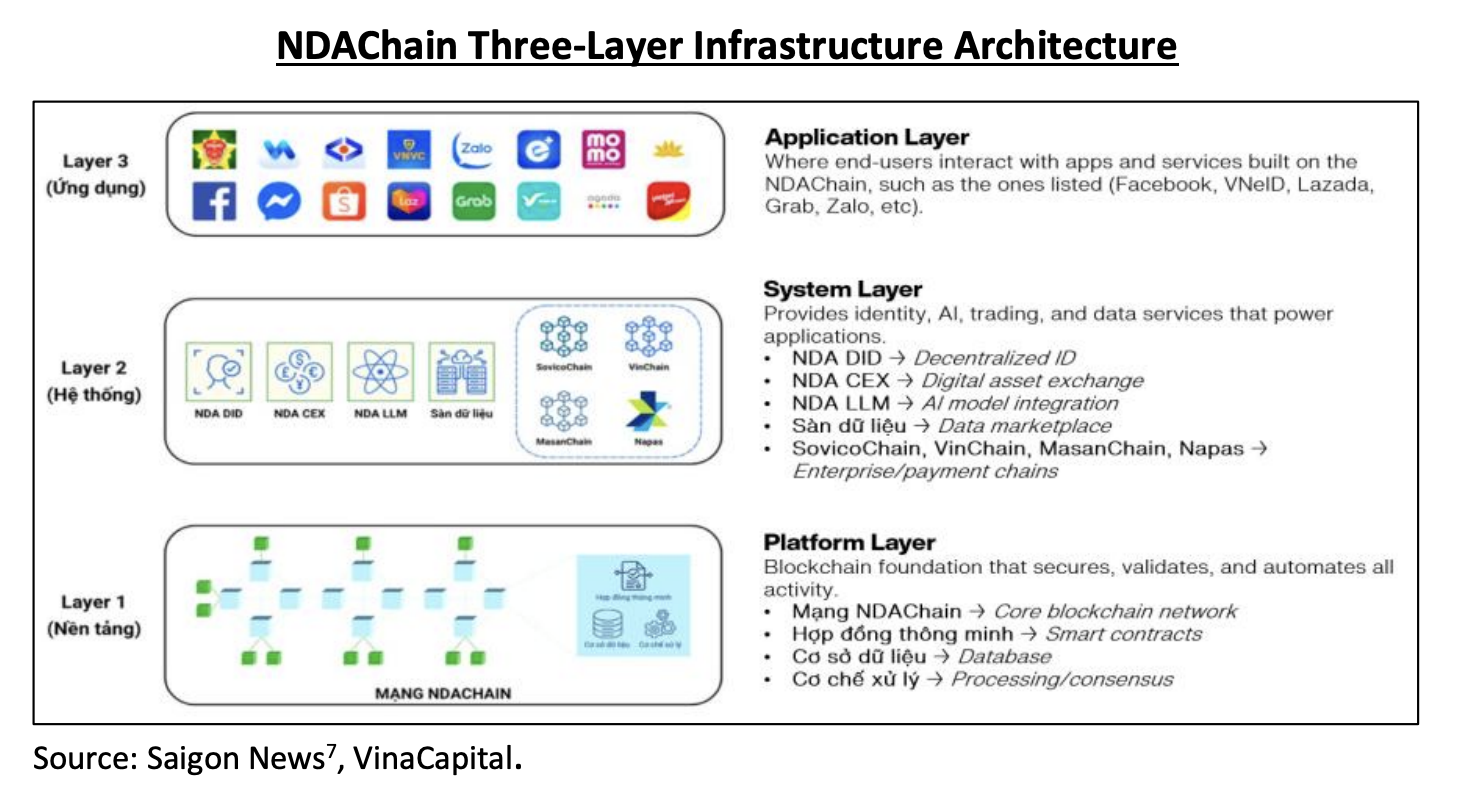
The National Data Association (NDA) started NDAChain in July 2025 as a permissioned blockchain for safe financial transactions, digital identities, and tokenized assets like bonds, commercial invoices, and carbon credits.
NDAChain is not just a place to trade cryptocurrencies, but it also provide the basic infrastructure for licensed exchanges to meet regulatory compliance and traceability needs.
The research “Shaping the Vietnamese Crypto Asset Market” by VinaCapital in September 2025 said that $100 billion in crypto trading volume goes through offshore platforms per year. Onshoring this business might bring in $2–3 billion in tax income each year and lower the risk of dealing with unregulated foreign exchanges.
Market Trends and the Future of User Migration
The change won’t happen all at once. Remitano thinks that at first, the market will be divided between permitted domestic platforms and offshore exchanges. Users can stay on overseas platforms until local ones have similar product ranges, fees, and liquidity. The requirement to settle in VND and the limit on foreign ownership to 49% could make it harder for businesses to get money quickly, especially those who deal across borders.
But domestic institutions have distinct benefits when it comes to following the rules, integrating local payments, and building trust with regulators. Military Commercial Joint Stock Bank is working with Dunamu (the company that runs Upbit), and Techcombank and VPBank have set up systems for tracking and storing assets. These agreements could speed up migration once the licenses are issued.
The pilot will only work if it is done well. OJK’s work in Indonesia indicates that strong capital requirements can make markets stable, but they can also slow down innovation if approvals take too long. Vietnam is on the FATF grey list, which makes it even more important to have effective AML/CTF controls in place for the country to be taken off the list.
In the region and around the world
Vietnam’s strategy is different from the more open ones in Singapore and Hong Kong, which focus on innovation with lower capital requirements but tight continuing oversight. It is more like Indonesia’s recent licensing system, which has stringent capital requirements to keep the economy stable and get tax money from a $100 billion market every year.
The idea fits with a global trend toward regulated crypto marketplaces onshore. The delayed stablecoin bill in South Korea, the debut of Japan’s JPYC, and the EU’s MiCA framework all show how hard it is to find a balance between innovation and control. Vietnam’s requirement that all transactions be in VND and that businesses be based in the country is similar to China’s focus on monetary sovereignty, but Hanoi is more open to private sector engagement than Beijing.
Conclusion
Vietnam’s decision to start regulating crypto exchanges in January 2026, with a minimum capital requirement of VND 10 trillion ($400 million), is a clear move away from illegal activities and toward regulated onshore marketplaces. The high threshold makes sure that the financial strength is strong, but it only lets well-capitalized domestic institutions enter early.
With 17 million people now trading crypto and $100 billion leaving the country each year, successful implementation may bring in billions in tax revenue, improve investor protection, and make Vietnam the regulated crypto hub in ASEAN.
In the next few months, execution will be put to the test: timely approvals, competent oversight, and competitive local platforms will decide whether consumers move to offshore exchanges or stay on them. Vietnam’s controlled approach is a unique paradigm for Southeast Asia’s growing use of cryptocurrencies. It puts stability ahead of quick liberalization. The conclusion will have an effect on not only Vietnam’s digital economy but also the larger regional discussion over how to balance innovation with government control.