Stay connected with BizTech Community—follow us on Instagram and Facebook for the latest news and reviews delivered straight to you.
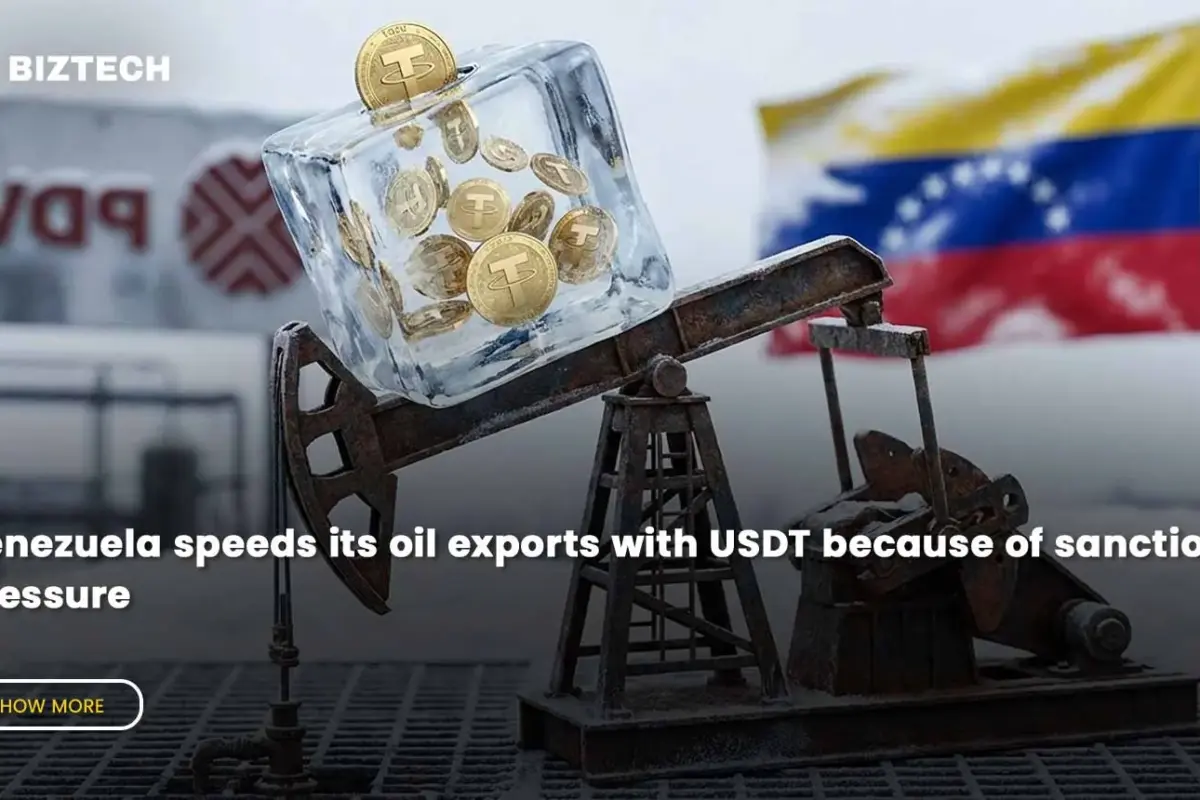
A thorough investigation by the Wall Street Journal published in late December 2025 found that Venezuela has secretly changed how it pays for oil exports by making Tether’s USDT stablecoin the main way to settle crude shipments. The change is one of the biggest uses of cryptocurrencies for commodity trade at the state level. It lets the sanctioned country keep its cash flow going even though it can’t use regular banks.
Analysts say that about 80% of the money Venezuela makes from selling crude oil is now in USDT. In early 2024, the national oil corporation PDVSA started demanding spot oil customers to pay in the dollar-pegged stablecoin. This slowly became the norm for most export contracts. The change has made transfers faster and more dependable, and it has also greatly reduced the risk of having assets frozen in foreign banks.
Read also: USDT surpasses Visa in transaction volume to reach $3.9 trillion in Q3
How USDT Became Venezuela’s Oil Payment Lifeline
In 2024, PDVSA began slowly switching to USDT payments since it was getting harder to route payments through traditional correspondent banking networks. The United States and its allies have put sanctions on Venezuela that have repeatedly frozen the country’s oil money in foreign accounts. This has caused cash-flow problems even when customers were eager to pay.
PDVSA gets around a lot of these traditional chokepoints by mandating USDT for spot transactions. Buyers send USDT straight to certain wallets, which lets them access dollar-equivalent value right away without having to go through banks. After you get the stablecoin, you can either trade it for bolivars at local exchanges or use it right away to buy things from other countries.
Asdrubal Oliveros, a local economist, called the technique a practical way to deal with being cut off from the rest of the world: “Venezuela has found a way to keep oil revenue coming in while lowering the risk of funds being frozen abroad.” USDT is faster and more reliable than traditional financial systems, which don’t work as well because of current sanctions.
The system has changed a lot since it could just receive payments. Venezuela has made it easier for USDT to be used in the country. Now, some banks and licensed exchanges can provide the stablecoin to enterprises in the private sector. Even though there are formal limits on the use of the dollar, this makes it easier for both international trade and currency exchange within the country.
A Bigger Look at Geopolitics and the Energy Market
Venezuela’s switch to USDT payments happens in the middle of a complicated situation with changing oil alliances and some easing of sanctions. In late 2025, there has been more talk about letting small amounts of Venezuelan crude back into the U.S. market through legal means. At the same time, the U.S. government has taken control of a number of tankers that are thought to be carrying oil outside of recognised channels.
In this uncertain context, the USDT mechanism gives Venezuela more operational freedom. Payments settle virtually right away, which lowers the chance of counterparty failure and gets rid of the multi-day delays that used to put funds at risk of being frozen. The method also lets PDVSA keep making money in dollars without having to rely on U.S. or European banks directly.
Venezuela is not the only country that uses this method. Several other places that are tightly restricted or have been sanctioned have looked into using bitcoin channels for international trade and energy exports. The pattern shows that people are looking for other ways to get money when traditional ones become hard to get.
What this means for the market and the law
The extensive use of USDT for oil transactions in Venezuela has gotten conflicting comments from people in the cryptocurrency industry. Supporters see it as strong proof of real-world usefulness, showing how stablecoins may play important economic roles even under difficult situations. However, others are worried about how it looks for a sanctioned state to rely significantly on a privately produced stablecoin for big commodity trade.
People have been looking into Tether’s reserve transparency and compliance standards for a long time. The company’s choice to handle significant oil-related transactions has raised additional doubts about how much it works with international sanctions regimes. Tether says it follows the law and has put in place strong screening measures, but it still doesn’t give full transaction-level disclosure.
From a regulatory point of view, Venezuela’s use case shows that stablecoins can be used for both good and bad purposes: they can help people get access to money and make cross-border transactions more efficient, but they can also be used to avoid sanctions and traditional control. This tension will probably have an effect on future global stablecoin rules, especially in places where they are trying to find a balance between new ideas and safety.
Impact on Venezuela’s economy
In the US, more people can now use USDT, which has had real effects. Private companies can now more readily do business in dollars, which helps bring in important items in an economy that is still dealing with hyperinflation and currency regulations. Many businesses now use the stablecoin as an alternative currency, even though it’s not officially recognised.
This change fits with Venezuela’s long-standing trend of dollarization, where U.S. dollars are already used in many private transactions even though bolivars are the official currency. USDT has digital benefits like mobility, divisibility, and resistance to physical confiscation that make it especially appealing in this situation.
What Comes Next
Venezuela’s adoption of USDT in its oil export payment system is one of the most important examples of how cryptocurrencies may be used in commodity trade at the state level. The deal gives short-term operational reprieve from sanctions pressure, but its long-term viability depends on a number of things:
- Tether and the big exchanges still putting up with it
- Changes in U.S. sanctions policy on Venezuelan energy
- Establishment of national regulatory frameworks for stablecoin utilisation
- More countries around the world are willing to accept stablecoin payments for energy transactions.
The story shows that digital currencies can work well in places where politics gets in the way, but they can also be quite complicated. Stablecoins are faster, more reliable, and easier to get than traditional finance right now because of sanctions. But using them by those who have been sanctioned makes it hard to enforce the rules, follow them, and find the right balance between humanitarian concerns and security goals.
As digital finance and global energy markets continue to cross paths, Venezuela’s experience will likely be an important example for other countries who are having the same problems. The experiment is still going on, but its effects will be seen far beyond Caracas.