Stay connected with BizTech Community—follow us on Instagram and Facebook for the latest news and reviews delivered straight to you.
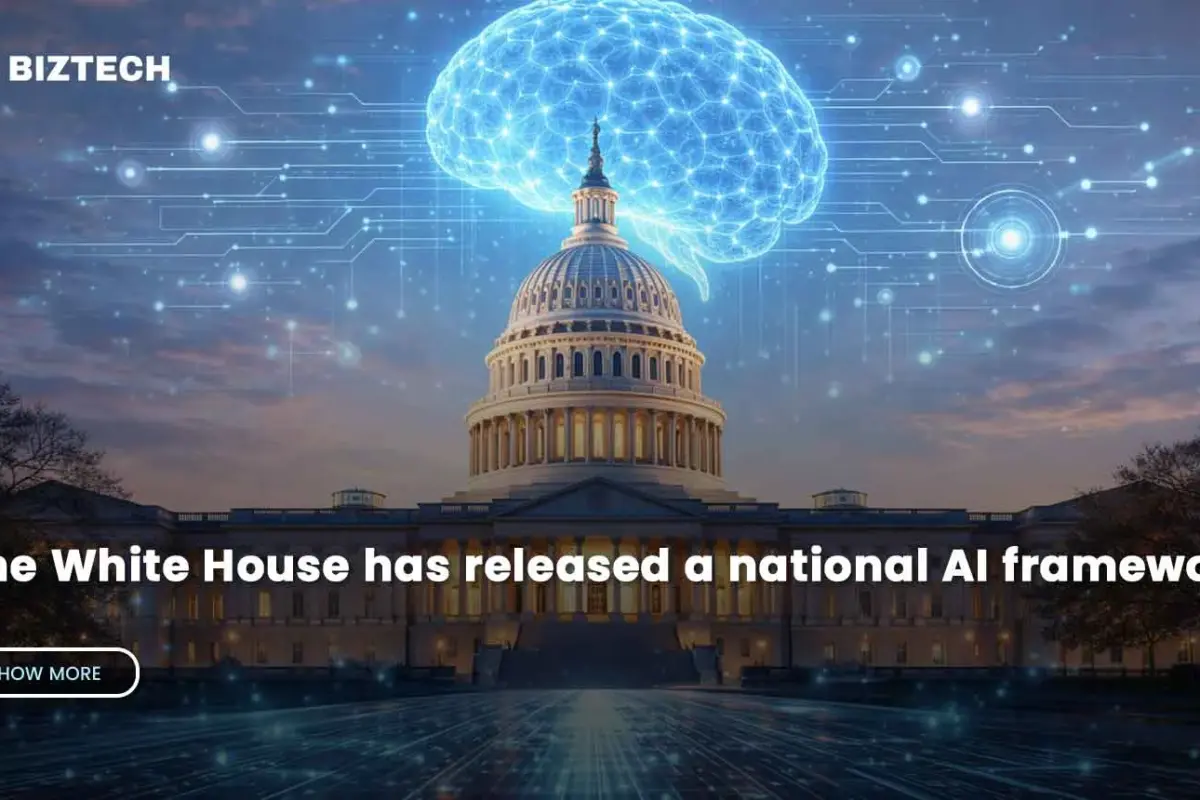
The Trump administration has put out a whole list of suggestions for laws about artificial intelligence. They want Congress to make a single, unified federal framework and make it clear that they don’t want a patchwork of state-level rules that don’t agree with each other. The document, which came out on March 21, 2026, lists six policy areas that are most important. It also shows that the government wants to take a light-handed approach to regulation in order to speed up innovation, defend basic American values, and keep the U.S. in the lead in the global AI race.
At its core, the framework says that having different standards in different states would make it harder for developers to follow the rules, slow down deployment, and eventually hurt America’s ability to compete with China and other countries that are using centralised, state-directed AI programmes. The plan makes it clear that “Congress should preempt state AI laws that impose undue burdens.” It frames preemption as necessary to sustain a national market for AI technologies.
The six main areas of attention are:
- Keeping kids safe and giving parents more power in the face of AI-generated content and deepfakes.
- Making communities stronger by using technology responsibly and stopping fraud.
- Protecting creators’ rights and intellectual property while letting courts settle continuing disagreements over training data.
- Protecting free expression and stopping the government from going too far in content moderation.
- Speeding up AI innovation by using regulatory sandboxes, giving more people access to federal datasets, and making it easier to get permits for data-center energy infrastructure.
- Getting the workforce ready for changes in the economy caused by AI through targeted training and education programmes.
There is no mention of a new AI regulating agency in the framework, which is a big deal. Instead, the government wants to use existing bodies and authorities, together with voluntary industry standards and cooperation between the public and private sectors. On the politically charged issue of whether AI can be trained on copyrighted material, the document takes a middle-ground stance. It says that current law probably allows this use, but it also recognises valid counterarguments and leaves the final decision to the courts instead of making new laws.
A lot of people are interested in energy policy. The framework calls for faster permitting for new data centres and encourages on-site power generation (including small modular reactors and natural gas). It also says that household consumers should not have to pay for the huge electricity needs of hyperscale AI technology. This shows that more and more people in Washington are realising that America’s AI goals are limited by the amount of energy we can produce at home.
More and more people are losing their jobs in crypto as AI use grows
The White House strategy focuses on developing the workforce and creating jobs in an AI-powered economy, but it doesn’t explicitly address the risk of job loss that is currently happening in many fields, including cryptocurrencies and blockchain.
In the last two months, more and more companies that are local to the crypto space have announced layoffs that are directly related to restructuring and automation powered by AI. In February 2026, Jack Dorsey’s Block announced plans to lay off almost 40% of its workers. Dorsey said that “rapid adoption of AI tools” was a major reason for the efficiency benefits that made the layoffs possible.
Messari, a blockchain analytics company, recently laid off more workers and changed its leadership as part of its shift to a “AI-first” business model. This week, Crypto.com did the same thing, with CEO Kris Marszalek warning on X that “companies that don’t make this change right away will fail.” The Algorand Foundation also stated that it will cut 25% of its staff, saying that both macroeconomic uncertainty and the need to make operations more efficient in a lower-growth environment were to blame.
These cuts aren’t just one-time things. They are part of a bigger trend: AI-powered solutions for data analysis, content moderation, customer assistance, trading algorithms, risk rating, and compliance monitoring are helping businesses do more work with fewer people. In the crypto business, which is used to boom-and-bust cycles, the combination of market consolidation and AI efficiency increases has sped up the process of cutting jobs.
The tendency makes things hard for an ecosystem that has long bragged about producing high-paying, future-proof jobs. AI may give us new tools (such real-time on-chain data, automated market making, and personalised DeFi interfaces), but it is also making many operational positions less important for people. The White House framework’s focus on training workers is appropriate, but it doesn’t say anything about how to help those people who have lost their jobs move into new AI-related jobs.
Finding a balance between new ideas, rules, and the effects on workers
The proposal from the government has a very lenient tone on purpose. It shows that they would rather move quickly than slowly by pushing for the repeal of restrictive state laws, more access to federal information, and regulatory sandboxes. The choice to let courts decide the copyright-training dispute instead of making a clear-cut ruling makes things even easier for model developers right now.
But the framework doesn’t say anything about a number of problems that are already producing problems in practice:
– What to do about AI taking jobs in fast-growing fields like crypto
– If AI-generated content should have to be clear or have a watermark on it
– The right role (if any) for government agencies in checking models that are high-risk
– Ways to stop a few hyperscalers from having too much computing power
These omissions are deliberate. The document is not a final plan for how to make the rules; it is just guidance for lawmakers. It gives Congress room to add details, or more likely, to have the kind of complicated, years-long negotiations that usually happen with big technological issues.
The framework is mostly good for the crypto business. A single federal strategy that overrules state regulations that make compliance more difficult would get rid of a big source of confusion. It would be easier to get permits for data centres faster, which would help with the computing bottlenecks that are currently holding up both AI model training and blockchain infrastructure. And the lack of a new AI super-regulator lowers the danger of strict control that may affect DeFi, stablecoins, and tokenized assets.
However, the workforce angle needs more consideration. For a long time, crypto has drawn talented people with the promise of quick cash and cutting-edge work. If AI automation speeds up job cuts in the sector, the industry will need to show that it can also make new, high-value jobs, especially in areas like AI-agent governance, on-chain analytics, decentralised computing marketplaces, and protocol security.
A Framework That Values Speed More Than Caution
The Trump administration’s national AI legislation framework is better seen as a starting point than a complete policy. It makes it apparent that the US wants to win the global AI race by moving quickly and gently. It does this by advocating for federal preemption, regulatory sandboxes, more access to data, and speedier energy permits, all while avoiding a new central AI regulator.
The proposal is mostly good for crypto. A unified federal approach would cut down on compliance fragmentation, and the focus on policies that encourage innovation fits with the industry’s need for clear laws for stablecoins, DeFi, and tokenized assets. The lack of discussion on job loss, however, leaves an unanswered question that the crypto business must answer itself: when AI changes how things are done and cuts jobs, can the industry show that it is still a net producer of opportunity?
In the next few months, we’ll see how seriously Congress takes the suggestions from the administration. With the midterm elections coming up in November 2026 and the political climate being so divided, any broad AI legislation is likely to be slow and controversial. In the meanwhile, the framework makes it plain what the U.S. government wants to do: it wants to be the leader in AI, and it plans to do this by reducing obstacles instead of putting up new ones.
The crypto ecosystem will only profit or suffer from that strategy if the details are filled in correctly and the industry quickly adapts to an AI-driven future that is already changing its own workforce and operations.
Read Also: Iran’s Threat to Google, Nvidia, and Other Big U.S. Tech Companies: What It Means for Crypto Markets