Stay connected with BizTech Community—follow us on Instagram and Facebook for the latest news and reviews delivered straight to you.
Dramatic fluctuations in Japan, one of the biggest economies in the world, startled the global financial markets once more toward the end of May 2025. Particularly for long-term tenors, the yield, that is, the return on Japanese government bonds, shifted significantly and reached values not seen in more than two decades.
Along with disturbing the conventional bond market, this rise affected the digital asset market, including Ethereum and Bitcoin. What is actually happening, and given this upheaval, what is the future of the crypto market? Let’s explore further.
Japanese Bond Yields: Unexpected Increase
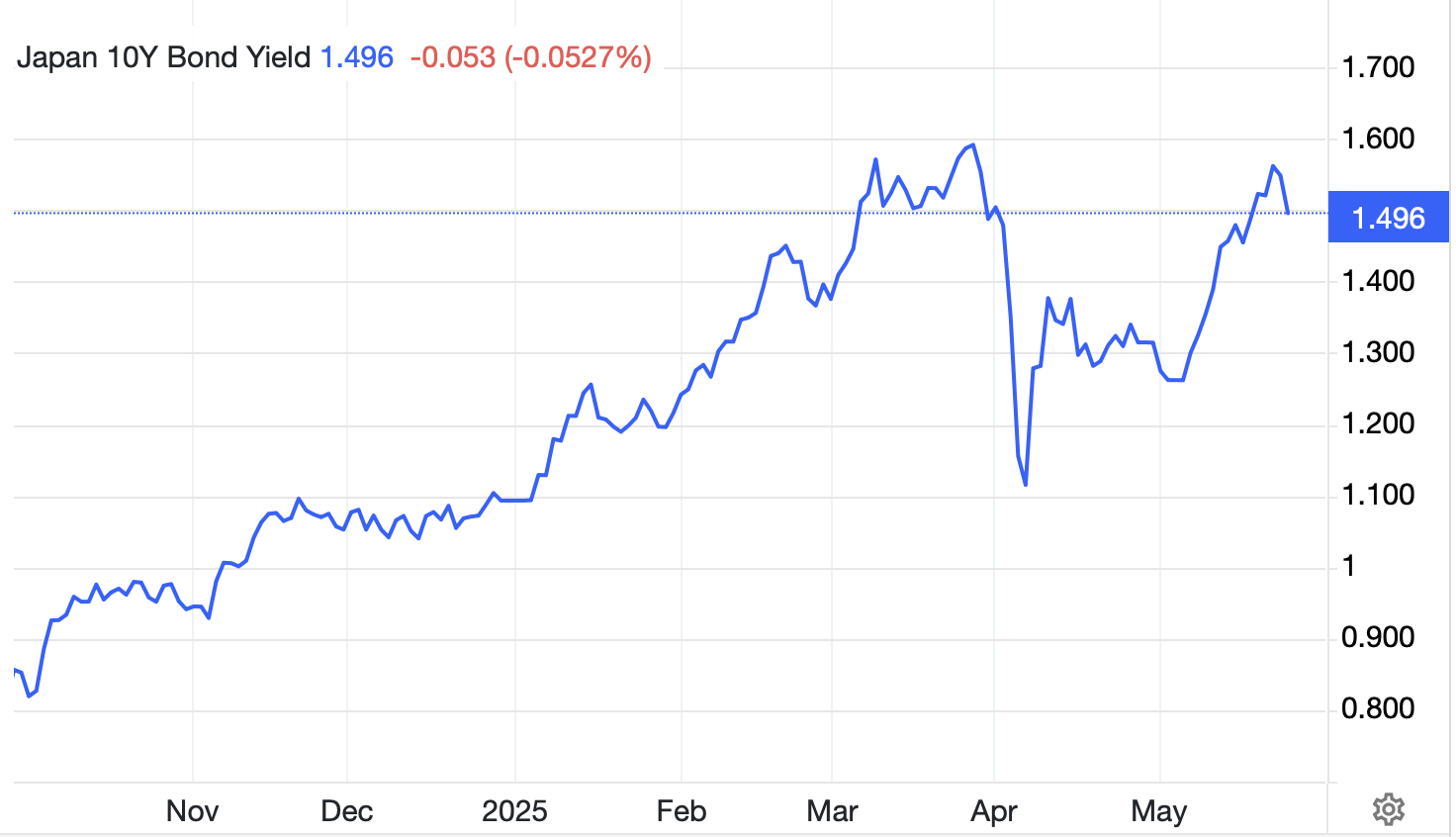
A Reuters story dated May 25, 2025, claims that the yield on 10-year Japanese government bonds (JGB) is currently hovering about 1.55% to 1.57%, a relatively high figure compared to the long-standing period of low interest rates that has defined Japan.
The longer-term bonds—20, 30, and even 40 years—yielding between 2.6% and 3.6% truly draw attention, though. These numbers are the highest since the early 2000s, when flip phones still enthralled people and the ideas of blockchain or NFTs were unknown.
This rise in yield is caused by the market’s expectations about changes in the Bank of Japan’s (BoJ) monetary policy. For years, the BoJ has maintained an ultra-low interest rate approach to support economic development.
However, the market is already considering a policy change in response to worldwide inflationary pressures and the recent yen strengthening.
Although the central bank’s public comments remain cautious, balancing preserving stability and reacting to global economic dynamics, Bloomberg revealed that investors are beginning to gamble on the Boj’s possible interest rate rise.
Why is bond yield important to watch?
Especially in nations like Japan, government bonds are regarded as among the safest securities available worldwide.
Bond yield is a benchmark for investors evaluating the returns on other investments since it shows the cost of government borrowing.
Bonds start to appeal more than hazardous investments like stocks or cryptocurrency as yields climb.
The safe choice suddenly becomes more appealing when one compares maintaining money in a high-interest savings account with playing in a casino.
Particularly with carry trading, the increase in yields also influences worldwide investment methods.
Investors have seized on low interest rates in Japan to borrow yen cheaply and then invest it in high-risk assets such as US tech companies or cryptocurrencies.
But as bond rates rise, borrowing in yen has become more expensive, and home Japanese bonds have grown more appealing. Consequently, the movement of money out of dangerous assets, including cryptocurrencies, has started to slow down.
Effects on the Crypto Market?
Famously erratic, the crypto market saw the effects right away. Foreign investors are mostly responsible for this pressure as they reposition their portfolios and begin to move money to Japanese bonds with better rates.
Furthermore, the dynamics are aggravated by the yen’s rise against the US dollar. For Japanese investors, assets valued in dollars, such as Bitcoin, get more costly when the yen increases.
This adds still another obstacle to the price increase of cryptocurrencies. An analyst from CryptoQuant observed that local investor interest has dropped as Bitcoin trading activity on Japanese exchanges dropped when bond yields started to climb.
Carry Trade and Capital Flow Shifts
For many years, carry trade has been a preferred tactic among world investors. By borrowing in cheap yen, investors can allocate money to higher-yielding assets—stocks in the S&P 500 index or cryptocurrencies—and allocate money to these assets.
Still, the rise in Japanese bond rates alters this computation. To help minimise losses resulting from rising borrowing rates, institutional investors, especially hedge funds, are beginning to reduce their exposure to high-risk assets.
The increase in domestic bond yields is like a call to their hometown for Japanese investors.
When home government bonds provide competitive rates with substantially less risk, why should one invest in risky assets overseas?
Consequently, the capital flow entering the crypto market is beginning to diminish, which generates extra selling pressure.
Policy of the Bank of Japan: between cautious and passive
Although the BoJ has not clearly stated the benchmark interest rate, comments from central bank officials indicate a small but notable change in their posture.
BoJ Governor Kazuo Ueda said in a press conference on May 20, 2025, that the central bank will keep tracking inflation statistics and the yen’s value without excluding future policy changes as conceivable.
This “passive but vigilant” posture is likely to encourage market speculation regarding the conclusion of the zero interest rate period.
Should the BoJ actually hike interest rates or let bond yields to keep climbing, demand on speculative assets like cryptocurrencies is probably going to grow.
Given Japan’s still very high public debt, several analysts—as mentioned by Nikkei Asia—argue that the BoJ will proceed carefully to prevent home economic shocks.
Possibilities amid Uncertainty
Not all news is negative even if the crypto market finds this environment difficult. Some participants in the market see possible increase.
Should the increase in Japanese bond rates cause turbulence in the world financial markets, Bitcoin might once more be shining as “digital gold.”
The crypto community on platform X supports this story since some users claim that global economic turmoil could motivate investors to hunt alternative assets outside the conventional banking system.
Furthermore displaying indications of resiliency is the bitcoin market. Supported by favorable attitudes toward looser US monetary policy, Bitcoin and Ethereum commenced trading with modest gains at the beginning of this week.
The steady global trading volume for key cryptocurrencies recorded by CoinMarketCap suggests that the market has not totally lost impetus.
What Should Noted Going Forward?
Investors in cryptocurrencies must keep an eye on several important elements going ahead.
First, one still finds great significance in the movement of the yen against the US dollar. Should the yen keep strengthening, the pressure on dollar-based denominated cryptocurrencies could remain.
Second, the major deciding factor will be BoJ policy. Changes in yield curve control (YCC) or government interest rates could speed the movement of money out of cryptocurrencies.
Not just in Japan but also outside of it are US changes worth observing.
According to the Wall Street Journal, the Federal Reserve is probably going to keep high interest rates until the end of 2025 in order to lower inflation, therefore stressing riskier assets. Crypto might, however, benefit if the US departs from projected monetary policy earlier than anticipated.