Stay connected with BizTech Community—follow us on Instagram and Facebook for the latest news and reviews delivered straight to you.
For decades, it sat largely dormant — a vast steel artery buried beneath the Saudi desert, built for a war that never quite came. Today, the East–West Crude Oil Pipeline, known as Petroline, has become the most consequential piece of energy infrastructure on the planet as the world scrambles to reroute oil flows away from the Strait of Hormuz, which is no longer safe to cross.
The disruption of Gulf shipping lanes has revived one of the oldest questions in global energy strategy: can the Red Sea serve as a meaningful alternative corridor for oil exports when Hormuz fails? The answer emerging from Riyadh, shipping terminals, and energy trading desks is carefully qualified — yes, partially, and for now. But the window is narrow, the risks are multiplying, and the limits of the workaround are already visible.
The Geography Of Last Resort
The Red Sea has always occupied a unique position in the architecture of global trade. Stretching roughly 2,250 kilometres from the Bab el-Mandeb strait in the south to the Suez Canal in the north, it handles between 12 and 15 per cent of total global trade volume. It serves as the primary artery connecting Asian manufacturing to European consumers. For energy markets specifically, it is the corridor through which Gulf crude reaches the Mediterranean and, by extension, Atlantic basin refiners.
Saudi Arabia’s geography makes it uniquely positioned to exploit this corridor. The Kingdom’s Red Sea coastline stretches approximately 1,800 kilometres — nearly three times the length of its Persian Gulf shoreline — providing multiple port facilities, including the major export terminals at Yanbu and Jeddah. That coastline diversity is not accidental. Saudi planners recognised decades ago that a kingdom whose economic survival depends on oil exports could not afford to be entirely dependent on a single maritime chokepoint.
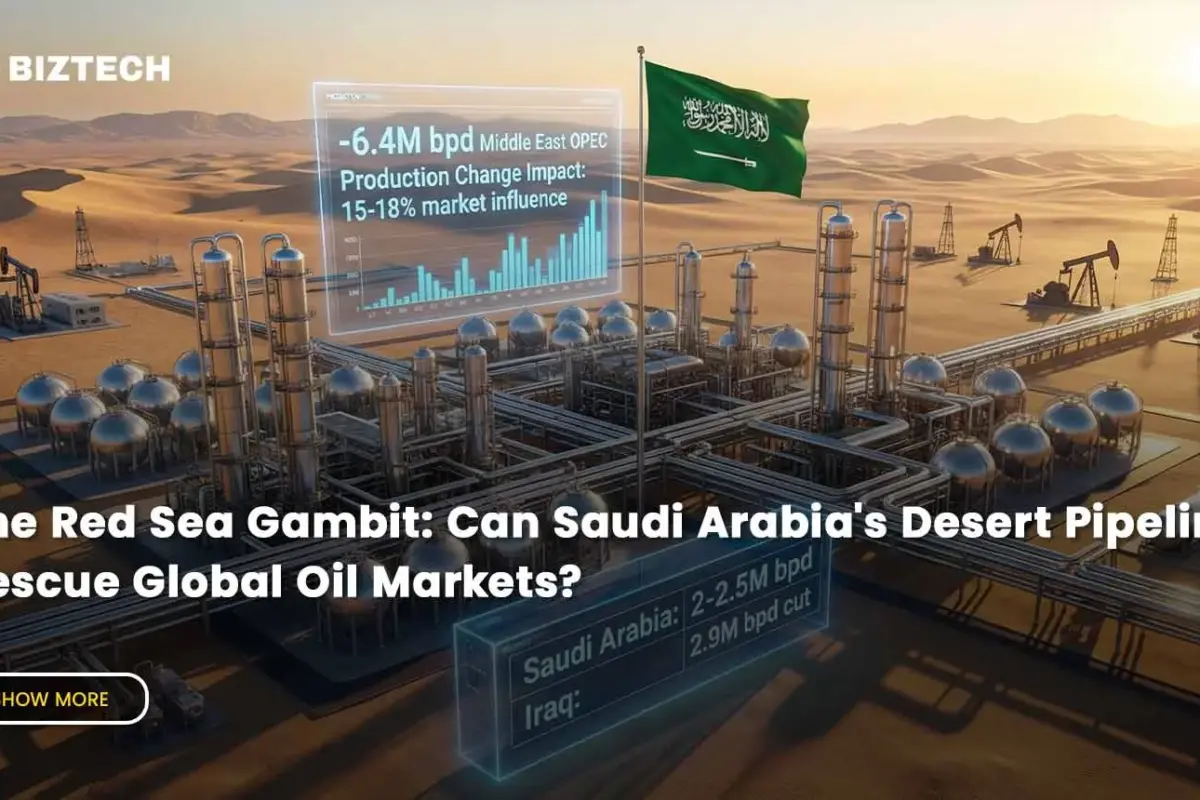
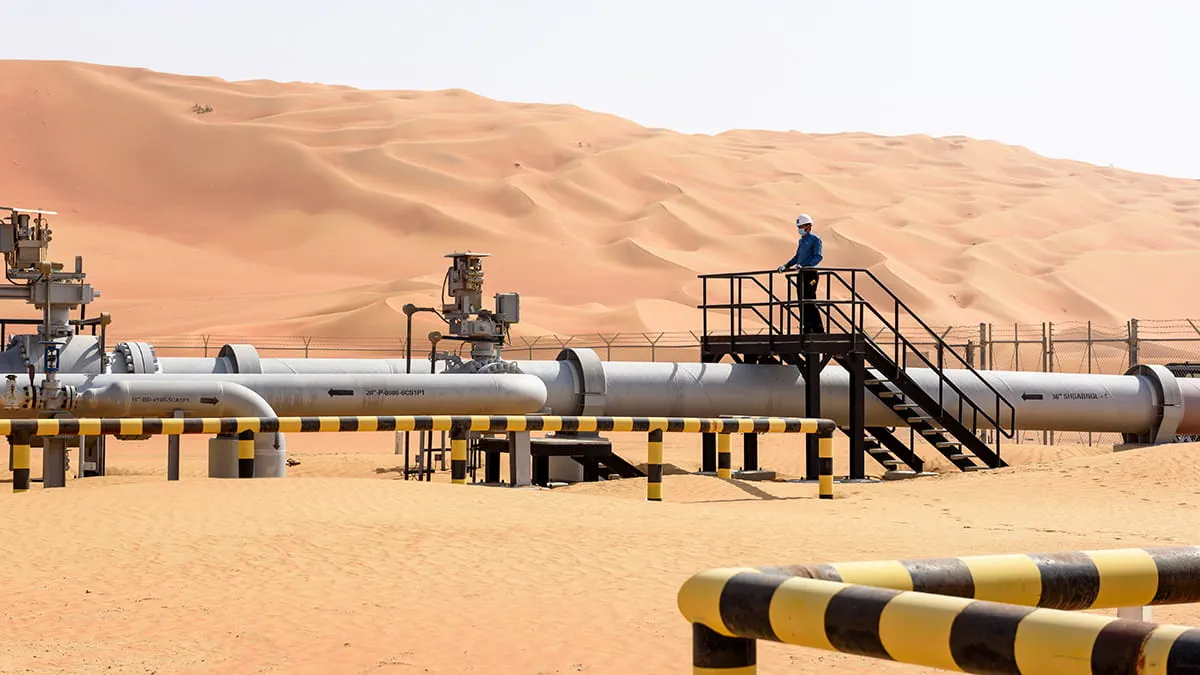
Petroline was the infrastructure answer to that vulnerability. Constructed in the 1980s partly in anticipation of Iranian threats during the Iran-Iraq War, the roughly 1,800-kilometre pipeline runs from the Eastern Province oil fields near Abqaiq and Ras Tanura westward across the Najd plateau to the Red Sea terminal at Yanbu. At full capacity, it can move approximately 7 million barrels per day — a figure that, until recently, existed largely on paper.
Aramco’s Emergency Pivot
That figure is now being tested in real time. Amin Nasser, chief executive of Saudi Aramco — the world’s largest oil producer by volume — has confirmed that the company is ramping Petroline utilisation toward its full 7 million barrel per day capacity, describing the timeline as a matter of days rather than weeks. The operational pivot represents one of the most significant emergency mobilisations in the history of global energy infrastructure.
The early data suggests the ramp-up is already underway. Exports from Yanbu have climbed to an estimated 2.2 to 2.5 million barrels per day in early March. Approximately 20 tankers have been reported queuing offshore at Yanbu, waiting to load Arab Light and Extra Light grades that would, under normal circumstances, have been loaded at Gulf terminals and transited Hormuz.
Some of those cargoes are moving further west. Egypt’s SUMED pipeline, which runs from Ain Sokhna on the Red Sea to Sidi Kerir on the Mediterranean, is absorbing a portion of the flow, allowing crude to reach European and Atlantic basin markets without passing through the Suez Canal’s constraints. Pakistan has also emerged as an early adopter, shifting import volumes to Yanbu-origin cargoes, with the Pakistan National Shipping Corporation recently loading approximately 73,000 tonnes aboard a single vessel — a concrete illustration of how importing nations are recalibrating supply chains in real time.
The United Arab Emirates adds a supplementary bypass through its Fujairah pipeline, which connects Abu Dhabi’s onshore fields to the east coast port of Fujairah, sidestepping Hormuz entirely. That pipeline carries between 1 and 1.8 million barrels per day at capacity. Combined with Saudi Petroline volumes, analysts estimate that available alternative routing capacity reaches somewhere between 3.5 and 5.5 million barrels per day — enough to meaningfully stabilise flows to key Asian and European consumers, if not to replace Hormuz outright.
The Limits Of The Bypass
The arithmetic of the workaround, however, is unforgiving. The Strait of Hormuz, at its peak, handles approximately 20 to 21 million barrels per day — roughly one-fifth of global oil consumption. Iran, Iraq, and Kuwait, which collectively account for a substantial share of those flows, have no comparable overland pipeline infrastructure. Their crude has no Red Sea exit. When Hormuz is disrupted, their exports are disrupted, and no amount of Saudi pipeline capacity changes that calculus.
The structural ceiling on alternative routing is therefore fixed well below Hormuz’s baseline throughput. Even in an optimistic scenario — Saudi Petroline running at full capacity, UAE Fujairah pipeline fully utilised, SUMED absorbing additional flow — the total bypass capacity falls several million barrels per day short of what Hormuz ordinarily moves. For a global oil market already tightened by years of underinvestment, that gap is not academic.
More immediately, the Red Sea route faces its own threat matrix. The Houthi movement in Yemen, which spent much of 2024 conducting drone and missile strikes against commercial shipping in the Red Sea and through the Bab el-Mandeb strait, has demonstrated capability and stated willingness to target vessels transiting the corridor. While Houthi operational tempo has fluctuated with the broader regional conflict, the group retains a substantial arsenal and has explicitly framed attacks on shipping as an extension of its support for Palestinian and Iranian-aligned causes. Any renewed Houthi campaign could effectively close the Red Sea to commercial traffic — transforming the backup route into a second front of disruption rather than a relief valve.
The Military Dimension
The strategic sensitivity of the Red Sea corridor has attracted a significant American military presence. Logistical Support Area Jenkins, a rapidly expanding U.S. Central Command logistics installation in the region, reflects Washington’s recognition that the energy corridor it is implicitly underwriting with its naval presence requires a physical security architecture to match. That presence, however, cuts both ways: American military facilities in the corridor represent potential targets in any broader escalation scenario, and their presence raises the political stakes of any attack on the corridor’s infrastructure.
Insurance markets have already registered the heightened risk environment. War risk premiums for vessels transiting both the Strait of Hormuz and the Red Sea have risen sharply, adding measurable costs to every barrel of oil that moves through either corridor. For price-sensitive importing nations — Pakistan, India, and smaller Southeast Asian economies — those premium increases are not negligible, effectively functioning as a hidden tax on energy security imposed by geopolitical instability.
The Strategic Verdict
In cold strategic terms, the Red Sea is not a substitute for the Strait of Hormuz. The scale differential is too large, the dependencies of non-Saudi producers too absolute, and the Red Sea’s own vulnerability to Houthi and Iranian action too real to treat the corridor as a reliable long-term alternative. Hormuz, for all its fragility, remains irreplaceable.
What the Red Sea corridor does offer is something more modest but genuinely important: a pressure valve capable of softening the immediate impact of Hormuz disruption, buying time for diplomatic and military efforts to stabilise the Persian Gulf, and preventing the kind of acute supply shock that could tip a stressed global economy into recession.
Saudi Arabia’s four-decade investment in Petroline — built for a crisis that seemed perpetually impending and perpetually deferred — has, in that limited sense, paid off. The pipeline is doing exactly what it was designed to do. Whether the Red Sea itself remains open long enough for that design to matter is the question that now sits at the centre of global energy security — and the answer depends less on infrastructure than on the decisions being made in Tehran, Washington, and Sanaa in the hours and days ahead.
Read Also: Revived US-China Trade Tensions Rattle Global Markets Amid Tariff Escalations