Stay connected with BizTech Community—follow us on Instagram and Facebook for the latest news and reviews delivered straight to you.
On March 19, 2026, the Federal Reserve made a move that many people expected but were nonetheless hesitant about: it kept the federal funds rate at the target range of 3.50% to 3.75%. The move came at a time when services prices were still rising, the job market was cooling but not collapsing, and there was new geopolitical concern because of the ongoing US-Israel-Iran war. In the near term, the result was predictably bad for risk assets, including Bitcoin. BTC fell more than 4% in the hours after the FOMC statement.
Jerome Powell, the head of the Federal Reserve, started his news conference after the meeting by talking about how strong the US economy is. People are still spending a lot of money, businesses are still investing, and overall growth is still being called “solid.” But he was just as emphatic about the sectors that were weak: the housing market is still having trouble because of high mortgage rates, and the job market is clearly slowing down. Inflation, on the other hand, is still above the 2% objective, and core measurements are proving to be more stubborn than many experts had thought.
Then Powell talked about the big problem that everyone was thinking about: the growing turmoil in the Middle East.
He stated, “It’s not clear what the effects of events in the Middle East will be on the US economy in the short term.” “Rising energy prices would make inflation go up, but it’s too soon to tell what effect this will have on the economy as a whole.”
That one remark nicely summed up the Fed’s current position: it is data-dependent, mindful of conflicts, and not ready to commit to either dramatic easing or fresh tightening. Powell’s comments and what he said after that made it quite clear that the Committee plans to stay in wait-and-see mode until there are clearer signs about inflation and the effects of geopolitical events.
The CME FedWatch Tool Says No Rate Change Is Coming Soon
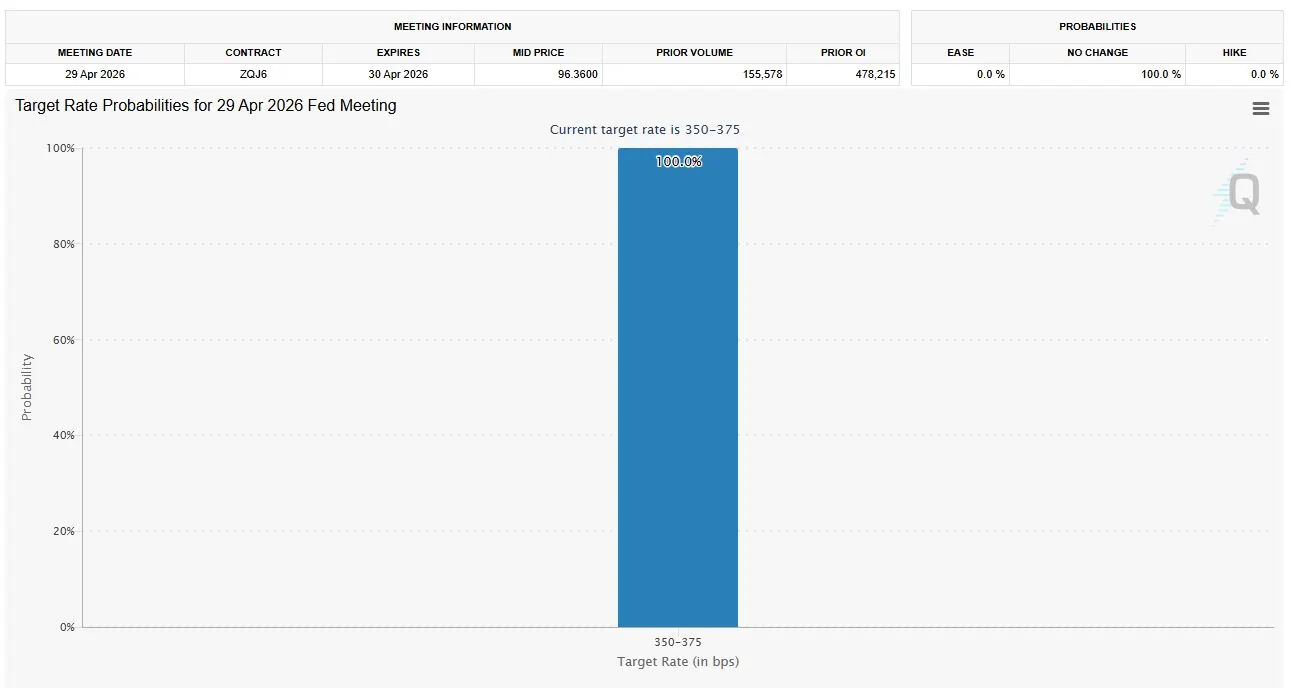
The Fed’s cautious tone was reflected in the market prices. The CME Group’s FedWatch Tool says that there is now almost 100% chance that rates will not change at the next few sessions. Traders have mostly ruled out any big cuts before the second half of 2026. This is a big change from earlier estimates, which had planned for several 25-basis-point cuts by the middle of the year.
The fresh geopolitical uncertainty and the sticky inflation statistics that came out earlier this week have pushed the market towards a higher-for-longer story. The Fed did drop rates three times in 2025, but the present delay shows that officials aren’t sure that the disinflationary process is strong enough to warrant more easing, especially since oil prices are sensitive to problems in the Middle East.
Bitcoin and other cryptocurrencies drop as risk appetite falls
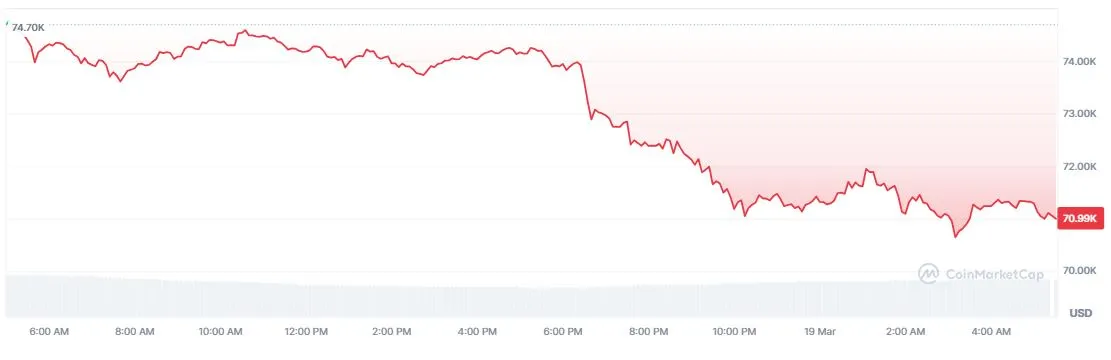
The news had an almost immediate effect on crypto prices. In the hours after the FOMC statement, Bitcoin plummeted more than 4%, going from the low $70,000s to briefly testing the mid-$67,000 level before finding some support. Ethereum and other large altcoins did the same thing, and the overall market capitalisation of all cryptocurrencies fell by about 4–5% in the same time frame.
The move wasn’t terrible by crypto standards—Bitcoin is still well above the important $60,000–$63,000 support cluster that has held up throughout past corrections—but it did show how sensitive the asset is to changes in the economy. Higher interest rates for longer make it more expensive to hold on to assets that don’t pay interest, like Bitcoin. On the other hand, geopolitical danger tends to push money towards traditional safe havens like gold, Treasuries, and the US currency instead than volatile cryptocurrencies.
In a market report that was out soon after the verdict, cryptoQuant analyst Darkfost pointed out the bigger picture:
“Historically, times when oil prices go back up often happen at the same time as BTC end-of-cycle phases.” Higher oil prices and tensions in the Strait of Hormuz could make people less willing to take risks and make it harder to predict the future of volatile assets like Bitcoin.
The analyst’s observation is based on what has happened in the past. Oil strength and geopolitical tension have often coincided with Bitcoin decline in its later stages, when risk-off flows take hold and liquidity tightens.
Geopolitical Overlay Makes Things Less Certain
The Fed’s choice wasn’t made in a vacuum. The war between the US, Israel, and Iran has gotten worse in the last few weeks, with bombings, missile exchanges in response, and threats to the region’s energy infrastructure. There have been no severe supply problems yet, but the risk premium built into oil prices has gone up a lot. That extra cost affects inflation expectations, which in turn affects the Fed’s calculations.
Powell’s statements about the Middle East were careful but revealing. He said that increasing energy costs would raise the headline inflation rate, but he also said that it is “too early” to judge the overall economic effect. The Fed is definitely keeping an eye out for secondary consequences, such firms having to pay more for inputs, consumers having less money to spend, and possible supply chain problems, while not making any quick policy changes.
The combination of higher rates for a longer time and geopolitical risk makes things hard for Bitcoin in particular. The asset hasn’t been able to regain its late-2025 momentum beyond $100,000, and people’s feelings about it are still shaky. The Crypto Fear & Greed Index is still in the “extreme fear” range, which shows that most retail investors are being careful.
Institutional Flows Bring Some Stability
Even though prices have been sluggish, institutional stance has stayed mostly favourable. Spot Bitcoin ETF flows have maintained net positive in the last several weeks, but not as quickly as they did during the late-2025 boom. Corporate treasuries keep growing instead of shrinking, and numerous big asset managers have openly confirmed their long-term belief that Bitcoin is a good way to diversify a portfolio.
These structural bids assist keep prices from going down too much, unlike in past bear cycles when panic selling made things worse. But they haven’t been enough to stop the overall bearish momentum, which is still being driven by macroeconomic problems and geopolitical concerns.
Levels of technical analysis and a look ahead to the near future
Bitcoin is now worth over $69,000, up from a low of about $65,725 over the weekend. The $60,000–$63,000 zone is still the most important support cluster, thanks to historical volume and the 200-week moving average. If the price breaks below that level, the technical view will definitely turn bearish, and the path to $55,000–$58,000 would certainly open up.
If the price goes back up to $70,000–$72,000, it would stop the immediate negative pressure and maybe even start short covering. If the price stays above $75,000, the bulls will have more momentum, and the chances of the price testing higher levels in the $80,000–$90,000 range will go up.
The short-term prognosis still depends on data and is vulnerable to geopolitics. Some important things to keep an eye on are:
- Any news about a large-scale release of G7 strategic oil reserves;
- Upcoming US economic releases (CPI, PPI, and employment numbers that were delayed because of the recent government shutdown);
- More news about the conflict in Iran, especially in the Strait of Hormuz;
- Fed speakers and FOMC minutes that might give more information about the “higher-for-longer” position.
Conclusion
It wasn’t surprising that the Fed kept rates the same, but the timing—during a time of increasing tensions in the Middle East—made the risk-off reaction across markets much stronger. Bitcoin’s plunge of more than 4% shows how sensitive the asset is to rising rates for a longer time and geopolitical instability. However, it is still above critical technical support.
Risky assets are having a hard time right now since inflation is high and the Fed can’t do much about it, and oil prices are unstable because of conflict. But the fact that ETF inflows are constant, companies are still buying, and the long-term technical structure is still in place shows that the market is digesting rather than giving up completely.
Traders need to be careful. The $60,000–$63,000 range has strong historical support, but if it breaks lower, it will be more likely to hit deeper targets. For the market to go up, there will probably need to be clearer macro tailwinds, such dovish signals from the Fed, less violence in the Middle East, or a new surge in ETF activity.
For the time being, volatility is likely to stay high. It’s likely that Bitcoin’s next big rise won’t be based on technicals alone, but on the effects of monetary policy, oil prices, and news from around the world. In this kind of situation, the best thing to do is still to manage risk carefully and choose your spots wisely.
Read Also: Iran’s Threat to Google, Nvidia, and Other Big U.S. Tech Companies: What It Means for Crypto Markets