Stay connected with BizTech Community—follow us on Instagram and Facebook for the latest news and reviews delivered straight to you.
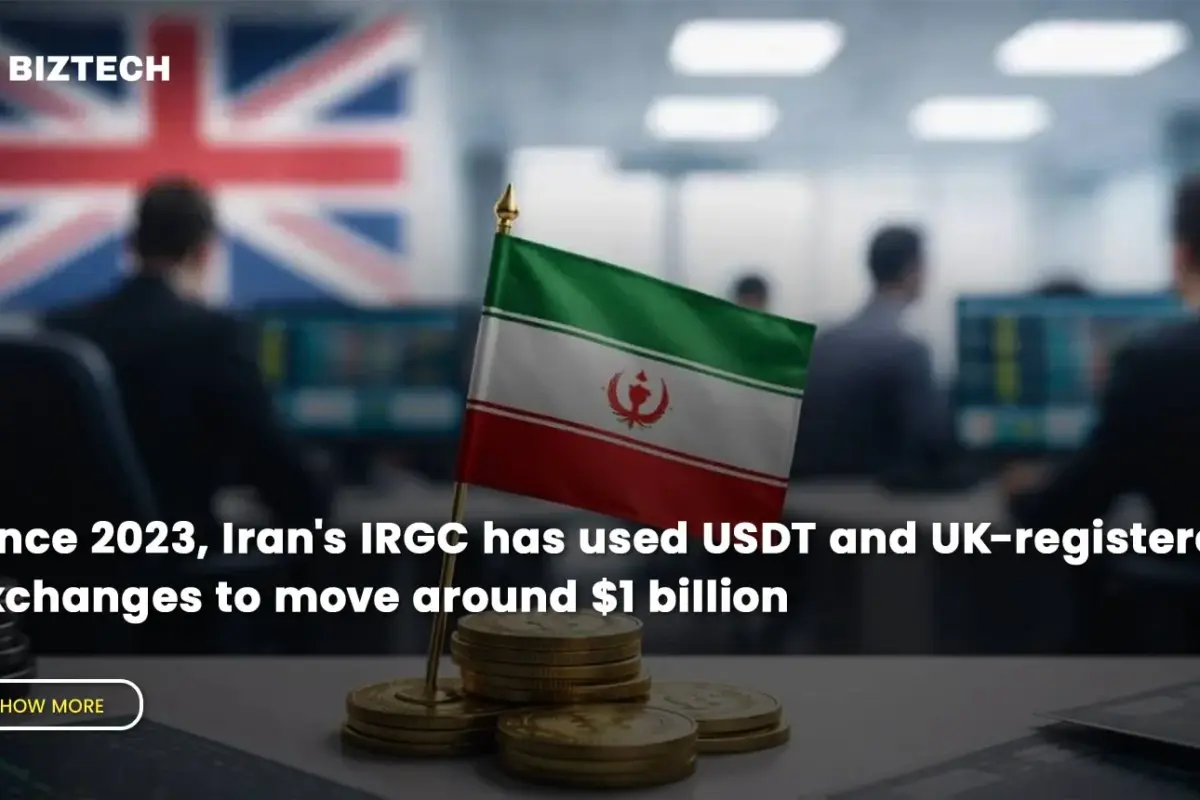
According to a report from blockchain intelligence firm TRM Labs on January 9, 2026, Iran’s Islamic Revolutionary Guard Corps (IRGC) has built a complex cryptocurrency infrastructure to get around international sanctions. Since 2023, they have moved almost $1 billion in digital assets through two UK-registered exchanges.
The results show that the transactions were planned and not just done when they were convenient. Zedcex Exchange Ltd and Zedxion Exchange Ltd, both legally registered in the UK, were the main points of contact in the network. On-chain analysis indicates that almost 56% of the total transaction volume handled by these platforms came from or was sent to addresses or companies associated to the IRGC.
Over the course of the period, the amount of transactions linked to the IRGC network grew a lot:
- 2023: around $23.7 million
- 2024: $619.1 million, which is a huge 26-fold rise
- 2025: $410.4 million (still a lot of activity, even though it went down from the previous year)
TRM Labs called the pattern “systematic and sustained,” which means that the IRGC has built a strong financial channel using stablecoins, notably Tether’s USDT on the Tron network, to keep money flowing and do business across borders even if banking is very limited.
Why USDT and Tron?
The decision to use Tron and USDT is strategic. Tron has very low transaction costs (typically less than $0.01) and can handle a lot of transactions at once, making it great for moving a lot of money cheaply. USDT is the most popular dollar-pegged stablecoin, with more than $170 billion in circulation. It is a reliable way to hold value and trade money that closely resembles the U.S. dollar without needing to use typical correspondent banking arrangements.
This combination lets sanctioned groups do the following:
- Get paid for oil, petrochemicals, or other goods they send out
- Pay suppliers and middlemen in several places
- Move money around inside Iran and to friendly groups in the region
- Stay away from SWIFT and other international payment systems that are watched
TRM Labs stressed that the infrastructure is not just for transactions but also for strategy: “The IRGC is not using crypto sporadically; it has built a financial architecture that supports ongoing operations at scale.”
Shells Registered in the UK and Ownership That Isn’t Clear
Both Zedcex and Zedxion have very small corporate footprints. Public data show virtual office locations and minimal operational transparency, which are typical signs of shell companies that are often utilised to get around penalties. Even though they are registered separately, on-chain flows show that they work together as one network.
The report says that both businesses are connected to Babak Morteza Zanjani, an Iranian financier who was previously punished by the U.S. and others for avoiding sanctions and laundering money through oil transactions. The unclear ownership and governance structure makes it possible to process massive amounts of data while protecting the people who will benefit from it.
Instead than being exchanges that people can use to buy and sell things, Zedcex and Zedxion are mostly places where stablecoins are processed. They take in, combine, and send money to wallets and services that are further down the line.
Connections Downstream and Integration in the Real World
Money that goes through the Zedcex-Zedxion network doesn’t just stay in crypto ecosystems. TRM Labs found that a lot of money was leaving Iran through domestic platforms including Nobitex, Wallex, and Aban Tether. These platforms tie blockchain activity to Iran’s real economy.
One major transaction sent more than $10 million to accounts linked to people that the U.S. has banned for helping the Houthi rebellion in Yemen. The whole process went through stablecoins, which meant that traditional banks weren’t involved at all.
The transaction graph shows that numerous digital payment providers and financial institutions are also involved in transactions in Turkey. This shows how stablecoin networks may be used in regular payment channels.
What This Means for Global Sanctions and Stablecoin Rules
The TRM Labs analysis shows that a bigger trend is happening: sanctioned nations and non-state players are seeing public blockchain networks, especially those that support low-cost, high-speed stablecoins, as important parts of the financial system. Tron’s dominance in this area is interesting since it has low costs and quick finality, which makes it great for sending a lot of money quickly.
People have looked at Tether’s role in avoiding sanctions many times. Even though the corporation has compliance systems and periodically publishes reserve attestations, the fact that sanctioned entities are still using the service on a significant scale continues to draw criticism. The IRGC case is another well-known example in this ongoing discussion.
Read also: Tether Reports Freezing $1.8 Million in USDT Tied to Drug Trafficking and Sanctions
Conclusion
It is already well known that Venezuela uses USDT a lot to sell oil. Iran’s analogous tactic shows that state players who are heavily sanctioned are coming up with similar solutions: stablecoins linked to the dollar on blockchains that are fast and cheap. This confluence makes it hard to think about how decentralised technology and geopolitical enforcement fit together.
The IRGC instance shows how profoundly stablecoins have become a part of real-world banking, even in places with the strictest international rules. By the end of 2025, the worldwide volume of stablecoins will have reached $310 billion.
The research is both a warning and a case study. It shows that although public blockchains make it easier than ever for people to interact financially, they also give sanctioned actors new ways to keep their economic lifelines open. Dealing with this tension will probably still be one of the most important regulatory problems in the next few years.