Stay connected with BizTech Community—follow us on Instagram and Facebook for the latest news and reviews delivered straight to you.
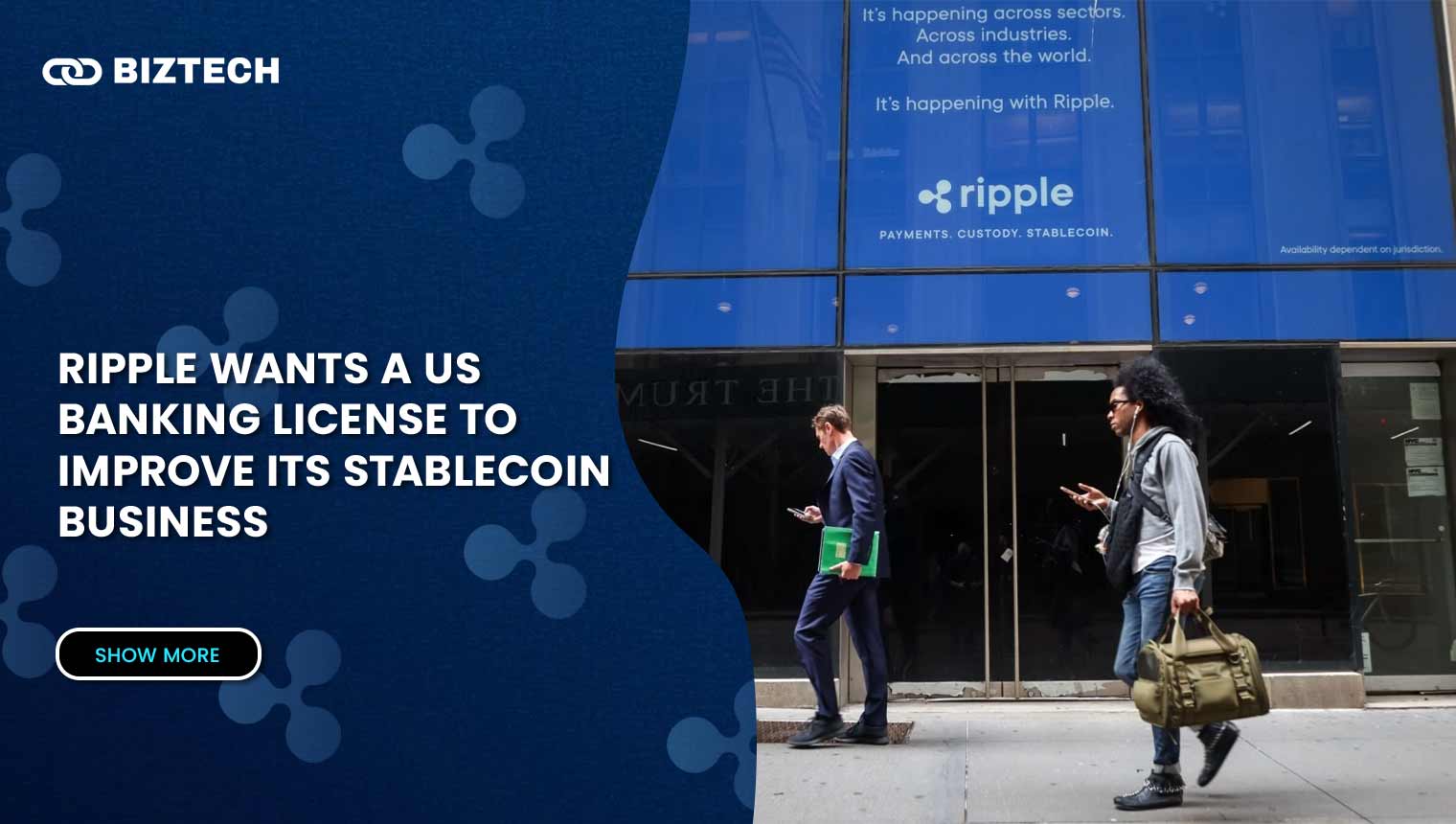
Ripple Labs has made a big move toward combining bitcoin with traditional finance by asking the U.S. Office of the Comptroller of the Currency (OCC) for a national banking license.
On July 2, 2025, CEO Brad Garlinghouse announced the move on X. It comes after Circle, the company that issues USDC, made a similar application.
It also follows the recent enactment of the GENIUS Act, which regulates stablecoin issuers. Ripple wants the federal government to keep an eye on its Ripple USD (RLUSD) stablecoin to make it more trustworthy and give it a stronger place in the changing digital asset market.
A Push for Legitimate Regulation
Ripple’s request for a national bank charter shows that it is serious about following the rules. This builds on the fact that the New York Department of Financial Services (NYDFS) already oversees RLUSD.
Garlinghouse said that the OCC charter will create “a new benchmark for trust in the stablecoin market,” putting Ripple under the watch of both the federal and state governments. The U.S. Senate enacted the GENIUS Act in May 2025, which says that larger stablecoin issuers must be watched by the OCC. This step comes after that.
The choice comes after Circle asked for a national trust bank charter on June 30, 2025, to manage USDC reserves.
Both businesses are responding to the rising need for clear rules in the cryptocurrency space, especially for stablecoins that are tied to the U.S. dollar. Ripple’s RLUSD, which has a market valuation of about $470 million, wants to compete with top coins like Tether (USDT) and USDC by following new federal rules.
Application for a Federal Reserve Master Account
Ripple has also applied for a Federal Reserve Master Account through Standard Custody & Trust Company, which it bought in February 2024. This is in addition to its OCC charter.
Ripple could keep RLUSD reserves directly with the Federal Reserve through this account. This would make things safer and less dependent on third-party intermediaries.
Garlinghouse said that this access will “future proof trust in RLUSD,” giving it an edge over other stablecoins. Ripple wants to make its operations easier and attract institutional investors looking for safe, compliant stablecoin solutions by getting direct access to the U.S. central banking system.
Market Response: XRP Is Gaining Ground

According to CoinGecko data, the news led to a good market reaction, with XRP, the native coin of the XRP Ledger, increasing 4,7% to $2.29 within 24 hours. The amount of trading rose by 38% to $3.65 billion, and the open interest in XRP futures rose by 8% to $4.5 billion, showing that investors were more interested.
The token reached its highest point of $2.27 not long after Garlinghouse’s post, then stayed stable. Analysts say that XRP is testing a resistance level between $2.35 and $2.60. If things stay good with the regulations, it could go up even more.
The GENIUS Act and the Business World
The House of Representatives is now looking at the GENIUS Act, which sets rules for stablecoin issuers. These rules include having fully backed reserves and federal oversight.
Ripple is actively seeking an OCC charter, which puts it in a good position to meet these requirements. This might create a precedent for other crypto companies.
Garlinghouse pointed to the change in the regulatory environment, saying that “Congress is working towards clear rules, and banks are leaning in.” This is a big change from the past, when laws were more rigid and were commonly called “Operation Chokepoint 2.0.”
Ripple’s move is similar to Circle’s, but Anchorage Digital is still the only crypto company with an OCC charter, which it got in 2021. These events are getting a lot of attention from the sector because government banking licenses might help crypto and traditional finance work together, which would lead to further institutional adoption.
Strategic Challenges and Implications
Ripple wants to get a banking license so it can offer more than just stablecoins. It wants to use the XRP Ledger for rapid cross-border payments and enhanced custody services.
Jack McDonald, Ripple’s Senior Vice President of Stablecoins, said that having both the OCC and NYDFS watch over RLUSD would make it more open and compliant, which might make it eligible for FDIC insurance.
This might make RLUSD the top alternative for banks and other financial organizations.
But getting the OCC charter and Federal Reserve account requires a lot of work to check Ripple’s finances and compliance rules, which might take months.
Even with these problems, getting clearance would let Ripple work smoothly across state lines, which would make it more credible and efficient.
Conclusion
Ripple’s apps are a big deal for the crypto business because they show that it is moving toward more integration with traditional finance. The OCC is looking over Ripple’s charter, and the GENIUS Act is moving forward.
Ripple’s work could change the stablecoin market and make XRP more popular. Ripple is establishing itself as a leader in the confluence of blockchain and banking as regulatory clarity approaches. This could set a new standard for trust and innovation in the digital asset market.