Stay connected with BizTech Community—follow us on Instagram and Facebook for the latest news and reviews delivered straight to you.
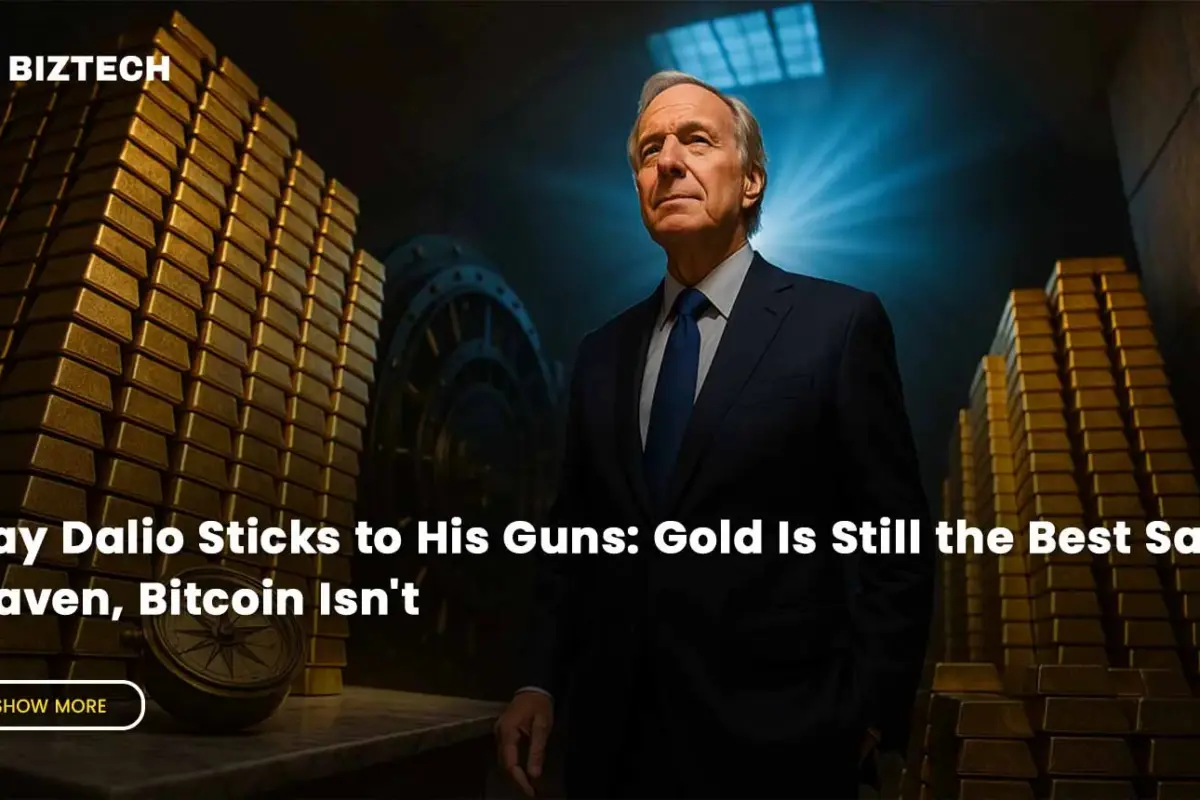
Ray Dalio, a billionaire investor and founder of Bridgewater Associates, had a clear message for the cryptocurrency community when he spoke on the All-In Podcast recently: “There is only one gold” when it comes to safe-haven assets during times of global war and monetary turmoil.

Dalio’s comments, which were made on March 3, 2026, come at a time when the economy is unstable and Bitcoin isn’t doing well, but actual gold is still on a bull run that has lasted for years. The famous hedge fund manager said that Bitcoin can’t be a reliable long-term store of value or digital equivalent to gold because of central bank preferences, privacy issues, quantum computing risks, and its constant connection to tech stocks.
The main point of Dalio’s thesis is that central banks decide what counts as real money and reserve assets. He stressed that gold is the second most important reserve asset that central banks around the world hold, after U.S. Treasuries, and has been for hundreds of years.
Dalio added, “Gold is not a precious metal that people guess about.” “It is the most well-known money.”
He compared this to Bitcoin and asked why any central bank would keep reserves in the cryptocurrency for a long time. Dalio said that central banks put more value on assets that are acknowledged by everyone, are politically neutral, and have been demonstrated to work in many economic systems. Even if Bitcoin has a finite supply and is decentralised, it doesn’t have the institutional support and long history that gold does.
Dalio has said before that Bitcoin has “hard money” qualities, such as a limited quantity and a set schedule for issuing new coins. However, he still thinks these qualities are not enough on their own. He thinks that for something to be a real safe haven, it needs to be widely accepted by sovereign institutions, not only by those who want to buy it or trade it.
Privacy and quantum risks are still big worries
Dalio also talked about two long-term problems with Bitcoin: privacy and quantum vulnerability.
He said, “Any transaction can be watched,” and he pointed out that Bitcoin’s public record lets everyone see all the transfers between addresses. There are tools that can help protect your privacy, but the base protocol doesn’t offer any default anonymity, which makes it less appealing to users who value privacy.
Dalio repeated a worry that has been going around in technical circles for years when he talked about quantum computing. Quantum technology could someday make elliptic curve cryptography (ECDSA), the signature mechanism that Bitcoin uses to keep transactions safe, less secure. People in the Bitcoin community are talking about post-quantum cryptography enhancements, but there is still no agreement on how to do it at the protocol level.
Dalio said that these weaknesses make Bitcoin less reliable as a long-term reserve asset than gold, which doesn’t face the same kind of existential technological danger.
Bitcoin Acts Like a Tech Stock
Dalio said something that has been true for a long time: Bitcoin is quite similar to technology stocks, especially when the market is stressed. Bitcoin usually moves in the same direction as growth-sensitive assets when they are under pressure, as when rates go up, liquidity tightens, or people stop taking risks.
He said, “So, from an ownership point of view, supply and demand can change if someone is squeezed in one area and has to sell something else they own.”
This link has become very clear in the last few months. Bitcoin’s price has dropped more than 45% since it reached a high of almost $126,000 in October 2025. It is now worth about $68,420. Gold has gone up more than 30% to $5,120 per ounce during the same time, separating itself sharply from crypto and supporting Dalio’s opinion that the two assets serve quite distinct purposes.
15% of your portfolio should go to gold or bitcoin?
Dalio suggested putting 15% of your portfolio into either gold or Bitcoin in July 2025 as a method to get the best return on risk in a time of high sovereign debt and currency debasement. Both assets were going up at the same time. But since then, their trajectories have changed a lot.
The decoupling has simply made Dalio more sure that gold is still the best way to keep your buying power during times of monetary turmoil. He still thinks Bitcoin is a good speculative asset and a way to diversify a portfolio, but he doesn’t think it can replace gold in the “all-weather” framework that Bridgewater made famous.
The World Order Is Broken: A Bigger Macro Message
Dalio’s most recent comments fit into a bigger story he has been telling for a few years: the global order that came after World War II, with the US in charge and the dollar as its base, is falling apart. As geopolitical tensions rise, debt levels become unsustainable, and trust in fiat systems falls, traditional safe havens become more vital than ever.
Dalio told investors last month that the “world order” had broken down and that protecting wealth today means thinking about how to spread out your assets. He thinks that gold is still the best way to protect against currency devaluation and systemic instability. Bitcoin is new and exciting, but it doesn’t yet have the same level of confidence and use by institutions.
What this means for crypto investors
Just because Dalio is doubtful doesn’t imply Bitcoin shouldn’t be in portfolios. He is willing to put up to 15% of his money into either gold or Bitcoin, which shows that he thinks the cryptocurrency could help protect against inflation and add variety to his portfolio. But the fact that he prefers gold to Bitcoin shows a critical point: institutional trust still strongly favours assets with a long history and wide support by governments.
For people who believe in Bitcoin, the hard part is still showing that decentralised digital scarcity can one day be as credible as gold in institutions. Dalio’s opinion will probably be popular among traditional investors until central banks start putting a lot of money into BTC or until Bitcoin shows that it is less connected to risk assets.
For now, the difference between gold’s long-term rise and Bitcoin’s short-term drop is a real-time example of two different stories about scarcity and safe-haven status. It’s apparent what Dalio thinks: when people stop trusting currency systems, gold is the only thing that matters.
Read Also: Bitcoin Drops to $63K as U.S.-Israel Strikes on Iran Shake Risk Markets