Stay connected with BizTech Community—follow us on Instagram and Facebook for the latest news and reviews delivered straight to you.
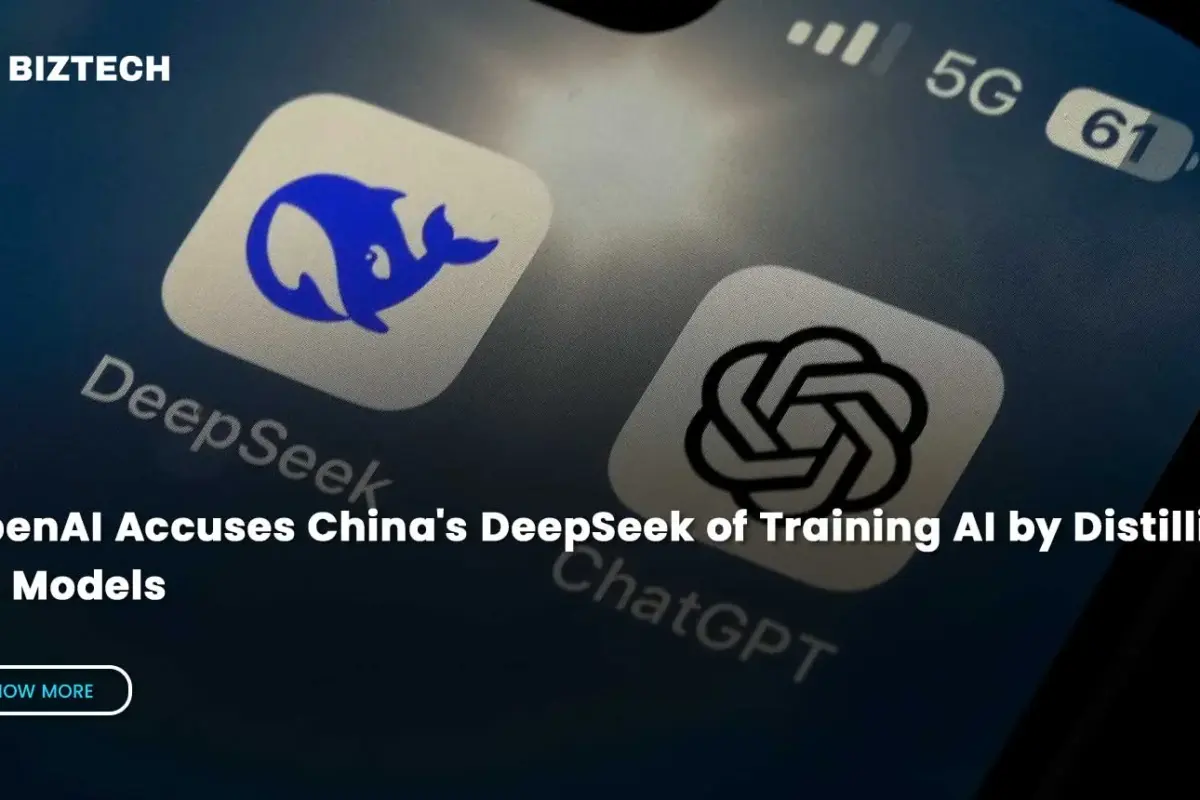
OpenAI has told US lawmakers that a Chinese artificial intelligence company may have trained its models using techniques derived from American systems, according to a memo seen by Reuters.

The internal document, circulated among staff in January, alleges that Hangzhou-based DeepSeek used a process known as “distillation” to improve its R1 model. Distillation allows a new system to learn from an existing model’s outputs rather than its original training data, potentially enabling developers to replicate capabilities without direct access to proprietary technology.
OpenAI’s concerns come amid intensifying competition between the United States and China over advanced AI systems, as Washington tightens export controls on high-end semiconductors used to train powerful models.
DeepSeek has denied the claims. In a statement to Reuters, a company spokesperson said its progress was based on independent research and domestic hardware, adding that it operated through “open collaboration”.
What is distillation?
In artificial intelligence, distillation involves transferring knowledge from a large “teacher” model to a smaller “student” model. By analysing the teacher’s outputs, the student can approximate their performance in a more compact or efficient way.
While the method is widely used within companies to streamline systems, questions arise when outputs from proprietary models are used externally without permission. Critics argue that it can blur the boundary between legitimate innovation and unauthorised imitation.
DeepSeek’s R1 model, released in May 2025, gained attention for topping several open-source benchmarks. On the LMSYS Chatbot Arena, it reportedly achieved a leading Elo score, outperforming many Western-developed models.
OpenAI’s memo suggests that such rapid gains could have involved learning indirectly from advanced US systems, including its own latest models.
Export controls and strategic rivalry
The dispute highlights the broader geopolitical context of AI development. The US government has restricted exports of advanced chips — including those made by Nvidia — to China, citing national security concerns and the potential military use of AI.
However, techniques such as distillation may allow developers to replicate advanced capabilities without directly importing restricted hardware or source code, complicating enforcement efforts.
Members of Congress, including lawmakers on the House Select Committee on China, are reviewing the issue as part of ongoing investigations into technology transfer. Some have called for stronger safeguards to protect American intellectual property.
OpenAI’s memo reportedly proposes measures such as embedding watermarks in model outputs and pursuing international agreements on AI governance.
Industry-wide tensions
The accusation arises amid a period of rapid model releases on both sides of the Pacific. US firms have introduced increasingly capable systems focused on multimodal reasoning and enterprise applications, while Chinese companies — including DeepSeek and Alibaba’s Qwen — have narrowed performance gaps, often emphasising cost efficiency and open-source access.

Analysts say distillation occupies a legal and ethical grey area. Dr Elena Rodriguez, an AI policy specialist at Stanford University, told Reuters that the technique “accelerates progress but raises difficult questions about where innovation ends, and imitation begins”.
Beyond intellectual property, the dispute also involves environmental and economic issues. Training large AI systems demands significant energy, and while distillation can cut computational costs, it does not stop the increasing electricity demand linked to AI growth.
Market response
Financial markets responded cautiously to the reports. Nvidia’s shares fell slightly amid renewed discussions of chip export controls, though wider technology indices remained mostly stable.
As the global AI race accelerates, the episode highlights the challenge for policymakers: how to protect domestic innovation while managing a field characterised by rapid development, international research, and intense commercial competition.
Whether clearer international rules can emerge in such a competitive environment remains uncertain. For now, the controversy illustrates how technological advancement and geopolitical tension are becoming increasingly intertwined.
Read Also: China Records Sharp Rise in Number of Generative AI Users