Stay connected with BizTech Community—follow us on Instagram and Facebook for the latest news and reviews delivered straight to you.
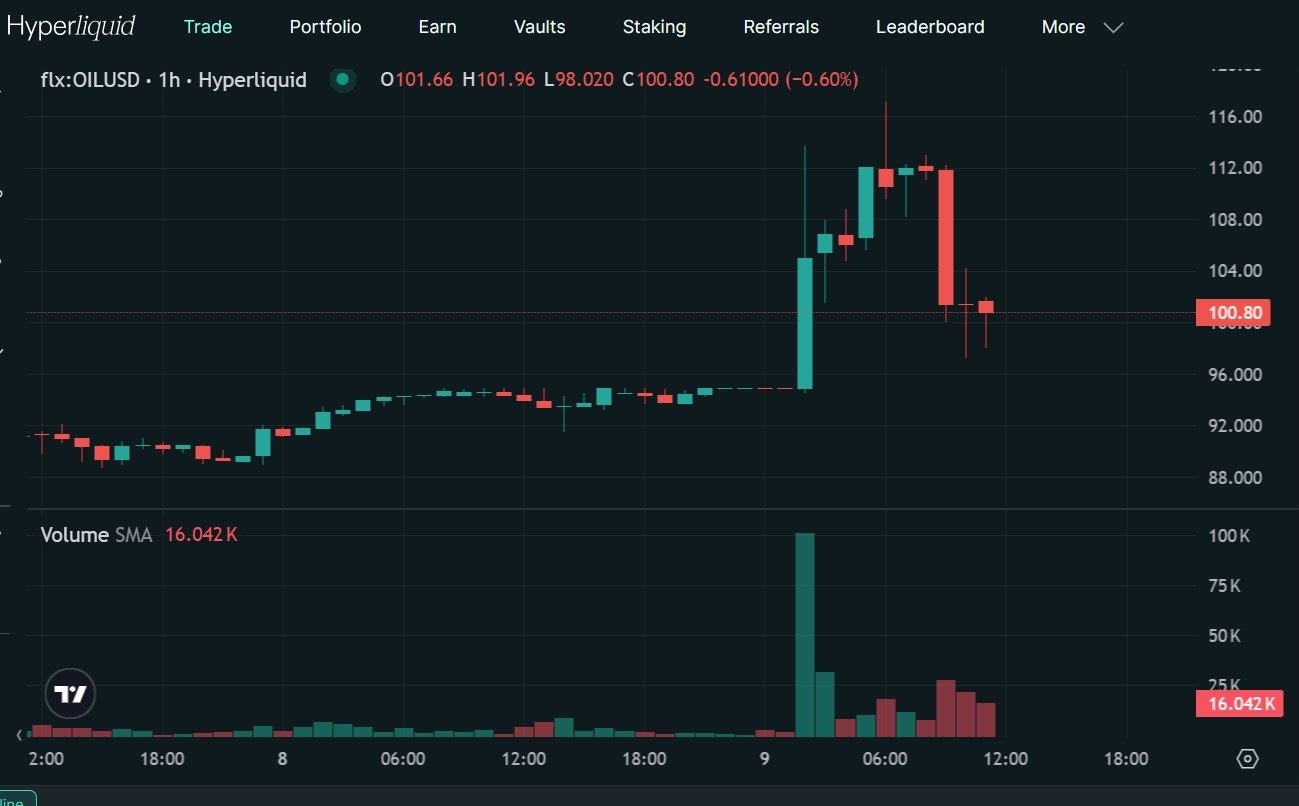
Early on Monday, March 9, 2026, oil prices fell drastically from a 25% rise over the weekend that briefly brought futures above $117 per barrel.
The Financial Times said that G7 finance ministers were going to have an emergency call to talk about releasing 300 to 400 million barrels from strategic petroleum reserves all at once. This could be a way to calm the markets after the new rise in the U.S.-Israel-Iran dispute.
The news made some sell their energy contracts right away to make money. On Hyperliquid, crude oil perpetuals fell about 14.5% from their overnight high to about $100.
This shows that traders immediately changed their minds about the chances of a large-scale supply intervention.
The battle is still a threat to production and transportation routes through the Strait of Hormuz, but the possibility of a big reserve drain has reduced short-term worries about a long-term supply shock.
Bitcoin, which had dropped to about $65,725 during the height of the oil-driven risk-off move, quickly bounced back.
According to CoinGecko data, BTC was trading around $69,472 by mid-morning Monday, which is about 3.45% higher than its low over the weekend. The bounce shows that the crypto markets are starting to separate from the initial fear, but they are still quite volatile.
Geopolitical Catalyst Meets the Way the Market Works on the Weekend
The U.S.-Israel airstrikes on Iranian targets over the weekend of February 21–22 shocked risk assets at first. Cryptocurrency became the main way to show how people felt about geopolitical risk when traditional financial markets were closed. Bitcoin’s quick drop below $66,000 was similar to the larger drop in equities futures and commodity-linked securities.
But the quick drop in oil prices on Monday morning gave people some breathing room. If the G7 all agreed to release reserves on the proposed scale, it would be one of the biggest strategic drawdowns in history. This may make up for a lot of any problems with Iranian supply. Even if no final decision has been made, the fact that there is a conversation has changed traders’ minds from thinking about the worst-case supply situations to thinking about policy responses.
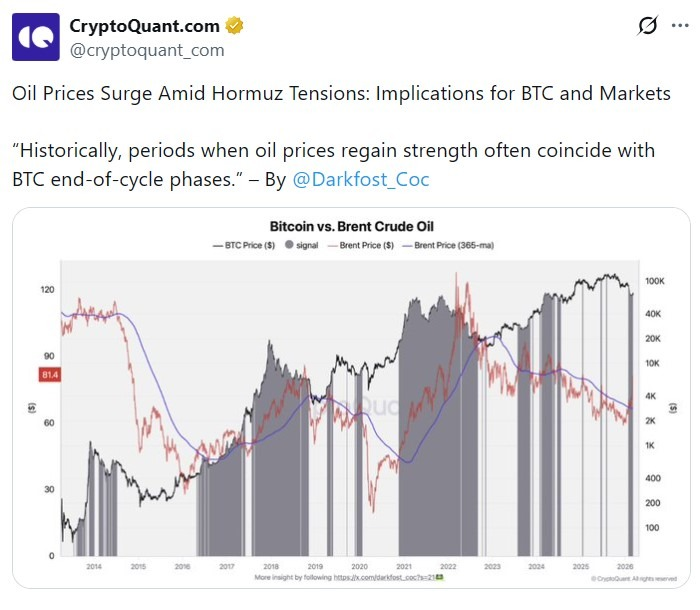
In a market update, Darkfost, an analyst at CryptoQuant, said that times when oil prices stay high have often been followed by late-cycle phases for Bitcoin. He stated, “Higher oil prices and tensions in the Strait of Hormuz could make people less willing to take risks and make the future of volatile assets like Bitcoin more uncertain.” The recent move fits this pattern: oil prices went up but Bitcoin couldn’t get back to higher levels, which is why the market is consolidating right now.
Hyperliquid Takes Advantage of Weekend Demand for Oil
The episode also showed how decentralized perpetual futures platforms are becoming more important for giving people access to established asset classes 24/7. During the weekend rise, Hyperliquid’s oil-linked contracts experienced a huge increase in volume. According to Pine Analytics, a company that analyzes data on the blockchain, the trading interface Tradexyz, which is based on Hyperliquid, had its greatest weekend volume ever, surpassing $720 million.
Pine said that this is the second big wave of demand for Tradexyz in the last month. The company noted on X, “These episodes show that the platform is taking in demand for traditional assets from people who don’t have access to TradFi or when centralized exchanges are down.”
Hyperliquid’s ability to give traders access to oil futures 24 hours a day, 7 days a week has been especially useful during geopolitical crises when traditional markets are closed. Traders looking to hedge or bet on energy price shocks outside of usual trading hours have turned to the platform’s HIP-3 oil contracts as their go-to place.
Bitcoin’s Technical Position and Big Risks
Bitcoin’s rise back to the $69,000 range has kept it above the important $60,000–$63,000 support zone, which acted as a floor during the slump over the weekend. The level matches the highest points of the previous cycle in 2021 and major on-chain demand clusters, making it a strong base for any possible resurgence.
Still, the overall tendency is still gloomy. Bitcoin is still down about 44–50% from its peak in October 2025, which was over $126,000. The Crypto Fear & Greed Index is still in the “extreme fear” range, which means that many retail investors are being very careful.
Macro headwinds are still the most important thing. The U.S. inflation data that came out on Friday was hotter than predicted, which lowered hopes for big Fed rate reduction in early 2026. The central bank has been careful because of rising prices for services, stable job numbers, and the possible inflationary effects of proposed tariff initiatives. Risky assets, like Bitcoin, have been hurt by a stronger U.S. currency and less need for cash.
Uncertainty about politics throughout the world is another concern. The G7’s debate on releasing reserves has alleviated fears about oil prices in the short term, but if the Iran dispute becomes worse or the Strait of Hormuz is blocked, risk-off flows might start up again and put pressure on crypto markets.
Conclusion
Bitcoin’s drop to $63,000 over the weekend and rise back to almost $69,000 show that it is the only major risk market that trades 24/7 when traditional finance is down. Compared to previous geopolitical shocks, the reaction this time was rather mild. This shows that long-term holders are still buying and that ETF inflows are still strong, even though sentiment is still very negative.
Hyperliquid’s record weekend volume shows how decentralized perpetuals are becoming more and more important for giving people access to traditional assets even when the market is closed. For people who trade Bitcoin, the most important levels are still $60,000–$63,000 as immediate support and $70,000+ as the point at which bullish momentum starts up again.
The next week will be very important. U.S. equities futures will open again on Sunday night (U.S. time), and if the situation in Iran gets worse, people may become more risk-averse. On the other hand, news of a large-scale G7 reserve release or dovish comments from the Fed would probably calm people’s feelings and help Bitcoin recover.
The market is still in a high-risk consolidation phase for now. The $60,000–$63,000 range has the strongest historical support, but there is still a chance of losing money if macroeconomic or geopolitical conditions get worse. To get through the current situation, you need to be disciplined about managing risk and keep a tight eye on oil flows, Fed talk, and ETF activity.
Read Also: Bitcoin Drops to $63K as U.S.-Israel Strikes on Iran Shake Risk Markets