Stay connected with BizTech Community—follow us on Instagram and Facebook for the latest news and reviews delivered straight to you.
After the synchronised U.S.-Israel attacks on Tehran over the weekend of February 21–22, 2026, Iran’s cryptocurrency ecosystem saw a huge rise in outflows. Blockchain intelligence company Elliptic said that the number of transactions leaving the country’s biggest exchange, Nobitex, rose by over 700% within minutes of the first indications of the attacks.
The strikes, which were said to have hit important sites and killed Supreme Leader Ayatollah Ali Khamenei, caused a lot of concern in Iran’s financial systems. Elliptic’s report on Monday, March 2, 2026, said that the surge was not gradual but almost instant, with money quickly moving to foreign exchanges that have previously received a lot of money from Iran.
Tom Robinson, the co-founder and chief scientist, said that the movement was a conventional response to capital flight:
“This shows that people and businesses are moving value out of the reach of domestic controls or possible asset freezes.” Crypto is a speedy, censorship-free way to get around existing banking systems.
The withdrawals fit with patterns that Elliptic has seen in the past when Iran was very unstable, like big protests in late 2025 and new U.S. sanctions pronouncements. Nobitex has always been the main on-ramp and off-ramp, letting users turn rials into crypto and take them out to other wallets.
Nobitex: Iran’s Main Crypto Gateway
Nobitex is still the most important part of Iran’s crypto economy. The software enables users convert rials to cryptocurrencies and withdraw money to external wallets. This helps them use global financial systems even if banks have severe rules. Nobitex handled almost $7.2 billion in transactions in 2025 and said it had more than 11 million registered users. These numbers show how important it is to the system.
Elliptic has already connected Nobitex to money that comes from the Islamic Revolutionary Guard Corps (IRGC). A report from January 2026 said that Iran’s central bank might have used the platform to strengthen the rial when it was under a lot of stress. Because of these links, Nobitex has become a target for international scrutiny, including penalties and actions to implement them.
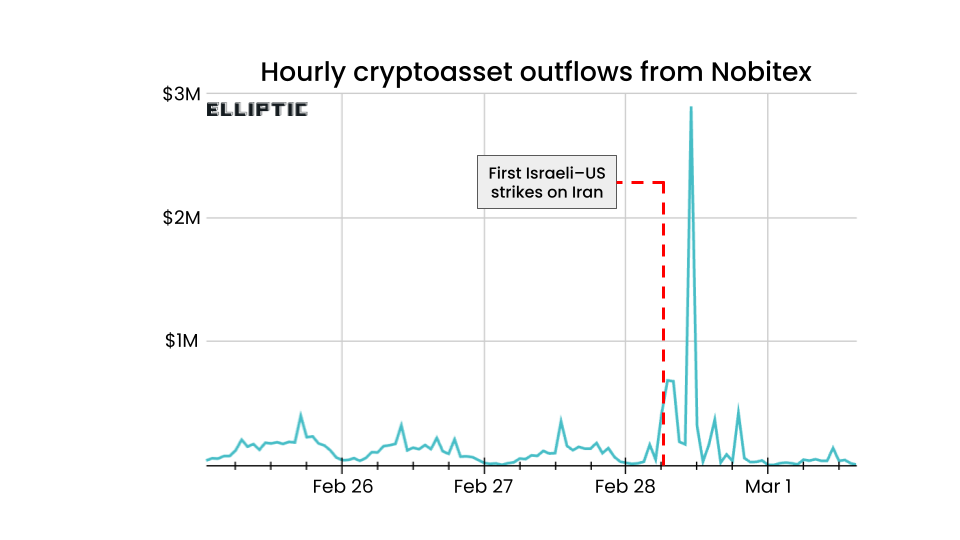
The 700% outflow rise over the weekend is one of the biggest short-term changes Elliptic has seen from Iranian platforms. Even while the specific destinations are yet unknown, early tracking reveals that the money is going to several overseas exchanges that are known to accept Iranian users.
Crypto as a Lifeline That Can’t Be Stopped
Iran has been using cryptocurrencies for a long time to lessen the effects of international sanctions. Stablecoins, notably USDT on Tron, and Bitcoin have become very important for keeping value, getting money from abroad, and doing business across borders because access to SWIFT is quite limited and many foreign institutions won’t do business with Iran.
The present escalation makes things more urgent. If government accounts or wallets related to the IRGC are frozen again, more crypto could leave the market. Chainalysis said earlier in 2026 that Iran’s crypto ecosystem was worth $7.78 billion in 2025, and that IRGC-related addresses received more than $3 billion in inflows in the fourth quarter alone.
Elliptic’s research suggests that there were similar spikes during past crises:
- Protests and internet blackouts across the country in late December 2025
- More IRGC-linked businesses in the U.S. will be hit with sanctions in January 2026.
- Military clashes in the middle of 2025
Nobitex was the main link between domestic rials and global crypto liquidity in each scenario.
A Wider Market and Political Context
The airstrikes and news of Khamenei’s death have shaken the markets all across the world. Oil prices went higher because people were worried about problems in the Strait of Hormuz. When trading started again on Monday, stocks fell dramatically. Gold and the U.S. dollar became stronger as safe havens.
But compared to altcoins, Bitcoin held up better. After dropping to about $60,000 just after the news, it climbed back up to the mid-$60,000s. This suggests that some investors see BTC as a portable, censorship-resistant store of wealth during times of political uncertainty. Stablecoins, especially USDT, probably got much of the short-term flight-to-safety flows from Iranian consumers.
The episode shows how cryptocurrencies can be used in both sanctioned and crisis-hit economies:
– For regular people, it’s a way to protect themselves from hyperinflation, currency regulations, and banking limits.
– For state-affiliated actors, a way to shift money out of networks that are being watched
This dualism keeps making it harder for governments around the world to work together. Authorities are going after platforms and addresses that are connected to illegal activities, yet the same tools give millions of people who are economically isolated access to money.
What to Expect and What the Law Says
Elliptic’s analysis says that if things become worse, more crypto could leave Iran more quickly. If there is a long power vacuum, more sanctions, or asset freezes, even more people could use Nobitex and other such gateways.
The rise makes it even harder for regulators around the world to keep an eye on and limit crypto flows without hurting regular users in the process. Blanket prohibitions could drive activity farther underground or to places with less rigorous rules. Targeted enforcement, which focuses on known IRGC-linked addresses and companies, is still the best way to go, even though there are still gaps in enforcement.
As tensions rise in the Middle East, they will certainly continue to affect people’s willingness to take risks. Iran’s crypto ecosystem will likely continue to be a real-time indicator of both capital flight by citizens and state-level measures to avoid sanctions. The 700% jump in outflows after the weekend strikes isn’t just a market event; it’s a clear example of how digital assets are changing how people act with money in crisis areas.
Read Also: Bitcoin Drops to $63K as U.S.-Israel Strikes on Iran Shake Risk Markets