Stay connected with BizTech Community—follow us on Instagram and Facebook for the latest news and reviews delivered straight to you.
The rising tensions between the US, Israel, and Iran have once again affected the financial markets, but this time the effects have been quite clear in an unexpected place: decentralised perpetual futures trading on Hyperliquid.
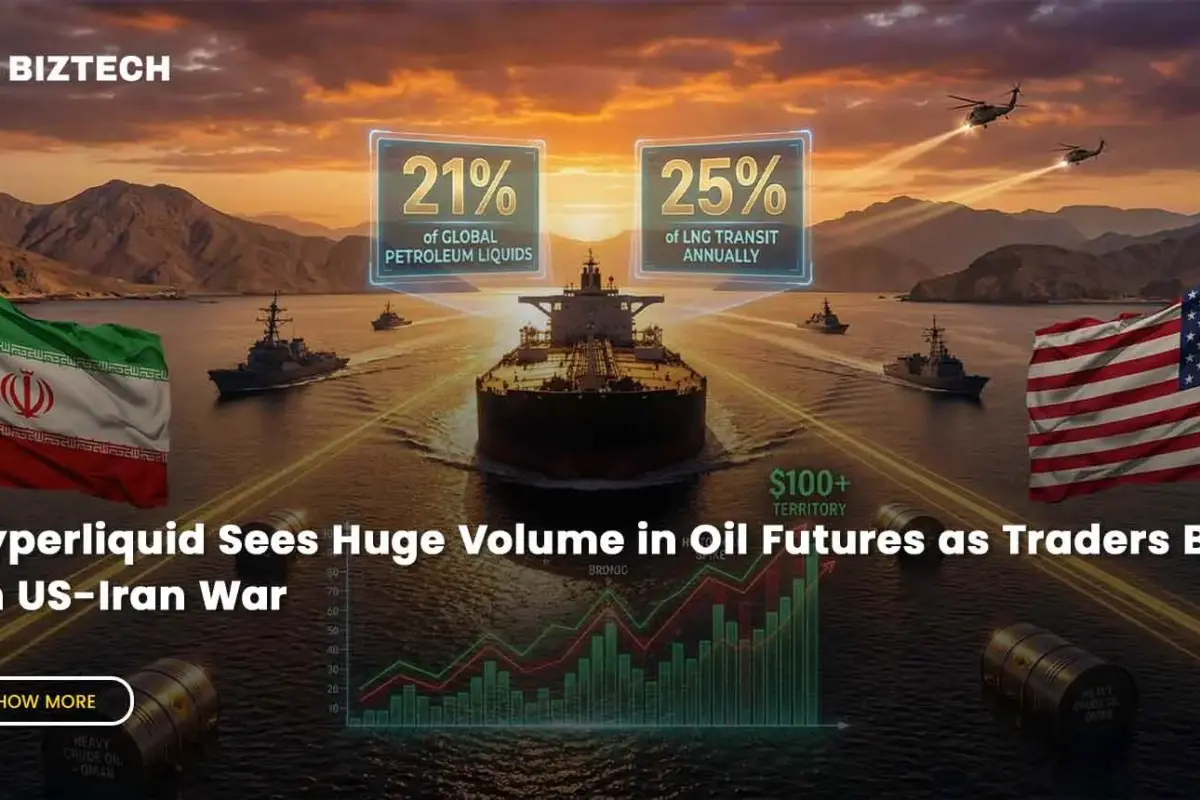
Traders put almost $720 million in volume into Hyperliquid’s oil-linked perpetual contracts over the weekend and into early March 2026. This was the most activity on the platform’s Tradexyz interface on a weekend ever.
The rise happened after crude oil prices rose more than 25% to almost $117 per barrel overnight, then fell quickly amid news of possible G7 strategic reserve releases. Because regular commodity markets were closed over the weekend, Hyperliquid was one of the few places where people could talk about the risk of oil prices in real time.
The numbers speak for themselves. Pine Analytics’ on-chain data shows that Tradexyz, a popular trading frontend built on Hyperliquid, had its busiest weekend ever from February 28 to March 1, with more than $720 million in trades. That number is much bigger than the roughly $75,000 worth of identical oil contracts that were traded on Coinbase over the same time period. This shows that liquidity for synthetic commodities exposure has clearly moved to crypto-native, 24/7 platforms.
Why traders are using Hyperliquid to bet on oil
It’s easy to see why Hyperliquid is popular during geopolitical shocks. Hyperliquid runs all the time, unlike centralised futures markets like CME Group or ICE, which have set trading hours. Traders can open, change, or close leveraged positions on oil prices at any time of day or night. This makes it a great place to trade when news breaks outside of regular market hours.
The platform’s oil perpetuals are fake contracts that are settled in USDC and can be leveraged up to 50 times. There is no funding-rate arbitrage between spot and futures. Hyperliquid has been a popular place for traders who want to monitor commodity price changes right away, especially when legacy markets are down. This is because it is always open, has huge leverage, and settles in stablecoins.
The recent instability in Iran was a perfect example of this. Reports of U.S.-Israeli raids on Iranian nuclear and military installations spread late Sunday into Monday. Oil futures on Hyperliquid shot up before regular energy markets could react in any meaningful way. Prices on the platform went up considerably when it was later reported that G7 finance ministers were talking about releasing 300 to 400 million barrels from strategic reserves in a coordinated way. This happened before U.S. equities futures started.
Pine Analytics said that the trend was obvious proof that structural demand was changing:
“These two waves of demand on Tradexyz in the past month show that the platform is taking in demand for traditional assets from people who don’t have access to TradFi or when centralised exchanges are down.”
The insight fits with Hyperliquid’s overall growth path. Since it released HIP-3 (its growth-mode upgrade that cut costs by up to 90%), the platform has been getting more and more of the perpetuals volume in both crypto and synthetic assets. Oil contracts are one of the fastest-growing types of contracts, especially when there is geopolitical concern.
Wider Effects on Crypto and Regular Markets
The event shows a number of trends coming together:
1. 24/7 trading as a competitive advantage: When news comes outside of normal market hours, centralised venues don’t say anything. Decentralised platforms fill the vacuum by catching speculative flows that would have to wait until Monday morning.
2. Commodities going on-chain: Hyperliquid’s oil perpetuals are synthetic, which means they don’t deliver real barrels, but they provide you the same economic exposure. This lets traders who only deal in cryptocurrencies hedge or bet on energy prices without having to open broking accounts or deal with futures rollovers.
3. Stablecoin settlement dominance: All Hyperliquid contracts settle in USDC, which strengthens the role of dollar-pegged stablecoins as the main unit of account for on-chain derivatives.
4. Feedback loop to native tokens: Hyperliquid uses some of the trading fees to buy back and burn its governance token HYPE. The new increase in volume has already caused HYPE to go up, and it is now trading close to $36 as of March 12, 2026.
The pattern isn’t unique. Hyperliquid witnessed comparable jumps earlier in the same conflict cycle, when anxieties about oil prices rose sharply in late February. Each escalation seems to increase the market for decentralised commodities derivatives, which suggests that geopolitical instability could be a long-term benefit for platforms like Hyperliquid.
Risks and Problems
Even while Hyperliquid’s oil contracts have a lot of volume, they are still a niche commodity compared to regular energy futures markets. On CME oil contracts, daily volume is usually over $100 billion. Hyperliquid’s weekend peaks, which are record-breaking for the platform, are still only a small part of that.
There is also a lot of liquidity. During the busiest times of the weekend rise, spreads got substantially wider, and slippage became a problem for bigger orders. Professional liquidity providers have stepped in to make markets tighter, although the platform’s depth is still far less than that of older exchanges.
Another thing to think about is regulatory risk. As decentralised perpetuals take over more traditional assets, they come under more and more scrutiny from the CFTC and other regulators. The fact that you may trade oil, gold, or equity indices on-chain without KYC or position restrictions makes people wonder about market manipulation, wash trading, and systemic risk. These are all problems that centralised futures markets have been dealing with for years through monitoring.
What This Means for People Who Trade Crypto
Hyperliquid’s rise as a weekend oil-trading site gives traders both chances and reasons to be careful:
- Opportunity: You can quickly change your position based on geopolitical events because you can see commodities prices 24/7. When oil prices go up or down outside of normal hours, Hyperliquid is often the only place to share your thoughts.
- Be careful thin weekend liquidity might cause changes that are too big and severe slippage. Leverage is still high, and when the mood changes, liquidations can happen very quickly.
The bigger picture is structural. As geopolitical events have more and more of an effect on short-term market movements, decentralised platforms that never close are getting a bigger proportion of speculative flows.
The record volumes on Hyperliquid during the most recent spike connected to Iran are more than just a headline. They show that crypto-native derivatives are becoming the go-to place for expressing risk around the clock when traditional markets are closed.
For now, oil-linked perpetuals on Hyperliquid are still a small but quickly rising market. If geopolitical tensions stay high or if additional commodities shocks happen outside of typical trading hours, the platform might see even more demand.
Hyperliquid has quietly become one of the most important places in the 24/7 global market for traders that are comfortable with on-chain leverage and stablecoin settlement.
Read Also: Iran Sees 700% Spike in Crypto Outflows After U.S.-Israel Strikes