Stay connected with BizTech Community—follow us on Instagram and Facebook for the latest news and reviews delivered straight to you.
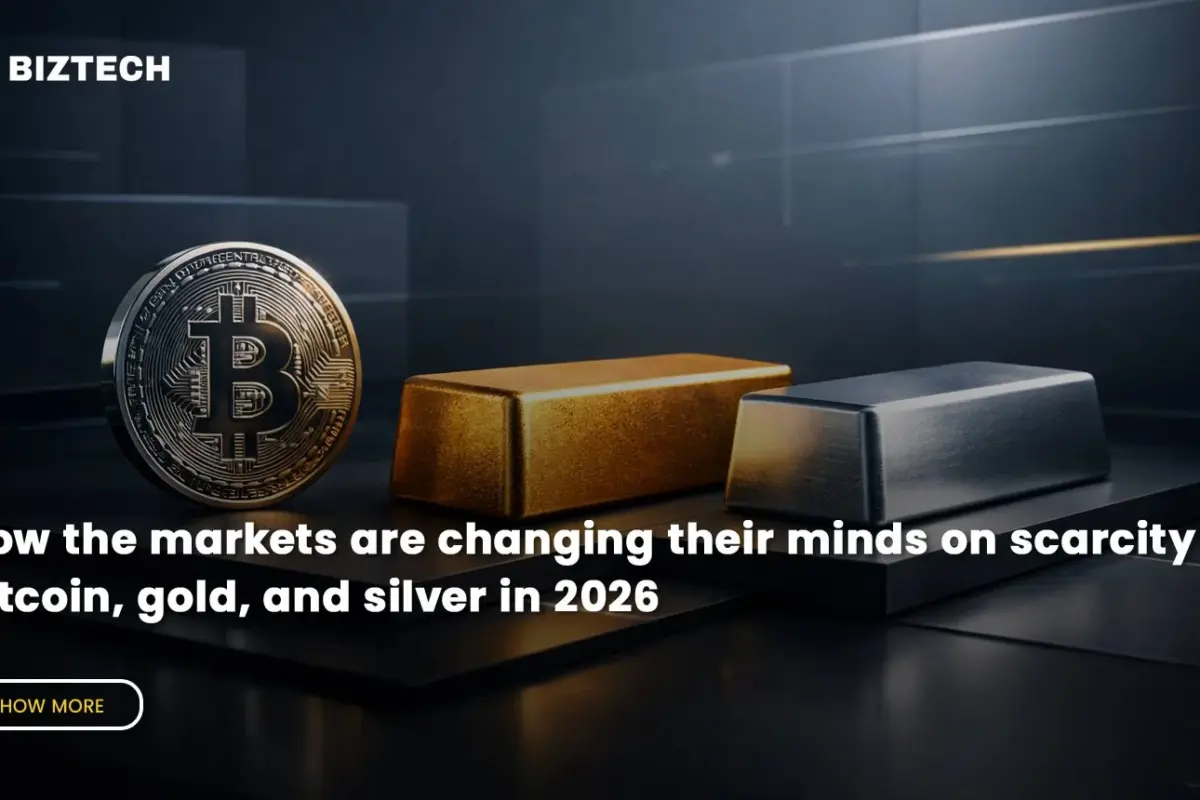
As 2026 begins, investors are looking at three of the most talked-about stores of value—Bitcoin, gold, and silver—in a very different way. People no longer think of scarcity as just a lack of resources or geographical limits. Instead, it is becoming more clear that it is a mix of credibility, liquidity, portability, and the larger financial systems that support each asset. The way money moves in and out of these assets shows not just how rare they are, but also how they act in today’s market.
This change isn’t about guessing which one will provide you the best return. Instead, it’s about realising that the value of scarcity is changing based on new standards. Investors are now looking at Bitcoin, gold, and silver through three basic perspectives.
Credibility: Is the Scarcity Mechanism Reliable?
The first and most important question that investors have is whether the system that imposes scarcity will work for a long time.
Bitcoin has the best story of programmed certainty. The code that governs it says that only 21 million coins can be made, and the number of coins made will be cut in half every four years. Without a lot of agreement, no one in charge can change this regulation. That predictability is one of the key reasons why institutional investors have chosen Bitcoin as a strategic reserve asset.
Gold has a considerably longer history of being reliable. For thousands of years, people have thought of it as a valuable metal. The annual supply of gold from mines is minimal compared to the amount already stored above ground. However, gold’s scarcity is credible since it is hard and expensive to extract, and it is widely recognised as a store of wealth. Central banks and sovereign wealth funds keep buying real gold because its scarcity is thought to be geopolitically neutral and not affected by the policies of any one nation.
Silver is in the middle. Mining economics also limit its availability, but around half of the annual production is used by industry (for things like solar panels, electronics, and medical uses). Silver’s dual purpose means that its scarcity is partly linked to cycles of industrial demand. This adds a further level of unpredictability that isn’t present with gold or Bitcoin.
Read also: Bitcoin Mining’s 2026 Outlook From AI Diversification, Tight Margins, and Ways to Stay Alive
Liquidity: How Easily Can Positions Be Entered or Exited?
The second dimension is liquidity, which is how quickly and at what cost an investor can add or remove exposure.
The rise of spot ETFs, futures markets, and perpetual swaps is very good for Bitcoin. In 2025, Bitcoin ETF assets under management topped $175 billion. Daily trading volume in spot and derivatives markets is usually over $100 billion. With this depth, even big institutional positions can be changed with very little slippage. At the same time, the growth of perpetual futures on exchanges like Binance and Bybit has made it feasible to make very big directional bets with only a small amount of money.
Gold is still quite liquid, but it’s more divided. In big cities like London, Zurich, and Singapore, physical gold (bars and coins) is quite easy to sell. However, moving a lot of it requires money for transportation, insurance, and storage. During trading hours, paper gold (futures, options, and ETFs) is very liquid, but it is mostly in a few big contracts, like COMEX. Outside of those hours, liquidity can drop very quickly.
In the spot market, silver is the least liquid of the three. The physical market is smaller and more likely to have violent squeezes when industrial demand or speculative positioning changes suddenly, even though silver futures are regularly traded. This dynamic often causes prices to change more quickly than they do for gold or Bitcoin.
Portability: How Easily Can Value Be Transferred?
The third lens is mobility, which is being able to move value across systems, boundaries, or governments.
This is where Bitcoin shines. You can memorise a private key, write it down, or store it on a hardware device and move it anywhere in the globe quickly and cheaply. This makes Bitcoin very appealing when capital constraints, political instability, or banking limitations make it hard to send money in the usual ways.
Gold is easy to carry in little amounts, but moving it in large amounts can be difficult and costly. To move big bars or coins, you need to make sure they are safe, insured, and follow customs rules. Digital versions of gold, such allocated accounts and ETFs, make it easier to move around, but they also add counterparty risk.
Silver is much worse off because of physical limits. Because it has a lower value density, carrying large amounts of it requires a lot more volume and weight than gold. This makes it impractical to move across borders except for tiny, high-value transactions.
How Financial Products Affect How People See Scarcity
In 2026, one of the most important things that will happen is that exchange-traded products (ETPs) and derivatives will have a bigger impact on how people see and price scarcity.
Spot ETFs have changed the game for Bitcoin. A lot of investors now use broking accounts instead of wallets that they keep themselves. This financialisation means that Bitcoin’s coding still controls how rare it is, but portfolio rebalancing, options hedging, and ETF creation/redemption movements have a bigger effect on its price.
Futures, options, and ETFs have been used to make gold and silver more like money for a long time. In both circumstances, the amount of trade that happens in paper markets is sometimes far higher than the amount of real supply. This makes the physical metal seem less scarce than it really is, which is what derivatives do. Because of this, price variations in these markets are caused as much by positioning and leverage as by changes in mine supply or demand for fabrication.
Because of this, scarcity is no longer a straightforward binary idea (“scarce” vs. “not scarce”). Market framework is what makes it happen. When there is a lot of derivatives activity, an asset can be objectively scarce but act like it is plenty. On the other hand, an asset with a lot of derivatives markets can nevertheless see big changes in price when physical supply gets scarce.
The main point of 2026’s scarcity repricing is that the markets aren’t picking a winner between Bitcoin, gold, and silver. They are giving each one a new job instead:
– Bitcoin: programmable, portable scarcity with rules for issuing coins that are very trustworthy, but there is a higher risk of regulation and price swings.
– Gold: collateral that is neutral in terms of geopolitics, has a lot of institutional confidence, and can be settled in person.
– Silver: a lack of both monetary and industrial uses that is more vulnerable to changes in real-economy demand.
None of these stories promises better results. Instead, they decide how money moves into each asset at different times in the economic cycle. Some investors value mathematical certainty (Bitcoin), while others value institutional reliability (gold), and yet others value industrial leverage (silver).
Conclusion
In 2026, scarcity is no longer just about physical or procedural boundaries. It is assessed based on the reliability of the enforcement mechanism, the liquidity and simplicity of position management, the flexibility to move between systems, and the financial instruments that influence price discovery. Bitcoin, gold, and silver all show scarcity in different ways, and markets are giving each of them a varied role instead of picking a single winner. It is now necessary to understand these stories, not simply the supply figures, in order to navigate the current investment landscape.