Stay connected with BizTech Community—follow us on Instagram and Facebook for the latest news and reviews delivered straight to you.
Capitol Hill is the most exclusive club in modern finance, and everyone knows it. Members of the United States Congress have unique, early access to changing macroeconomic policies, new rules and regulations, and huge government spending plans. Because of this structural advantage, the personal stock trades of these politicians have become a very popular type of alternative data for people who work in the market.
When a current member of a defence or energy committee suddenly buys a lot of shares in a certain sector just weeks before a big policy change is revealed, the market pays attention. Is this just a coincidence in retail investing, or is it an indication that new laws are about to be passed?
In the past, tracking this data was a long and tedious process of going through old government PDFs. Blockcircle has officially unveiled “Political Alpha,” a specialised analytical tool that extracts, standardises, and scores congressional trading data, turning bureaucratic disclosures into useful market intelligence.
This article goes into great detail about how Political Alpha works, the institutional methods it makes possible, and the big hazards of mindlessly copying politicians’ trades.
How Political Alpha Works
The STOCK Act of 2012 is the statute that made this data possible. It says that members of Congress must publicly report their financial transactions within 30 to 45 days. The legislation says that information must be open, but the raw data that the government gives out is known to be hard to understand and use in real time.
Blockcircle’s Political Alpha is made to fill this void. The software doesn’t just give you a raw feed of government filings; it also combines the disclosures and adds a layer of quantitative analysis. The program has capabilities including signal grading, tracking past performance, filtering by sector, and finding clusters.
The idea is to turn the chaotic flow of legislative disclosures into a structured dataset that both retail and institutional traders can use in their larger macro frameworks.
- How to Read the Tape: Decoding the Variables before making a trade based on what Congress is doing, analysts need to look at the details of the revelation. Not all political trades are equally important.
- Direction and Size: A purchase order shows that you believe the company’s stock will go up, while a sell order could mean that you want to take profits or that you think there will be regulatory problems. The cash figure, which is commonly shown in brackets like $15,001 to $50,000, gives you an idea of how much money the politician is willing to spend.
- Sector Concentration: A lot of money going into a certain industry is a clear sign. It typically gives a hint about where federal funding or good laws might go next.
- The Source: The politician’s identity is very important. A congressman on the Armed Services Committee buying defence contractors sends a much clearer signal than a legislator who isn’t on the committee making the same purchase.
- The Delay in Filing: This is the most important factor. There are two dates: the *Trade Date* (the day the asset was bought) and the *Filing Date* (the day the public finds out). Politicians have up to 45 days to report, thus the data is always behind. The difference between these two dates tells a trader how to deal with the momentum.
Not Just Copying Blindly
Without a structured context, alternative data is meaningless. Blockcircle gives four different ways to use Political Alpha.
1. Follow the industry (Policy Flow)
When a lot of politicians from different districts suddenly put money into the same industry, the market sees this as a sign of policy changes. For instance, intelligence committee members buying semiconductor stocks at the same time signals that the federal government will help. The focus here is on macroeconomic sector rotation, not on picking a specific stock.
2. The Signal for the Cluster
One transaction by a senator might be seen as managing their own portfolio. But when a “cluster” of politicians making identical deals in a short amount of time shows up on the monitor, the signal gets much stronger. This shows that there is a shared macroeconomic view or that they have access to similar private briefings.
3. Delay Taking Advantage
The underlying stock has often already moved by the time the public sees the filing because it takes 30 to 45 days to report. But institutional traders utilise the *Filing Date* to start a trend. The technique is based on the idea that even though the initial entry price is gone, the politician’s transaction will be made public, which will cause a second wave of retail momentum that may be exploited.
4. The Layer of Confirmation
Professional traders don’t utilise Political Alpha as their main buy signal. It works well as a strong confirmation tool. If a trader has previously made a positive fundamental thesis about the energy sector and Political Alpha data suddenly shows a lot of congressional accumulation in energy, the thesis is confirmed. On the other hand, if politicians are selling a lot of the sector, the trader knows to look over their first models.
Real-World Application
Blockcircle showed how useful the tool is by showing three different trading patterns from the April 2026 tape.
Case 1: The Energy Cluster (August Pfluger – R)

On March 13, 2026, Representative August Pfluger placed six buy orders at the same time. DMLP, EPD, Kimbell Royalty Partners, and Viper Energy were four of those assets that were significantly concentrated in the energy sector. Pfluger is from Texas, which makes energy a natural fit, but the fact that so many people are buying the cluster is interesting. Also, these trades weren’t made public until April 16, which is a huge 33-day backlog in knowledge. The recording confirms a bigger shift by institutions into energy assets when combined with data suggesting that the market is very interested in Chevron.
Case 2: Portfolio Rotation (Richard Larsen – D)
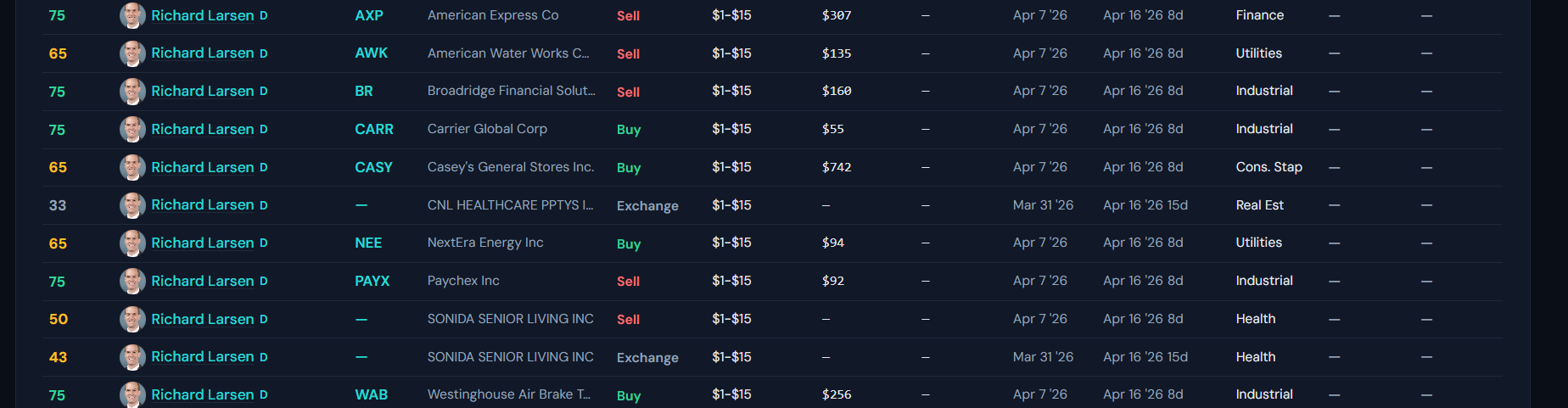
Unlike Pfluger’s targeted cluster, Representative Richard Larsen’s tape indicated a bigger reorganisation of his portfolio. He sold off stocks in the finance, utilities, and industrial sectors and moved the money into Carrier Global, NextEra Energy, and Casey’s General Stores. Analysts see this not as a sign of an insider policy, but as a standard macroeconomic rotation, which means transferring money between defensive and cyclical assets to deal with changes in the economy as a whole.
Case 3: The Speed Play (William Steube – R)

Representative William Steube bought shares in the quantum computing company IONQ and the hotel chain Marriott International. The filing speed is the most important thing to look at here. There was a 27-day delay in his IONQ trade, but there was only a six-day delay in his Marriott acquisition. Traders really like faster filings since the market hasn’t had as much time to price in the deal, which gives them a bigger window to catch the next wave of momentum.## The Reality Check: Risks and Limits
It’s always interesting to follow the financial manoeuvres of Washington’s elite, but using it as a surefire trading cheat code is a sure way to lose money.
The data is fundamentally retroactive. Because of the 45-day reporting window, retail traders are always making decisions based on old information. The best time to get in is nearly always gone.
Second, the idea that politicians know everything is often wrong mathematically. Many quantitative studies have shown that most congressional stock portfolios do worse than the S&P 500 index, which is the standard for measuring performance.
Lastly, blind copy-trading adds a lot of danger. Retail investors often buy at the local top because a senator did, without knowing the fundamentals, technical setup, or market liquidity. This gives institutions a way to get out of their positions.
Conclusion
The real usefulness of tools like Blockcircle’s Political Alpha isn’t that they let you copy exactly what politicians do, but that they let you see the bigger picture of how money and policy move.
When the market sees congressional committees quietly building up assets in certain areas, it gives us a rare, clear look at what Congress will be doing in the next several months. Alternative data is no longer just for Wall Street hedge funds. The data is now available to everyone. The modern trader’s biggest issue is not getting the information, but being able to use it appropriately.
Read Also: UK and Canada Move to Restrict Crypto Donations in Politics, Citing Foreign Interference Risks