Stay connected with BizTech Community—follow us on Instagram and Facebook for the latest news and reviews delivered straight to you.
The Crypto Fear & Greed Index has finally returned to greed territory after almost three months of steady fear and extreme fear readings. The index hit 61 on the morning of January 15, 2026. This was over the psychological 50 mark that separates neutral feelings from extreme optimism. The day before, it was at 48, which marked the conclusion of a protracted period of caution that started after the huge liquidation cascade in early October 2025.
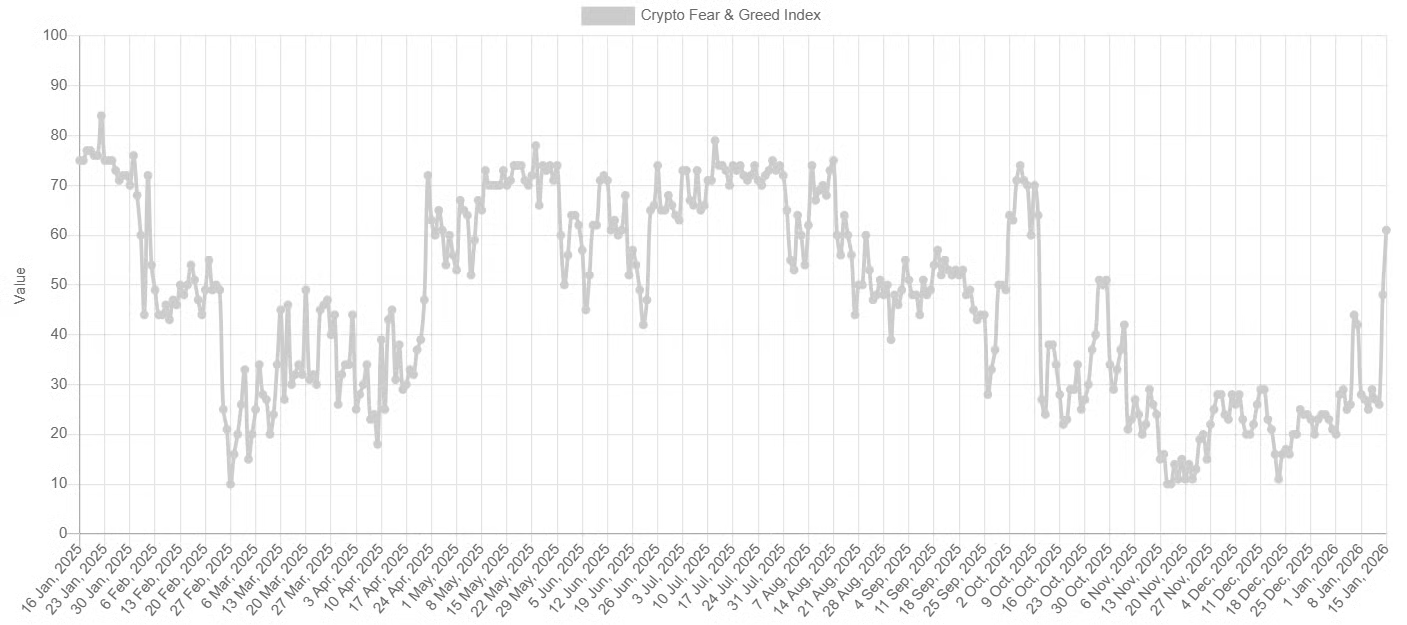
Alternative keeps the index up to date.me combines several real-time market indications to give a single daily score that ranges from 0 (very afraid) to 100 (very greedy).
It uses data from surveys, Google search patterns, social media sentiment, Bitcoin dominance, and volatility in major cryptocurrencies, as well as trading volume and momentum. A number above 50 means that people are becoming more confident, but a score between 70 and 80 frequently means that things are getting too hot, which is usually a hint that a correction is coming.
This most recent rise comes after the index spent most of November and December stuck in the teens and twenties, which were its lowest levels since the big drops in late 2022. The long-lasting dread phase was mostly caused by the $19 billion liquidation event on October 10, 2025. This was the biggest single-day wipeout in crypto history, and it wiped out leveraged long positions and sent Bitcoin crashing from over $125,000 to under $101,000 in just a few hours.
The Recovery of Bitcoin Sets the Tone
The rise in positive feelings closely follows Bitcoin’s steady rise over the past few weeks. BTC has risen back toward $97,700, its highest level since mid-November 2025, from a low of around $89,000 in early November. The most recent leg up started in earnest around January 10. It sent the asset back above its 21-day moving average and back above important psychological levels.
This strong price has started a virtuous cycle for emotions. Higher prices lower unrealized losses across portfolios, bring shelved cash back into the market, and bring in new money.
On January 13, spot Bitcoin ETF products in the US had their biggest one-day inflow in three months, bringing in $753.7 million. Cumulative net inflows have brought the entire amount of assets under management in U.S. spot BTC ETFs to around $123 billion, which is almost 6.5% of the total supply of Bitcoin.
The rest of the market has done the same. The total value of all cryptocurrencies went up 3.3% to $3.26 trillion. Major altcoins including Ethereum, XRP, Solana, and Dogecoin all gained between 2% and 6% in the same time period. The move has been big enough to raise the morale of most people, but not so much that it has reached the euphoric levels that sometimes come before big drops.
Read also: “Bitcoin Season” Not “Alt Season”: Why This Cycle Feels Different and Is 2026 the Year to Watch?
What the Index Parts Show
Breaking down the index drivers gives us more information about the change. Since the increase in October, volatility has calmed down a lot and is now at levels not seen since August 2025.
The velocity and volume of trading have turned positive, showing that more people are getting involved in both spot and derivatives markets.
Interest in cryptocurrency-related terms on Google has gone up, but it’s still far below the highs of past bull cycles. Social media sentiment, which had been very unfavorable throughout November and most of December, has now turned neutral to positive.
Bitcoin’s dominance, which had risen to about 61% during the anxiety period as investors put their money into what they thought was the safest cryptocurrency, has started to drop a little.
A slow drop in dominance frequently comes before capital moves into altcoins, but the index is still higher than it was during previous altseason periods.
These elements together point to the market transitioning from giving up to being cautiously optimistic. The situation isn’t completely greedy yet, but it’s certainly getting better.
Historical Context: Fear as a Precursor to Strength
If you look at historical cycles, long times of anxiety have often come before big changes. After the FTX crash sent the index down to single digits in late 2022, Bitcoin hit a low of around $16,000 and started to rebound over the next few months. The index hit very high levels of dread in March 2020, during the COVID-19 crash. After that, BTC started its epic bull run.
The present score of 61 is still rather low compared to the 80+ scores that were common during euphoric times in 2017 and 2021. In the past, prolonged readings above 75 have often happened at local tops, and swings out of profound fear into neutral or moderate greed territory have heralded the beginning of recoveries.
The October liquidation event is akin to other capitulation events that have happened before. In 2018 and 2022, huge leveraged liquidations got rid of weak hands and laid the stage for multi-quarter uptrends. The sentiment reset is structurally comparable to the last cycle, even though it hasn’t yet created the same kind of parabolic follow-through.
Institutional Flows and the Big Picture
Participation in institutions is still a stabilizing force. Spot Bitcoin ETF inflows have stayed positive even while prices have stabilized. BlackRock’s iShares Bitcoin Trust (IBIT) and Fidelity’s Wise Origin Bitcoin Fund (FBTC) keep getting new money, and the total value of all ETFs is getting close to $123 billion. These movements give the market a steady bid and help keep prices from going down too much, which is better than in past cycles.
The macroeconomic situation also supports a positive outlook. In 2025, the Federal Reserve cut rates three times by 25 basis points, reducing the target range down to 3.75% to 4.00%. Market prices show that people predict at least one more cut in early 2026. This would lower the opportunity cost of keeping non-yielding assets like Bitcoin even further. The Fed can loosen without soon raising prices again because inflation is slowing down (the September CPI was 3.0%) and labor data is getting better.
Things to Keep an Eye On in the Next Few Weeks
It’s good that the market is back in the “greed” zone, but it hasn’t yet hit levels that usually mean it’s getting too hot. When readings are between 60 and 70, they usually imply early-stage optimism instead than euphoria. There are a few important signs that will show if this change in mood turns into a longer-lasting rally:
- More money coming into ETFs and whether that pace picks up when U.S. institutions come back from managing their balance sheets at the end of the year
- Bitcoin dominance: A big drop below 58% would suggest that money is moving into cryptocurrencies.- Altcoin market scorecard metrics, including stablecoin outflows and how well they do compared to BTC
- In January, there were macro data releases, including delayed employment numbers that were influenced by the recent government shutdown.
- Funding rates and open interest in perpetual futures markets—if they are too high, it could mean that the market is about to run out of steam.
The market seems to be going from giving up to being cautiously hopeful for now. Bitcoin’s ability to stay above important technical levels while sentiment rises shows that there is strong demand behind it. Whether this turns into a full-blown risk-on climate or stays a bear market rebound will depend on how macro conditions, institutional flows, and technical confirmation interact with each other.
Conclusion
The fact that the Crypto Fear & Greed Index is back in the greed zone for the first time since October 2025 is a big psychological change. After months of being very careful because of big sell-offs and uncertainty in the economy as a whole, people are finally starting to feel more hopeful. Bitcoin’s steady rebound, robust ETF inflows, and better technical structure are the main reasons for its rise. The Fed’s expected softening will also help.
This is not yet a happy place, so you should still be careful. The market may be getting ready for a stronger first quarter of 2026, nevertheless, because of technical mending, institutional accumulation, and sentiment improvement. Investors who made it through the fear phase now have to deal with a landscape that could be more helpful but is still unstable. In the next few weeks, we’ll find out if this is the beginnings of a real change in trends or just a short break.