Stay connected with BizTech Community—follow us on Instagram and Facebook for the latest news and reviews delivered straight to you.
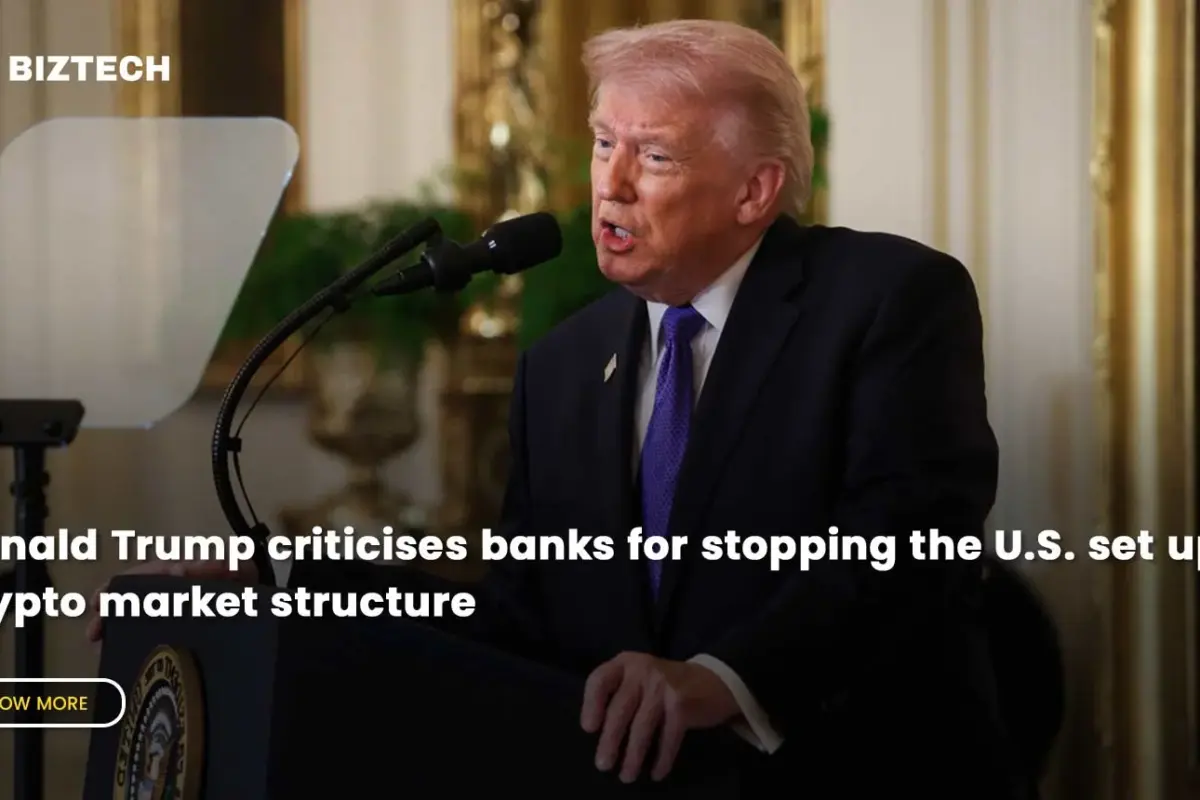
Donald Trump has openly criticised the banking industry for what he says are deliberate attempts to weaken or delay cryptocurrency legislation that is presently being considered by the U.S. Senate. On Tuesday, March 4, 2026, Trump wrote on Truth Social that he was angry with banks for trying to stop the market structure bill from passing, especially the parts that deal with stablecoin yield. He promised that this kind of intervention would not be allowed.
“GENIUS Act is being threatened and weakened by the banks, and that is unacceptable. We will not let it happen,” Trump wrote. He was talking about the Guiding and Establishing National Innovation for U.S. Stablecoins Act (GENIUS Act), which Congress passed in July 2025 to set up a federal framework for stablecoin issuers backed by the dollar.

The president also underlined how important it is to finish creating laws for the larger crypto market structure. He said that the US can’t afford to fall behind other countries in building its digital asset economy. The comments come at a key time: the CLARITY Act, which is the main bill for changing the market structure, has been stuck since early 2026 after Coinbase pulled its support in January, saying that the draft had become too favourable to traditional banking interests and too restrictive for DeFi and open protocols.
The Main Issue: Stablecoin Yield and Bank Deposits
The way interest or yield on stablecoins is handled is at the heart of the dispute. The GENIUS Act already says that stablecoin issuers can’t pay token holders directly in yield. These kinds of rewards are seen as deposit-like products that are subject to banking rules. But third-party systems like exchanges, lending protocols, and DeFi apps can still give consumers who deposit stablecoins a yield.
Banks say that even this indirect income makes a hole that might speed up the movement of deposits from regular accounts to crypto platforms. If those who own stablecoins can get competitive returns with the same level of stability and speedier settlement, retail and institutional money could leave the banking system. This could lower the amount of money banks can lend and put financial stability at risk.
Because of this, groups that represent banks have pushed to address what they see as a loophole in the proposed CLARITY Act. They want a blanket ban on any kind of yield connected to stablecoins, whether it’s issued directly by issuers or indirectly by intermediaries.
Coinbase and other crypto supporters have strongly disagreed with this point of view. They say that outlawing all yield will hurt innovation, make it less appealing to use stablecoins, and move activity to places with more lenient restrictions. Coinbase’s decision to stop supporting the bill in January was directly related to these yield restrictions. CEO Brian Armstrong said publicly that “no bill is better than a bad bill.”
The CLARITY Act is still up in the air because of the deadlock. There hasn’t been any news on a revised timeline since the Senate Banking Committee cancelled more markup sessions.
Three meetings at the White House, but no deal
The White House has tried to help people reach a consensus. Since January 2026, there have been three high-level meetings between people from the crypto business, banking lobbyists, and government officials. Reportedly, the topics were:
Setting limits on yield structures that don’t put bank deposits at risk
Making it clear what the differences are between legal stablecoin supply and DeFi/lending activities
Finding a balance between encouraging new ideas and making sure the economy is stable
Even though these talks have been going on, no agreement has been achieved. The crypto side still says that yield is important for keeping users and staying competitive, especially against China’s digital yuan (e-CNY) and other CBDCs that can offer interest-bearing features. Banking officials say that any yield on dollar-pegged tokens might destabilise the deposit base that supports lending and economic growth.
Trump’s Push for Crypto Laws Before the Midterms
Trump’s public comments seem to be timed to put pressure on Congress before the midterm elections in November 2026. He has said several times that regulating cryptocurrencies is one of the most important things his administration has done and that it is necessary to compete with China. The president’s statement on Truth Social backs up what he said earlier in Davos, where he called crypto regulation a “geopolitical imperative” to keep Beijing from taking over the space.
Reports say that crypto lobbying groups have raised about $200 million (about Rp3.3 trillion) to help candidates who embrace crypto in the midterms. The industry sees the CLARITY Act as a turning point: if it passes, it will bring long-awaited regulatory clarity; if it doesn’t, it could take years for real development to happen.
What Stablecoins and DeFi Could Lose
The conclusion of this argument will have effects that go well beyond the issue at hand:
– Stablecoin issuers: A blanket restriction on yield might slow down product development and make U.S.-based stablecoins less competitive around the world.
– DeFi platforms: Limiting stablecoins that pay interest would have a direct effect on lending, providing liquidity, and staking protocols that use interest mechanisms.
– Banks: Winning on yield limits would protect deposit bases, but it might also speed up the move of payments to digital channels that don’t involve banks.
– Retail users: Yield is a big reason why people retain stablecoins. If it were taken away, fewer people might use them and they might look for alternatives that are not regulated or offshore.
The GENIUS Act already makes it obvious how to issue stablecoins in a way that is legal at the federal level. The CLARITY Act, on the other hand, is meant to answer bigger questions about the structure of the market, such as custody, trading, and intermediary operations. Regulatory ambiguity will keep institutions from getting involved and delay down the integration of these pieces until they all fit together.
Conclusion
President Trump’s harsh words for banks that he says are blocking crypto market structure legislation show how deeply politicised the subject has become. The fight is between two different visions: one that puts banking stability and deposit security first, and another that wants to keep innovation and competition alive in the digital asset field. The CLARITY Act is stuck, and stablecoin yield is becoming the main issue.
The next few weeks will be very important. If Congress can come up with a solution that lets banks have limited, clear yield while still meeting their needs, the bill may have a better chance of passing. If not, the standoff could last until the November elections, leaving U.S. crypto policy in limbo while other countries move forward.
The stakes are huge for the crypto business. A good measure will free up institutional capital and solidify the U.S.’s position as a leader in digital banking. A long stalemate, or one that is too favourable to banking interests, might push innovation abroad and impede its acceptance at home. For years to come, the next steps in Washington will affect the direction of the U.S. crypto sector.
Read Also: Bitcoin Drops to $63K as U.S.-Israel Strikes on Iran Shake Risk Markets