
Stay connected with BizTech Community—follow us on Instagram and Facebook for the latest news and reviews delivered straight to you.
Deel, a global payroll platform, is making a big move toward making cryptocurrencies more popular by adding stablecoin salary payments for workers in the UK and EU. They hope to add this feature to the US later in 2026. On February 4, 2026, the project was launched. It uses MoonPay’s infrastructure to turn fiat salary into stablecoins and send the money directly to employees’ non-custodial crypto wallets.
Deel pays more than $22 billion in payroll each year to millions of workers in over 150 countries. The startup wants to give employees—especially those who work from home or across borders—a faster, cheaper way to get paid than standard bank transfers by introducing stablecoin payments. MoonPay takes care of the conversion and delivery on the blockchain, while Deel keeps track of salary calculations, tax withholding, compliance reporting, and legal duties in local currencies.
Read Also: Stablecoin’s Market Outlook 2026 : From a $310 Billion Milestone to a Trillion-Dollar Potential
Employees can choose to get all or part of their pay in stablecoins. This gives people who use digital assets for savings, sending money, or investing more options. The company uses MoonPay’s regulatory licenses, which include a New York BitLicense, many U.S. money transmitter licenses, and permission under the EU’s MiCA framework. This makes sure that the cooperation follows the rules in all areas.
JP Richardson, co-founder and CEO of Exodus wallet, talked about how the shift was important in a bigger sense. “You don’t get people interested in crypto by writing whitepapers.” “You do it with pay cheques,” he wrote on X, stressing that stablecoin payroll cuts down on delays and fees for workers around the world.
Regulatory Tailwinds in the EU and US
The launch comes at a time when the rules are changing quickly, making stablecoin payments increasingly useful for businesses. The GENIUS Act, which passed in July 2025, set up a government framework for payment stablecoins in the United States. It required complete reserve backing, frequent audits, and unambiguous redemption rights. This transparency has made it easier for traditional banks and fintechs to get involved.
Several important things have happened since then:
- In March 2025, World Liberty Financial released its USD1 stablecoin
- The Frontier Stable Token (FRNT) was issued by Wyoming in January 2026.
- Tether launched USAt, a dollar stablecoin that is licensed in the U.S. and issued by Anchorage Digital Bank and It was made to meet GENIUS standards.
In December 2025, the Federal Deposit Insurance Corporation (FDIC) suggested rules that would let bank subsidiaries supervised by the FDIC issue payment stablecoins under specific situations. This would make it even easier for established banks to get involved.
The Markets in Crypto-Assets (MiCA) regulation in Europe has set up a complete system for licensing and overseeing stablecoin issuers and service providers. MoonPay’s MiCA approval lets it do business legally in all EU countries, which is very important for Deel’s European expansion.
Market conditions and the state of competition
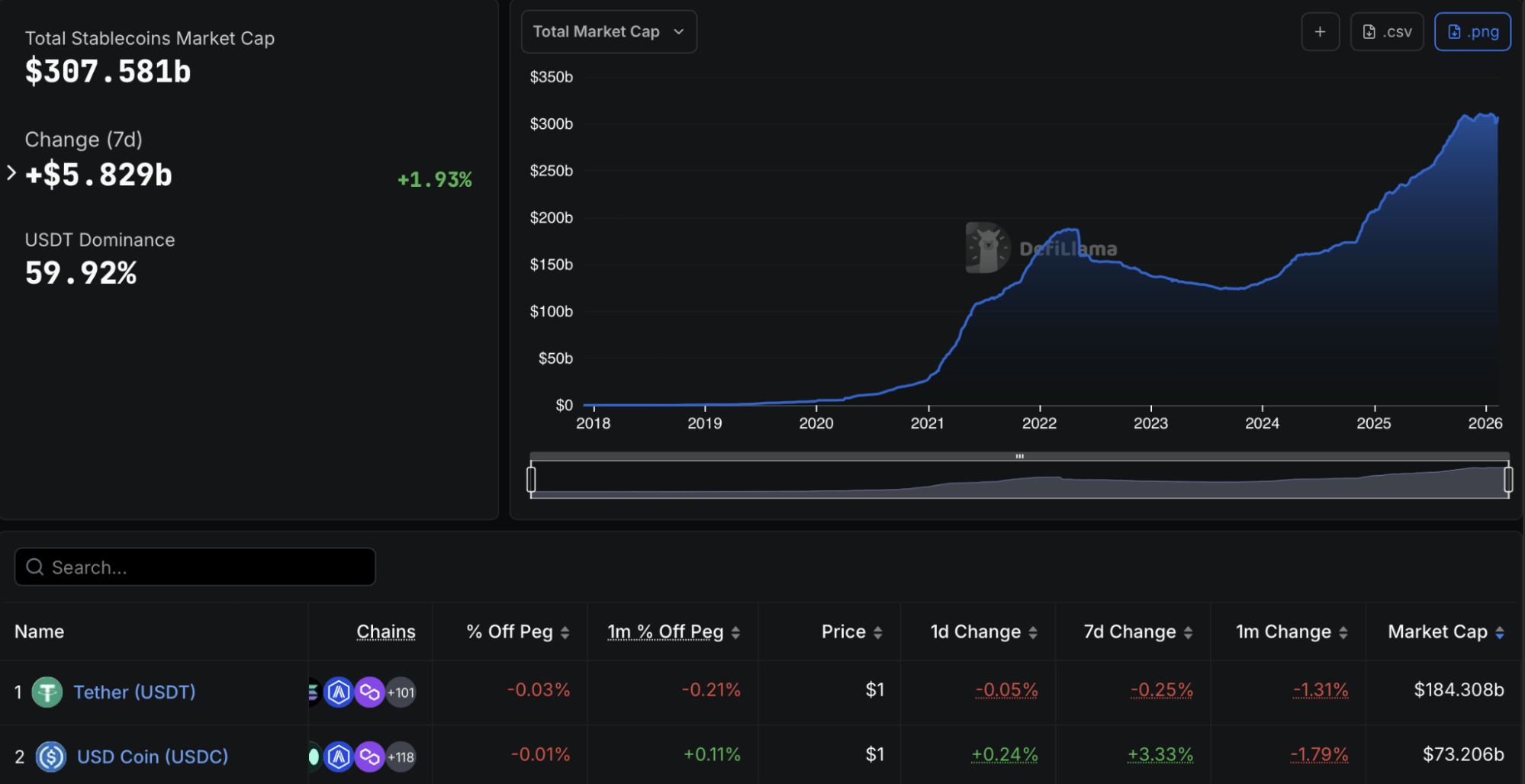
Even if new companies are entering the stablecoin sector, it is still very concentrated. According to DefiLlama, Tether’s USDT still has the biggest market cap, with over 60% of the total. Circle’s USDC has about 24%. Together, these two tokens make up most of the daily volume of stablecoin transactions.
It will be hard for new regulated stablecoins to get a significant market share. USDT and USDC have been around for a long time, thus they have a lot of liquidity, are easy to swap, and are accepted by merchants. To get users, new issuers need to get past network effects and show that they are both compliant and reliable.
Deel’s choice to work with MoonPay instead of establishing its own stablecoin shows that they are being practical: they are using infrastructure that already exists instead of building it from scratch. The methodology also works with how most enterprise crypto payroll systems work today: they turn fiat salary into stablecoins at the time of payment to stay in line with local labour and tax laws.
What this means for global payroll and crypto adoption
Deel’s move shows that stablecoins are becoming more popular in the real world for uses other than trading and speculation. Cross-border payroll is one of the most obvious business uses. It has real benefits for remote and foreign workers, such as faster settlement, fewer expenses, and 24/7 access.
The rollout in the UK and EU is a test. If it works out there, it might speed up the anticipated expansion in the U.S., where the GENIUS Act has already sparked interest from institutions by making rules clearer. If employees use Deel a lot and it works well, it might set a standard for other payroll providers to follow.
Enterprise payroll is one of the most sustainable ways for the broader crypto ecosystem to be used every day. Stablecoin wages make digital assets a part of everyday financial life without making people guess how prices will change. This utility-driven adoption is expected to last longer than speculative trading cycles.
Conclusion
Deel’s agreement with MoonPay to pay UK and EU workers in stablecoins is a big step toward making cryptocurrencies more useful in everyday life. Deel is solving actual problems like long wait times and excessive costs for cross-border payments by adding regulated stablecoin rails to existing payroll systems. They are also fully following all local labour and tax laws.
The project comes at a time when rules in the US and EU are making it easier for institutions to use stablecoins. If the launch goes well and more employees start using it, it might speed up comparable offerings from other global payroll providers and make stablecoins more widely accepted as a way to pay.
Right now, the focus is on execution: smooth conversion, dependable delivery, and clear compliance. If Deel can do those things, stablecoin payroll might go from being a small experiment to a normal option in the global remote-work economy.