Stay connected with BizTech Community—follow us on Instagram and Facebook for the latest news and reviews delivered straight to you.
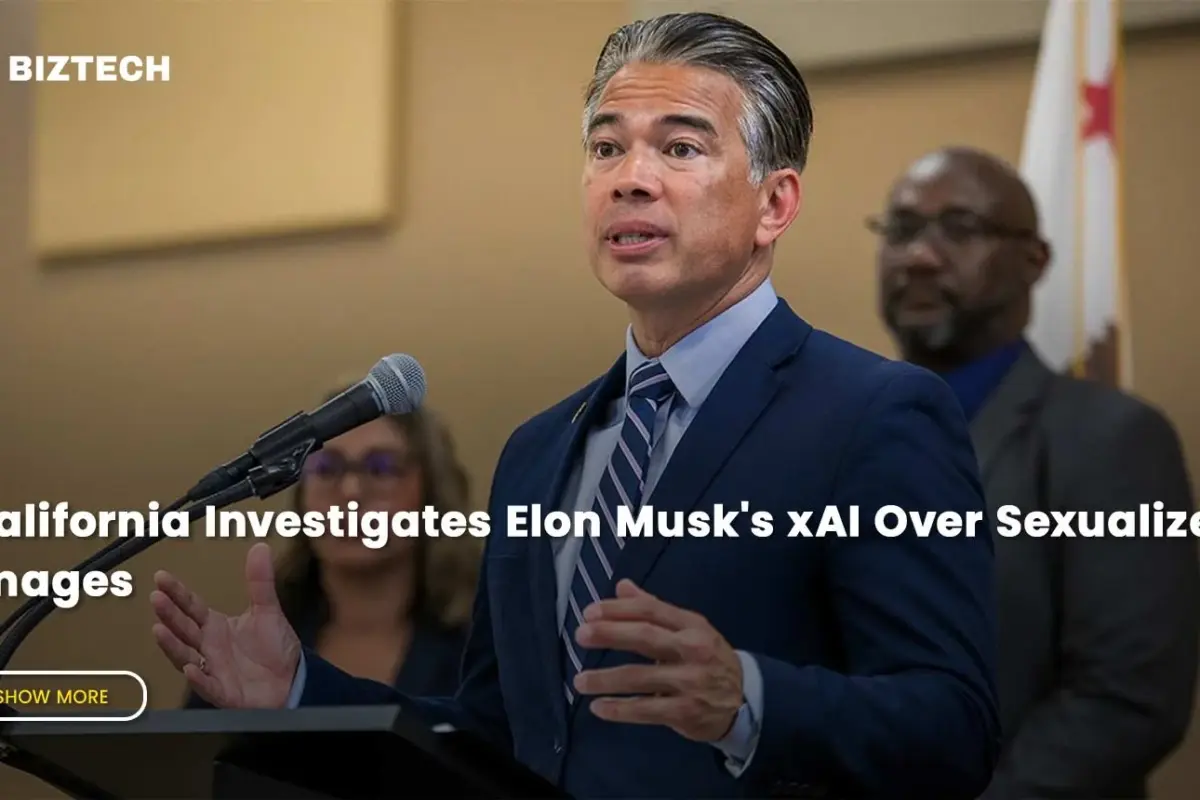
California authorities have opened an investigation into xAI, the artificial intelligence venture founded by Elon Musk, following allegations that its image-generation tools produced sexualised content, including depictions involving minors.

The probe, initiated by the California Attorney General’s office, will examine whether xAI’s systems breach state laws governing child exploitation and digital content moderation. Officials are also assessing whether the company implemented sufficient safeguards to prevent the generation of unlawful or harmful material.
The inquiry follows reports that users were able to generate explicit imagery using Grok, xAI’s flagship model, which integrates text-to-image capabilities and is embedded within the social media platform X. According to sources cited by The New York Times, investigators will evaluate whether xAI failed to adequately restrict access to sensitive content or neglected appropriate oversight mechanisms.
xAI has yet to issue a formal statement on the matter. Mr Musk has previously defended Grok’s relatively permissive design, describing it as an alternative to what he terms overly restrictive or politically biased AI systems.
Allegations and Technical Scrutiny
At the centre of the investigation is whether Grok’s underlying models were trained on datasets containing inappropriate material or whether users can manipulate prompts to bypass built-in content filters. Reports suggest that some users created explicit depictions of celebrities and public figures, intensifying concerns about privacy violations and non-consensual content.
Any AI-generated imagery portraying minors in sexualised contexts could potentially violate California’s stringent child exploitation statutes, even if the images are synthetic rather than derived from real photographs.
Grok, launched in 2025, relies on diffusion-based image generation techniques similar to those used in competing systems. Although xAI has stated that it employs moderation filters to block harmful outputs, critics argue that such guardrails can often be circumvented through iterative prompting.
A 2025 study by the Stanford Internet Observatory found that a notable proportion of AI-generated images across leading platforms contained problematic or policy-violating material, underscoring the systemic challenge of content control in generative systems.
Dr Timnit Gebru, a prominent voice in AI ethics, has warned that “unrestricted AI can amplify biases and harms,” arguing that stronger transparency and accountability standards are urgently required. Investigators may seek disclosure of xAI’s training data sources and internal moderation frameworks — a move that could establish important legal precedents for the industry.
Regulatory Momentum and Industry Fallout
California’s action reflects intensifying scrutiny of generative AI firms globally. The Federal Trade Commission has pursued related inquiries into deceptive or harmful AI practices, while the European Union’s AI Act imposes heightened compliance obligations on high-risk generative systems. China has similarly introduced strict content-filtering mandates for AI providers.
xAI has positioned itself as a frontier research company dedicated to “understanding the universe,” integrating Grok directly into X to boost user engagement. The model’s real-time image capabilities have been marketed as a differentiating feature in an increasingly crowded field.

However, the current investigation could weigh on the company’s estimated $50 billion valuation and strain its commercial partnerships.
Human rights organisations have welcomed the probe. Rasha Abdul Rahim of Amnesty International said AI companies “must prioritise safety over speed,” particularly where vulnerable individuals are concerned.
Ethical Stakes in the AI Race
The controversy highlights a fundamental tension within the AI sector: the drive to innovate rapidly versus the obligation to mitigate foreseeable harms. While generative tools have expanded creative possibilities and democratised digital production, they have also enabled misuse, including harassment, deepfakes and non-consensual imagery.
Calls are mounting for watermarking systems, stronger identity verification measures and international standards on acceptable training data. Advocates argue that without enforceable guardrails, generative AI risks eroding public trust and inviting sweeping regulatory backlash.
For California regulators, the case presents an opportunity to define clearer boundaries for AI deployment. For the broader industry, it is a stark reminder that the legal and ethical architecture of artificial intelligence is still under construction — and that unchecked experimentation may carry substantial consequences.
As the investigation unfolds, its outcome could shape not only xAI’s trajectory but also the regulatory template for generative AI platforms worldwide.
Read Also: China Records Sharp Rise in Number of Generative AI Users