Stay connected with BizTech Community—follow us on Instagram and Facebook for the latest news and reviews delivered straight to you.
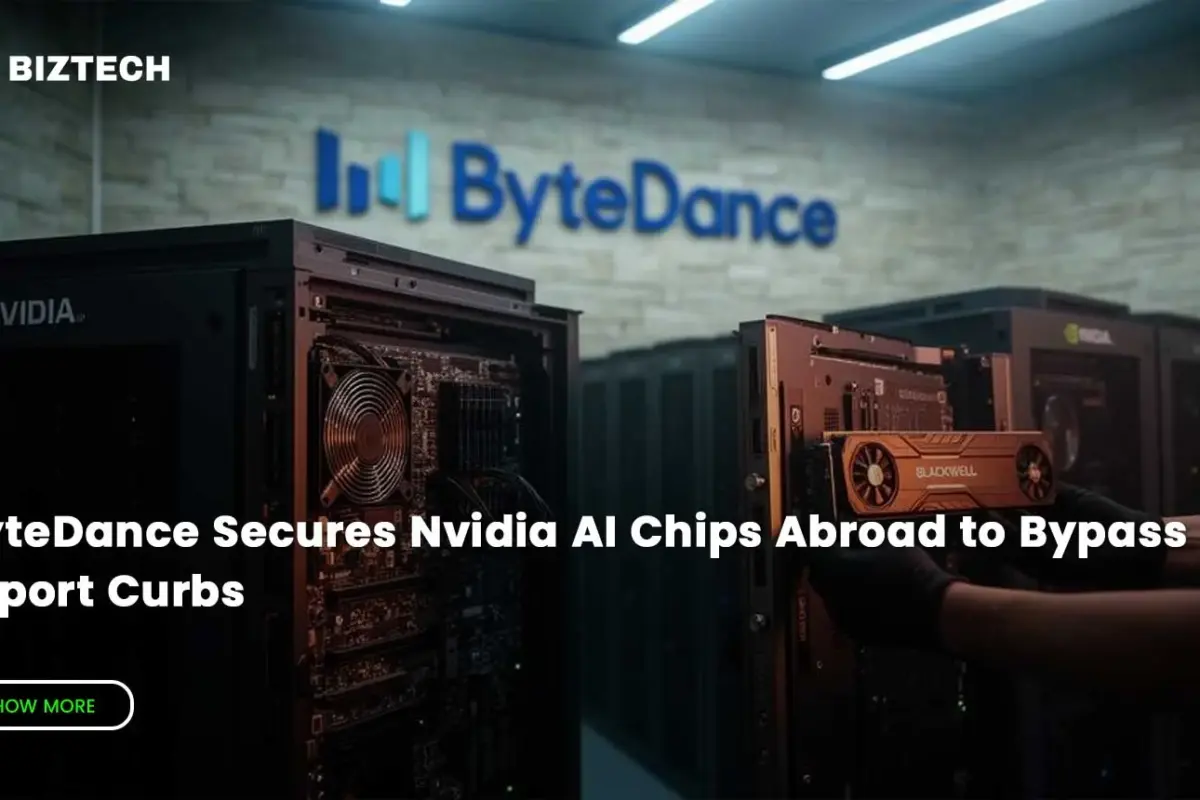
Chinese technology giant ByteDance, the parent firm of the globally popular short-video platform TikTok, is reportedly assembling advanced artificial intelligence computing power outside China using high-end chips produced by Nvidia.

The move illustrates how Chinese technology companies are adapting to stringent export restrictions imposed by the United States Department of Commerce, which has limited the sale of cutting-edge semiconductors to China over concerns about military and strategic applications.
Sources cited in the report indicate that ByteDance has arranged access to Nvidia’s most advanced AI chips through facilities located outside mainland China. By doing so, the company can continue building powerful artificial intelligence systems while formally complying with US export regulations.
ByteDance has not issued a public response to the report. With a valuation exceeding $200 billion, the company relies heavily on AI technologies to power TikTok’s recommendation algorithms, automated video generation tools and content moderation systems used by hundreds of millions of users worldwide.
A spokesperson for the Commerce Department acknowledged awareness of the report and emphasised that Washington would continue monitoring compliance with export rules, stating that the United States remains committed to preventing sensitive technologies from being diverted in ways that could threaten national security.
Navigating Export Controls
The strategy highlights the complexities of enforcing export restrictions within an increasingly globalised technology supply chain. As demand for AI infrastructure surges worldwide, companies are exploring creative operational structures to maintain access to high-performance computing resources.
Nvidia, whose processors have become central to the current AI boom, has seen extraordinary demand from major technology firms building large-scale machine learning systems. However, US controls on shipments of the company’s most powerful chips to China have forced Chinese companies to consider alternative arrangements, including overseas data centres or partnerships with international cloud providers.
For Beijing, such developments reinforce the urgency of achieving technological self-reliance. China has already accelerated investment in domestic semiconductor manufacturing and AI hardware development in response to Western restrictions.
Competitive Stakes in the AI Race
Access to advanced chips remains a decisive factor in the race to develop increasingly sophisticated AI models. Analysts say that maintaining large-scale computing capacity could allow ByteDance to narrow the gap with leading American developers such as OpenAI and Google, which operate some of the world’s most powerful machine learning systems.
Artificial intelligence has become a strategic priority across the technology sector, with governments and corporations investing billions in research infrastructure. The International Monetary Fund has noted that rising AI investment is helping offset broader trade slowdowns, even as geopolitical competition intensifies.

The report has sparked widespread debate among analysts and policymakers about the effectiveness of export controls. Some experts argue that restrictions may slow technological progress but cannot fully halt it, particularly when multinational corporations operate across multiple jurisdictions.
Geopolitical and Policy Implications
The revelation comes at a time of heightened technological rivalry between Washington and Beijing. US policymakers increasingly view advanced computing technologies as strategically sensitive, particularly given their potential military applications.
At the same time, artificial intelligence systems have become deeply embedded in commercial services, from social media platforms to financial analytics and logistics management. This dual-use nature complicates attempts to regulate access without disrupting global innovation.
ByteDance’s approach could prompt Washington to reassess the scope of its export controls or seek broader international coordination with allied countries to close potential loopholes.
For now, the situation underscores a fundamental reality of the AI era: technological competition between the world’s largest economies is intensifying, and companies operating at the forefront of innovation are adapting quickly to maintain their edge in one of the most strategically important industries of the 21st century.
Read Also: OpenAI Accuses China’s DeepSeek of Training AI by Distilling US Models