
Stay connected with BizTech Community—follow us on Instagram and Facebook for the latest news and reviews delivered straight to you.
By making its Pix rapid payment system available in Argentina, Brazil’s central bank has made a big step toward closer financial integration in the area. The expansion, which was announced on March 7, 2026, lets Brazilian residents residing in Argentina use Pix to make everyday payments, send money across borders, and do business in both nations. The decision is likely to speed up the use of cryptocurrencies in Argentina even more. Argentina is already the Latin American leader in per-capita crypto use.
The Banco Central do Brasil started Pix in November 2020, and it has quickly become one of the best rapid payment systems in the world. It lets people, businesses, and organisations send money to each other 24 hours a day, 7 days a week, with just a phone number, email, or QR code. Pix has quickly taken over as Brazil’s most popular payment option because it has almost no fees and settles right away. By the end of 2025, it handled more than 40% of all electronic payments in the country and more than 3 billion transactions every month.
The expansion to Argentina builds on previous agreements between Pix and other Mercosur countries to work together, and it shows Brazil’s desire to make Pix the norm for rapid payments in the area. The system now offers a smooth, low-cost alternative to old-fashioned cross-border transfers, which typically come with large fees and delays of several days. This is great news for Brazilians living in Argentina and Argentines with Brazilian links.
Pix Becomes a Way for People in Latin America to Get into Crypto
The expansion’s actual importance is how it indirectly but strongly affects the use of cryptocurrencies. Some of the biggest crypto platforms in Brazil, such Lemon, Binance Pay, Crypto.com, Mercado Bitcoin, and Kraken, already accept Pix as a main way to get money into the system. Users may quickly and easily change Brazilian reais into crypto, which has led to a huge increase in use in the area.

Argentina has the most crypto users per person in Latin America, even though it has a lower population. Lemon’s research “State of the Crypto Industry in Latin America 2025” says that Argentina has about four times as many crypto users as it did during the bull cycle of 2021. The adoption rate of cryptocurrencies in the larger LATAM region is now about three times higher than in the United States.
Lemon said that a lot of this increase is because of Pix-enabled fiat on-ramping. The research says that in 2025, Argentina had 5.4 million crypto app downloads, and more than 90% of them came from wallets that work with Pix payments in Brazil. The quick and cheap way to change reais into crypto has made digital assets much easier for people in other countries to get.
In real life, a Brazilian expat living in Buenos Aires or an Argentine with business ties to Brazil can now quickly add money to their crypto wallet via Pix, avoiding costly international wires or rigorous capital controls. This smooth bridge has made Pix an unplanned but very useful way for stablecoins and Bitcoin to get into the region.
Argentina’s economy has gone from hyperinflation to stable conditions
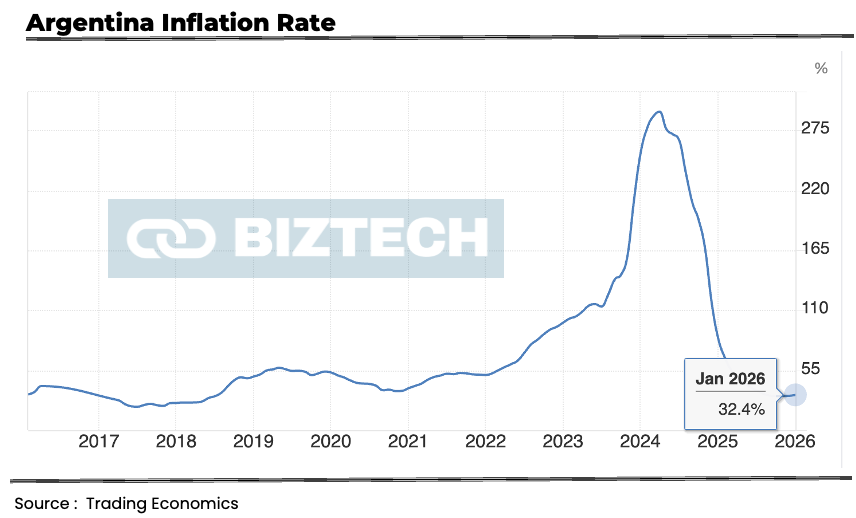
Argentina’s rise in crypto has been driven by need for a long time. Chronic inflation, severe currency regulations, and the peso’s periodic devaluation drove millions to dollar-pegged stablecoins and Bitcoin as ways to save money and send money. During times of high inflation, many families used stablecoins as a kind of parallel currency.
Lemon’s report from 2025 demonstrates that Argentina’s macroeconomic outlook has become better. Inflation plummeted to 37% in 2025, the lowest level in eight years and three times lower than the year before. The government also got rid of most currency controls, which means that for the first time in years, people could purchase and sell U.S. dollars freely on the open market. These changes have made crypto less of a necessary survival tool, but they have also made it possible to employ it in new ways.
As it gets easier for Argentines to get dollars, they are utilising stablecoins for more than just keeping their capital safe. They are using them for cross-border trade, payments to creators, and ordinary transactions. Pix integration speeds up this change by making it easy and cheap to move between reais and crypto ecosystems.
The Pix expansion makes Brazil the top in fintech in Latin America and deepens its financial links with Argentina. It also shows how national rapid payment systems can unknowingly speed up the use of cryptocurrencies. Pix’s success in Brazil, where there are almost no costs, payments are settled right away, and everyone accepts it, has set an example that other developing economies are keenly watching.
This is clearly a good thing for crypto platforms. One of the biggest things keeping people from using crypto is that there aren’t any easy ways to switch from fiat to crypto. Pix makes it easier for Brazilian users in Argentina (and maybe vice versa) to use digital assets by lowering the entry barrier. This is one of the most popular places in the world for digital assets.
This tendency goes beyond Pix. Western Union’s agreement with Crossmint to handle USDPT stablecoin payments on Solana, which was announced in late 2025, is another example of how traditional payments and blockchain rails are coming together. As more and more people use rapid payment systems around the world, they are becoming natural ways for regulated stablecoins to be used.
Problems and Future Prospects
The expansion is a clear gain for making cryptocurrencies easier to get, yet there are still problems. The economy in Argentina is getting better, which could lower the “necessity-driven” demand for stablecoins. This could restrict the growth of pure store-of-value use cases. Brazil and Argentina will also need to work together on regulations. Cross-border compliance, KYC/AML procedures, and tax reporting must all keep up with the number of transactions.
Still, the basics are good. Latin America has three times as many people using cryptocurrency as the U.S., which suggests that the region is ahead of the rest of the world. Pix’s expansion to Argentina increases the infrastructure layer that has already been important in getting that lead.
For crypto platforms that do business in the area, the message is clear: connect with fast payment systems like Pix. Not simply new technology, but also low-friction fiat on-ramps are the way to get a lot of people in emerging markets to use it.
As Brazil and Argentina’s banking systems become more compatible, Pix is quietly becoming one of the most important factors in the emergence of cryptocurrencies in Latin America. In the second half of 2026, we’ll see how much more this integration can boost adoption in the region and if other emerging markets will do the same.
Read Also: Iran Sees 700% Spike in Crypto Outflows After U.S.-Israel Strikes