
Stay connected with BizTech Community—follow us on Instagram and Facebook for the latest news and reviews delivered straight to you.
Bitcoin’s long-standing story as “digital gold”—a store of value that doesn’t change with the market and protects against inflation and monetary instability—is being looked at again. Bitcoin’s price has been moving more and more like high-beta growth stocks, especially software and technology stocks, as more institutions become involved through regulated vehicles like spot ETFs. The relationship has gotten more clear over recent times when the sector has been weak. This raises important issues about whether Bitcoin is still mostly a safe-haven asset or if it has become a risk-on proxy that is sensitive to macro liquidity and growth mood.
This change in behaviour is what led to the most important events in the crypto markets this week. Grayscale’s most recent study shows that Bitcoin is becoming more like growth stocks. At the same time, one Ether treasury business is doubling down despite losing billions of dollars on paper. BlackRock expands its DeFi presence through Uniswap, while Polymarket takes its fight with regulators to the federal level.
Read Also: Bitcoin stays above $90,000 even as tensions between the U.S. and Venezuela are rising
Grayscale: Trading Bitcoin Is More Like Investing in Growth
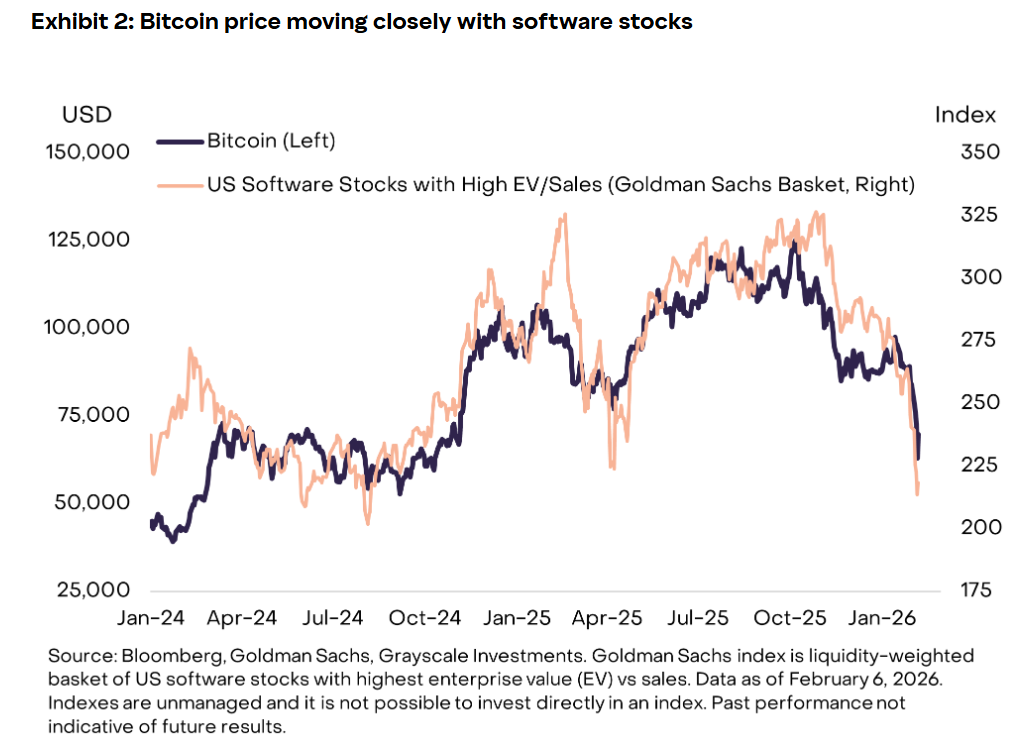
Zach Pandl wrote a recent report for Greyscale that says Bitcoin’s short-term trading patterns have changed from its long-term store-of-value premise. The company still thinks of Bitcoin as a rare, decentralised asset that isn’t affected by central bank policy. However, its recent price movements have been very similar to those of software equities, which have become more concerned about how AI will affect the industry.
Bitcoin and growth stocks have become more closely linked over the past two years, especially when software businesses are under pressure to sell. Bitcoin’s recent drop fits with this trend, which means that its short-term performance is more affected by general risk sentiment than by its distinctive monetary qualities. Grayscale’s study shows that there are two sides to the story: Bitcoin still has its long-term value proposition based on scarcity, but its shorter-term price movements are affected by macro and sector-specific risks, just like high-growth tech stocks.
BitMine Sticks with Ether Even Though They Lost a Lot of Money on Paper
During the recent market collapse, Ether treasury company BitMine Immersion Technologies added 40,613 ETH to its holdings. This brought its total holdings to more than 4.326 million ETH, which is worth over $8.8 billion at current prices. According to DropsTab data, the aggressive accumulation has led to unrealised losses of more than $8.1 billion. This shows a big difference between the company’s typical cost basis and current market pricing.
BitMine chairman Tom Lee has said again that the company is committed to Ether for the long term, even though investors have been very critical of the company and its price has been falling. The strategy is based on a wager on where Ether will go in the future. The whole portfolio, which includes crypto and cash, is worth about $10 billion. The move shows that some institutional investors are willing to deal with short-term volatility in order to get more long-term exposure with more conviction.
BlackRock adds BUIDL to Uniswap, making DeFi more interesting
BlackRock is getting more involved in decentralised finance by adding its tokenised money market fund, BUIDL, to Uniswap. The connection lets institutional investors who are on the whitelist trade the USD Institutional Digital Liquidity Fund directly on the blockchain. BlackRock is also buying Uniswap’s governance token, UNI, as part of the deal. This shows that the company is committed to the protocol’s ecosystem in a strategic way.
With more than $2.1 billion in assets under management, BUIDL is still the largest tokenised money market fund in the world. The fund has made more than $100 million in payouts from its U.S. Treasury holdings since it started. It has issued tokens on several blockchains, such as Ethereum, Solana, and Avalanche. The Uniswap listing is a big step toward connecting traditional asset management with decentralised trading infrastructure. This makes DeFi channels more legitimate for institutional capital.
Polymarket Takes Regulatory Fight to Federal Court
Polymarket, a decentralised prediction market, has sued the state of Massachusetts in federal court to stop state officials from trying to limit or shut down its event-based trading products. Chief legal officer Neal Kumar acknowledged the submission on Monday. He said that problems about jurisdiction that haven’t been answered should be dealt with at the federal level instead of through separate state enforcement.
The preemptive lawsuit wants to stop Massachusetts Attorney General Andrea Campbell from taking any action because it says that doing so would illegally interfere with markets that the Commodity Futures Trading Commission (CFTC) oversees. Polymarket says that the CFTC is the only group that can make rules for event contracts, and that state-level rules could lead to conflicting national standards.
The lawsuit shows that there is more and more antagonism between state regulators and federally focused crypto platforms. As prediction markets become more popular, it’s important for the sector’s long-term survival that there is clear jurisdiction.
Conclusion
Bitcoin’s growing connection to growth stocks goes against its usual “digital gold” story, especially when people are feeling less risky in the IT and software sectors. Grayscale’s analysis shows this tension, and BitMine’s aggressive Ether accumulation shows that some institutional players are still confident even if they have lost a lot of money on paper. BlackRock’s merger with Uniswap and Polymarket’s lawsuit against the federal government show how traditional finance and decentralised protocols are coming together more and more.
These factors—macro liquidity circumstances, regulatory certainty, institutional flows, and the contradiction between Bitcoin’s scarcity-driven premise and its increasingly risk-sensitive trading behavior—are expected to continue to impact the market as 2026 goes on. The asset class is still in a transitional phase for now; it is not totally separate from traditional risk assets or fully part of them.