Stay connected with BizTech Community—follow us on Instagram and Facebook for the latest news and reviews delivered straight to you.
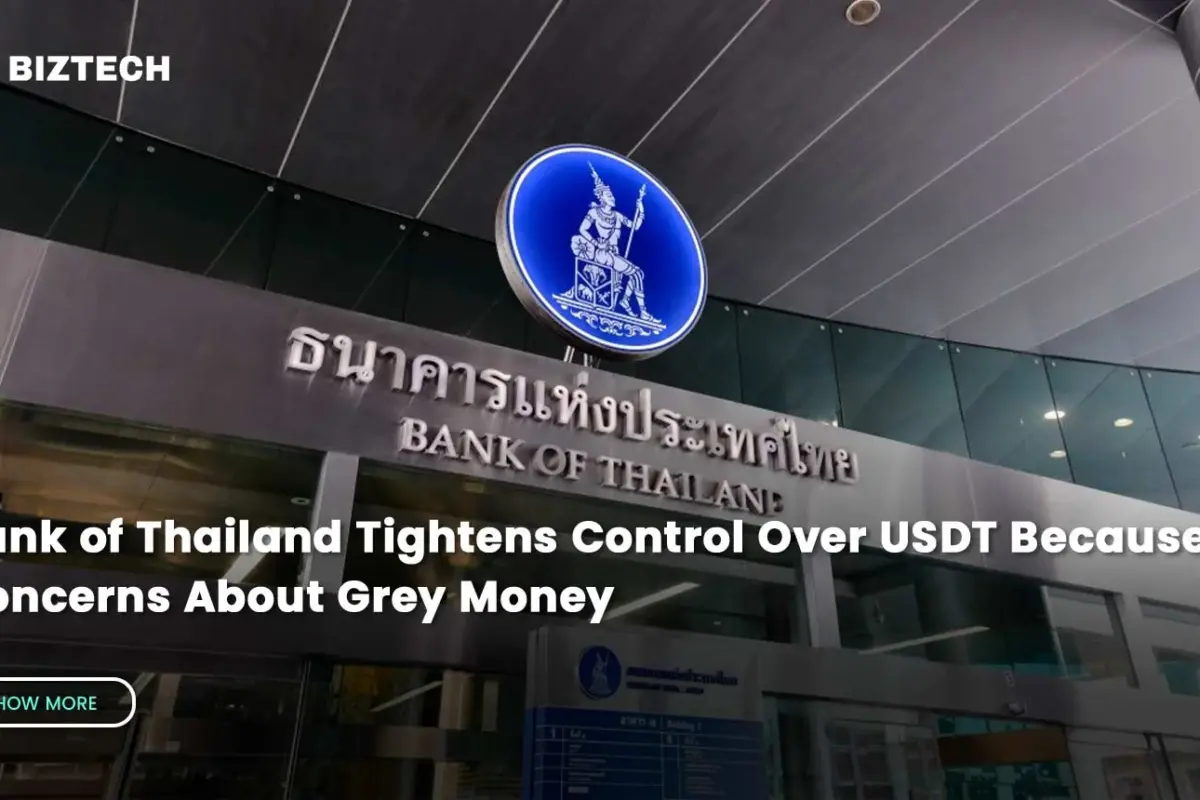
Thailand’s central bank is looking more closely at Tether’s USDT stablecoin because it has found traces of grey money moving via the country’s crypto trading channels. The Bank of Thailand (BoT) has chosen to keep an eye on stablecoin transactions in the same way that it does cash movements, gold trade, and electronic wallet transfers. The change shows that people are more worried that foreign-linked sellers are taking over the USDT market and that unregulated flows could hurt the economy.
During a recent briefing, Governor Vitai Ratanakorn said that about 40% of USDT vendors on Thai platforms are foreigners who shouldn’t be doing business in Thailand. The central bank decided to put stablecoin activities under the same supervision as high-risk cash and commodities transactions after this discovery. Thailand’s crypto market is still small, with an average daily trading volume of about 2.8 billion baht compared to 10–15 billion baht in the foreign currency market. However, the BoT said that size alone does not preclude the possibility of systemic danger.
“We won’t just be doing analysis anymore,” Vitai said. “The central bank will be more involved in fixing structural problems. If this problem isn’t fixed, it could have an effect on the stability of the economy as a whole in the long run.
The extra supervision is in line with what Prime Minister Anutin Charnvirakul said on January 9, 2026. The prime minister ordered stronger rules for both the gold trading and digital asset markets. These rules included requiring significant transactions to be reported, enforcing wallet identification, and making sure that the central bank, revenue department, and other financial agencies worked together.
Read also: Since 2023, Iran’s IRGC has used USDT and UK-registered exchanges to move around $1 billion
Foreign sellers control the USDT market in the US
The BoT’s research showed that a large part of the USDT supply in Thailand comes from international dealers who use local platforms to sell it. These vendors typically use the stablecoin as a bridge currency to move money in or out of the nation without using regular banking systems that have stricter rules around foreign exchange. The central bank sees this pattern as a possible way for “grey money” to flow. This is money that may not be illegal but doesn’t have clear documentation or regulatory transparency.
Compared to many other Asian countries, Thailand’s capital accounts have been pretty open. However, the government has become more watchful of money leaving the country and non-bank payment channels. Putting stablecoin transactions under the same rules as cash and gold is part of a bigger attempt to close perceived legal loopholes.
The move comes at a time when the use of stablecoins is growing around the world. By the end of 2025, the entire quantity of stablecoins had gone over $292 billion, with USDT holding a leading position with more over $187 billion (around 64% of the market). Chainalysis says that stablecoins made up for 84% of illegal crypto transactions in 2025, which added up to about $154 billion. Since late 2023, Tether has frozen more than $3 billion in USDT in response to 310 law enforcement requests in 62 jurisdictions. This includes a $182 million freeze related to five Tron addresses on January 11, 2026.
Even with these measures, high-profile cases still attract a lot of attention. A Wall Street Journal article from January 10 said that Venezuela uses USDT a lot to pay for oil exports. It said that around 80% of crude revenue currently settles in the stablecoin to get around U.S. sanctions. The similarity makes regulators everywhere uneasy because it makes them wonder: when does using a dollar-pegged token for a real purpose become sanctions evasion or grey market activity?
What this means for Thailand’s crypto ecosystem
Thailand’s crypto industry has risen consistently, even if it is smaller than those in nearby countries like Singapore and South Korea. Clear licensing standards that were put in place in recent years have helped local exchanges and wallet providers, but the central bank’s latest statement signals that the government is getting ready to make control much stricter. The fact that stablecoin flows are now being watched in the same way as cash and gold means that future rules may require tougher reporting, source-of-funds checks, and transaction limits.
The time is important. Thailand has been trying to become a regional centre for digital assets. For example, it plans to create a legal sandbox for tourists who want to use crypto payments. More emphasis from the central bank on USDT could have an effect on both domestic users and overseas visitors who use stablecoins to send money cheaply.
Tether’s position in the area is still complicated. The corporation has worked with law enforcement on freezes, but because it is the biggest player in trading and remittance corridors in emerging markets, it is hard for governments to limit it without hurting legitimate customers. The BoT’s approach seems reasonable—more monitoring instead of outright bans—but it shows that stablecoin flows will be watched more closely in the future.
Thailand isn’t the only country that is rethinking how to regulate stablecoins. Several Asian countries have made restrictions stricter or added new ones since the asset class is growing quickly and being used more and more in both legal and illegal movements. Japan’s debut of the yen-pegged JPYC in October 2025 and South Korea’s current debates over a stablecoin bill show that both countries are trying to find a balance between innovation and control.
Regulators around the world are dealing with a similar problem: stablecoins are useful and inclusive, especially in areas with a lot of remittances, but their pseudonymous character and ability to cross borders make it easier for money laundering, sanctions evasion, and grey-market activities to happen. The U.S. GENIUS Act and the EU’s MiCA framework are both attempts to set criteria for reserves and transparency. However, places with less regulation could become places where restricted flows happen.
The central bank’s aggressive posture may help the Thai crypto market in the long run by building trust and making the rules clearer. But it might also slow down adoption if compliance costs go up or foreign liquidity providers pull out.
In the next few months, we’ll see how far the BoT is willing to go with its surveillance framework and if other central banks in the region follow suit. Right now, it’s clear: stablecoins are still welcome, but they won’t be able to work in the shadows anymore.