Stay connected with BizTech Community—follow us on Instagram and Facebook for the latest news and reviews delivered straight to you.
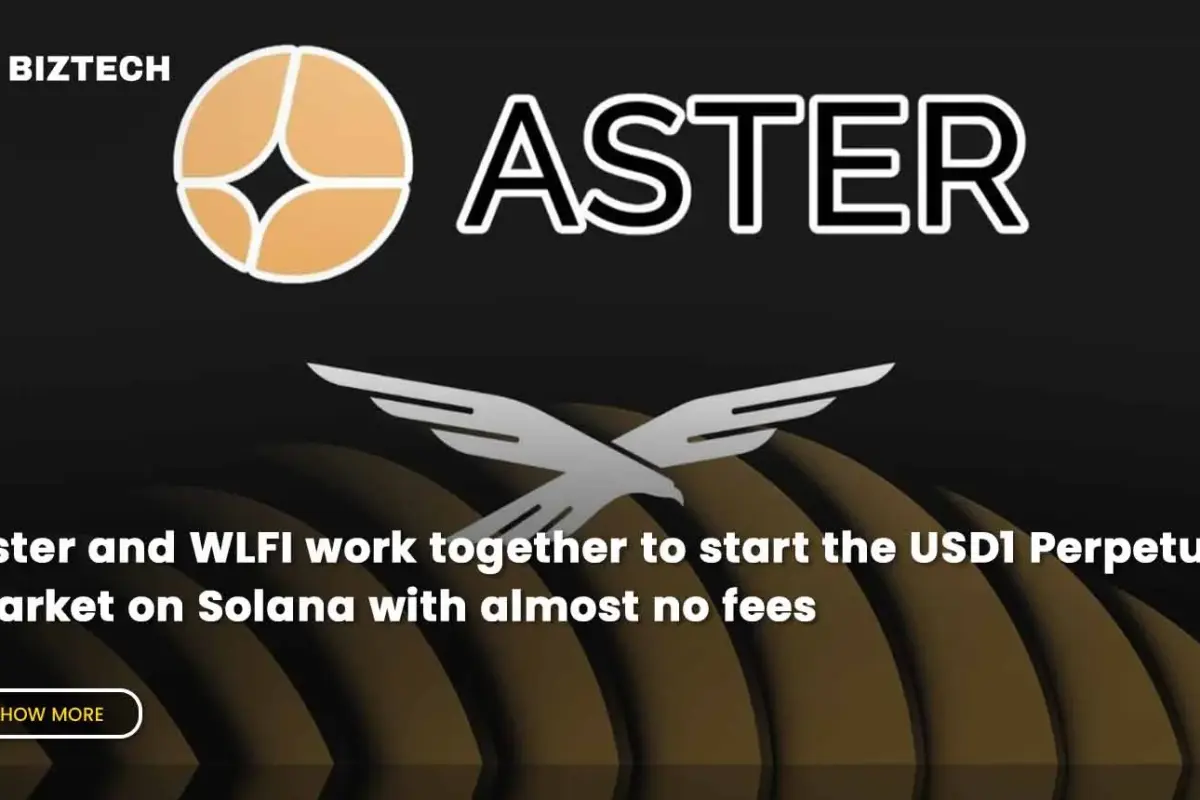
Aster, a rapidly expanding derivatives platform on the Solana blockchain, has made a big move to increase the liquidity and use of its ecosystem stablecoin USD1. On March 18, 2026, the project said it had formed a strategic relationship with World Liberty Financial (WLFI), the DeFi project supported by the Trump family, to start a new permanent futures market based on USD1.
The market went online in early access with three trading pairs: BTC/USD1, ETH/USD1, and SOL/USD1. Aster has said that more than ten more pairs would be introduced in the next few weeks. These will include major cryptocurrencies and maybe some altcoins as well. The most interesting thing about the new perpetual market is its high fees: makers pay 0 basis points (bps) and takers pay only 0.5 bps. That is a big drop from the 4 bps taker fee that is usual on USDT-based perpetual markets on both centralised and decentralised exchanges.
The almost-free maker fee is meant to draw in professional liquidity providers, market makers, and high-frequency traders who usually don’t want to pay costs to place orders. Aster wants to construct deep, tight order books from the start by getting rid of maker fees completely. This is very important for any perpetual futures market that wants to compete with established venues.
USD1 as the main collateral and trading pair
The new perpetuals use USD1 as its settlement currency, but it is also the main collateral and margin asset. Users can deposit USD1 straight to initiate leveraged positions. The margin requirements and liquidation criteria are the same as those of major stablecoins like USDC and USDT. Aster’s long-term plan is to make the token a core trading primitive on Solana and eventually on its own Aster Chain. The decision to make the market centred around USD1 shows this.
In the official statement, CEO Leonard made this point clear:
“We’re laying the groundwork for the Aster Chain mainnet launch by adding USD1 to our primary trading engine during this phase. Our 0-bps maker charge is meant to encourage people to join the USD1 market on Aster from the start.
The relationship with WLFI gives the project more meaning and importance. WLFI has made a name for itself as a politically aligned DeFi initiative with strong connections to powerful people in the present U.S. government. Aster is clearly trying to get money from institutions and people with political connections as it gets ready to grow much more.
Huge monthly WLFI token rewards
Aster and WLFI are giving away 2.5 million WLFI tokens every month to active traders in the USD1 perpetual market to get things moving again. The incentive programme is set up to reward people who consistently offer volume. Users that keep open interest and add to the order book depth will get more of the rewards.
The move is a classic example of DeFi growth hacking: employ token emissions to get liquidity going in the early, most vulnerable stage when a new market hasn’t yet reached escape velocity. If they work, the incentives might start a circle that keeps going: more WLFI awards attract traders, which raises the volume and improves execution quality. This draws in even more people, and as the ecosystem grows, WLFI emissions become more valuable.
The Long-Term Vision for Aster Chain
The USD1 perpetual launch is clearly meant to be the first step towards Aster Chain, the project’s own Layer-1 blockchain that is designed for high-performance derivatives trading. Aster Chain can handle more than 100,000 transactions per second, with block times of about 50 milliseconds and gas costs that are almost negligible. The goal is to make on-chain trading as fast and easy to use as centralised exchanges while keeping self-custody, permissionless access, and full decentralisation.
Aster may create liquidity and user habits in an existing high-throughput environment by starting the eternal market on Solana first. Then, it can move to its own chain. The concentration on USD1 guarantees continuity: when the Aster Chain mainnet becomes live, users who trade on the existing market will be able to easily move their positions and collateral.
The purchase of Vyper, a cross-chain trade terminal, earlier this year was a sign that the company wanted to work with more than one chain. Recent domain registrations and adjustments to the infrastructure show that work is being done to get ready for Ethereum, Base, BNB Chain, and maybe Monad. There has been no formal announcement of a multi-chain debut, but the clues are clear: Aster aims to dominate memecoin trade on other networks.
Price Action and Technical Outlook for the ASTER Token
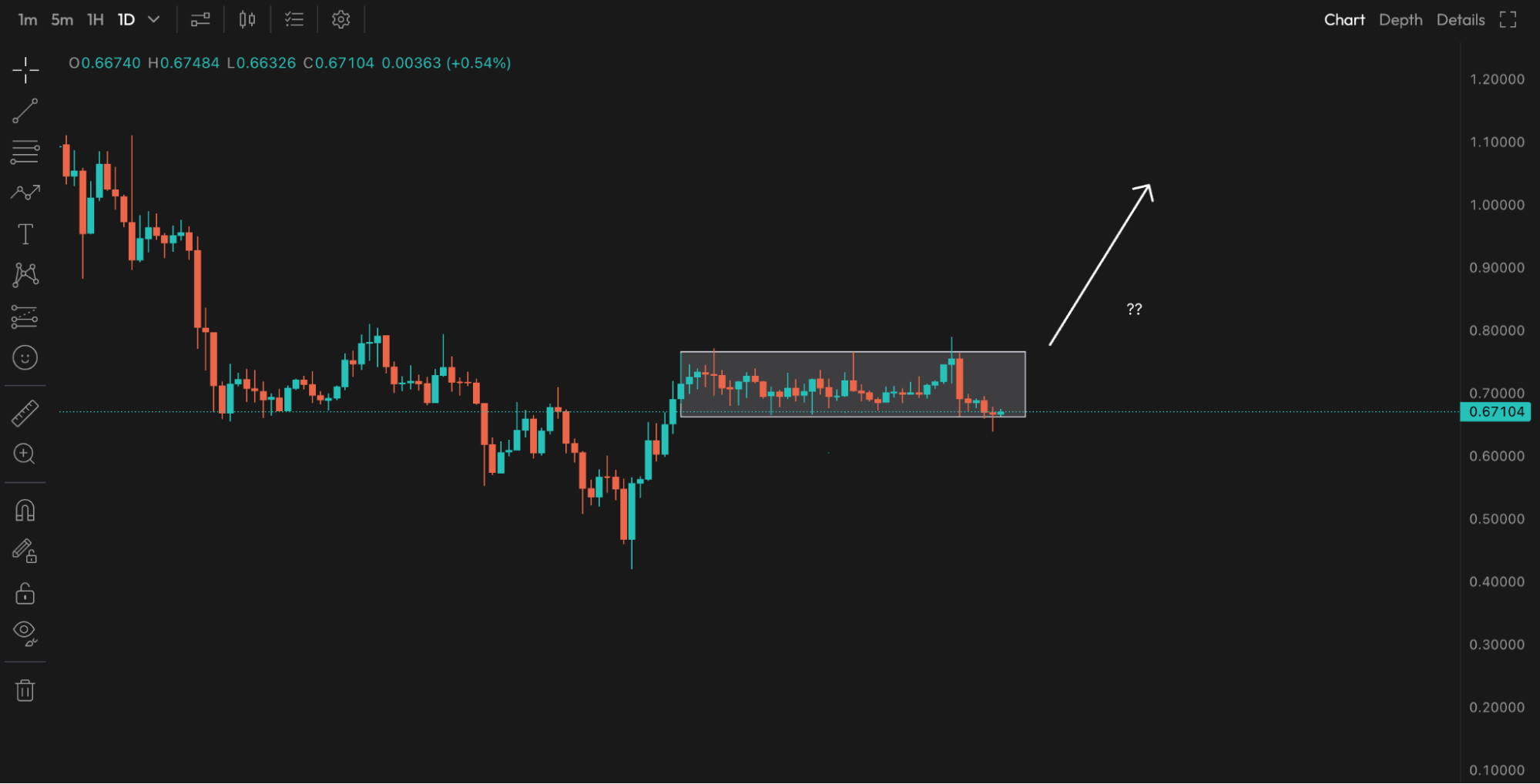
The ASTER token has had a hard time lately, even though it has made some basic development. At the time this was written, ASTER was trading at about $0.672, which is a drop of 9.43% in the last 24 hours. The market cap is at $1.71 billion, and the spot trading volume is about $62.53 million.
ASTER has made a liquidity sweep on the 5-minute chart and then bounced back from a demand zone. The structure looks like it might be making a higher low, which is an indication that the market is bullish in the short term as long as the price stays above $0.68. Right now, there is resistance around $0.72. If it breaks over that level, it could go up to $0.80–$0.85 in the near future. If $0.68 isn’t defended, the rebound structure will be weaker and the chance of a retest of lower supports near $0.60 will be higher.
The token’s weakness is perhaps a sign of how the market as a whole feels, not a problem with Aster’s roadmap. Bitcoin is still under pressure from macroeconomic problems and geopolitical uncertainty, which is causing altcoins and ecosystem tokens to drop. Once Bitcoin develops a stable base and people are willing to take risks again, high-conviction Solana projects like Aster tend to do better.
The Competitive Landscape and the Way Forward
The USD1 perpetual market joins a popular but still broken DeFi derivatives market on Solana. Drift, Zeta Markets, and Mango Markets all offer perpetuals, however centralised exchanges like Binance, Bybit, and OKX have the most total volume. Aster’s very low maker fee and WLFI token rewards make it very appealing to professional liquidity providers and high-frequency traders, who are the lifeblood of any deep perpetual market.
In the end, success will depend on how well you do:
– Quickly adding a lot of pairs to get people’s attention
– Stable liquidity depth and tight spreads to keep traders happy
– A smooth way to move to the Aster Chain mainnet without bothering users
– Using WLFI incentives wisely to create a community that can support itself
If Aster can do these things, the USD1 perpetual market might become a strong competitor to Solana’s main derivatives market. When a protocol captures viral product-market fit on Solana, it may make a lot of money. Pump.fun reached $1 billion in sales. Aster is clearly trying to go in the same direction, but this time in the stablecoin and perpetuals trading space.
So far, the market hasn’t reacted much, and ASTER has done worse than the rest of the market. But the basics—high fees, strong incentives, relationships with institutions, and a clear plan for a high-performance Layer-1—make Aster one of Solana’s most ambitious projects as we approach into the second quarter of 2026.
Over the next few months, one of the most significant things to keep an eye on in the Solana ecosystem will be whether it can turn that ambition into long-term liquidity and token worth.
Read Also: OpenSea Delays SEA Token Launch Amid Challenging Market Conditions