Stay connected with BizTech Community—follow us on Instagram and Facebook for the latest news and reviews delivered straight to you.
For the first time, gold has broken through the $5,000 per ounce barrier. It reached new all-time highs over the weekend and is still rising strongly until late January 2026. According to the company’s most recent quarterly report, which came out on January 26, Tether’s gold-backed token, Tether Gold (XAUT), is growing more faster than its main stablecoin, USDT, which is tethered to the US dollar.
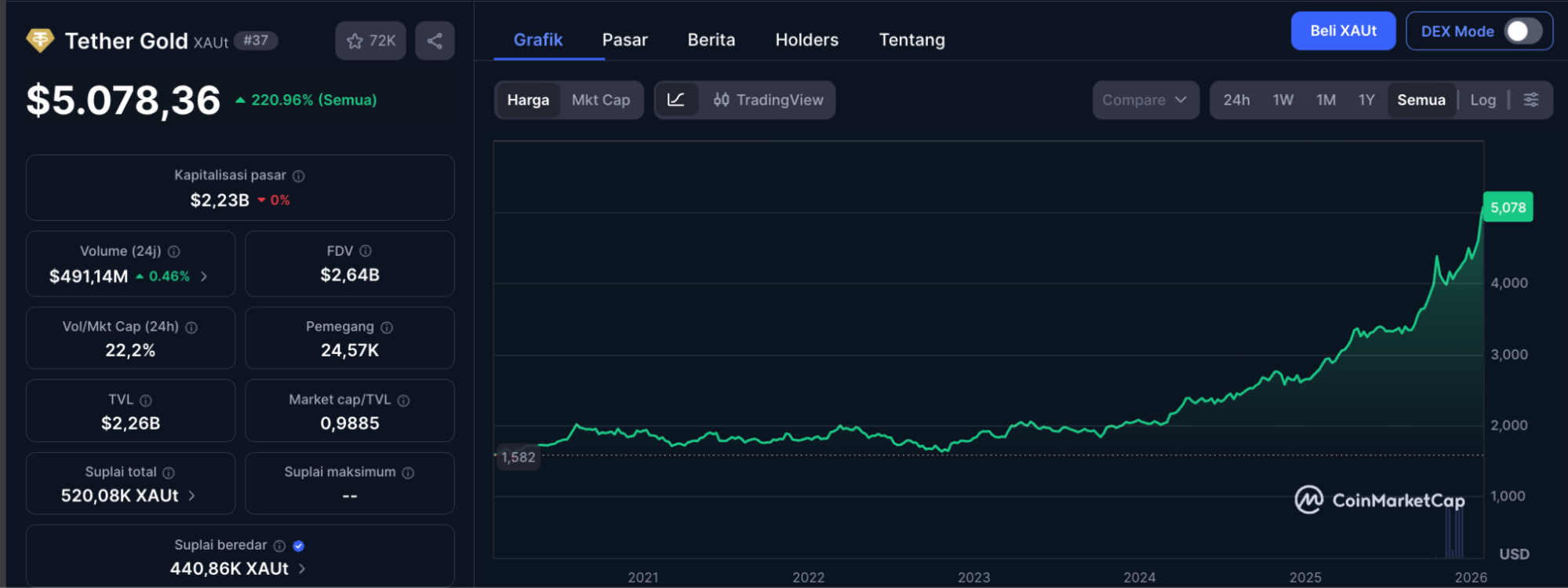
According to the BDO Italia report for the period ending December 31, 2025, Tether made over 375,000 XAUT tokens in the fourth quarter. This was a 38% rise from the previous three months. In contrast, the amount of USDT expanded by only 7% during the same time, reaching $187 billion. That means that XAUT’s supply grew about five times faster than USDT’s in relative terms during the last three months of 2025. This shows that investors were clearly moving towards gold-linked digital assets at a time when money was very uncertain.
XAUT’s market valuation is about $2.64 billion, which puts it solidly in the top 50 cryptocurrencies in the world. This is based on gold prices that are now above $5,100 per ounce. The token is now in direct competition with Paxos’s PAX Gold (PAXG), which has had a market cap of almost $2 billion since it came out in September 2019. Even though Tether came into the market later, it has now passed Paxos to become the biggest issuer of tokenised gold by circulating supply.
Read also: How the markets are changing their minds on scarcity in Bitcoin, gold, and silver in 2026
Gold’s rise makes people want to buy tokenised exposure
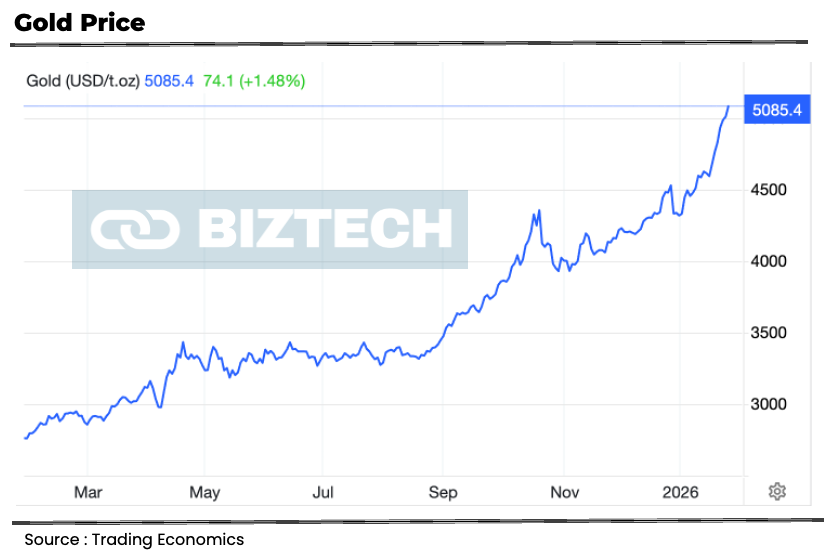
The fast rise in the value of actual gold has been one of the biggest macro stories of late 2025. Central banks kept buying gold all year, sovereign wealth funds put more money into it, and ordinary investors looked for ways to safeguard themselves from inflation and worries about currency debasement. A lot of people were watching the $5,000 psychological level, and the breach has strengthened gold’s historic function as a safe place to keep money during times of geopolitical uncertainty and loose economic policy.
XAUT’s growth is very similar to this pattern. CEO Paolo Ardoino has made the token a way to protect against long-term unpredictability in the economy. “XAUT is meant to lower uncertainty when faith in traditional monetary systems wanes,” he said in the news announcement. There is real gold housed in Swiss vaults that backs the product completely. Each token stands for one fine troy ounce. BDO Italia sends monthly attestations that prove reserves are equal to or greater than outstanding tokens, which meets the existing regulatory requirements for transparency.
Tether has also included the “Scudo” unit, which is equal to 1/1,000th of a troy ounce, to make it easier for people to invest in gold. The business sold about 173,400 XAUT in the fourth quarter of 2025, which is about $882 million worth of gold at today’s rates. That number of sales is more than three times more than the amount for the last two quarters, which shows that demand is growing.
Strategic Move Away from Relying Only on USD
XAUT has done better than USDT, which also shows a little but fundamental change in Tether’s reserve policy. USDT is mostly backed by U.S. Treasuries and cash equivalents, although the business has been slowly adding more precious metals to its portfolio. The attestation from September 30 stated that the company held about $12.9 billion in precious metals, mostly gold bars, which made up part of the $181 billion fiat-backed token supply.
The U.S. GENIUS Act, which passed in July 2025, requires stablecoin issuers to keep high-quality reserves and be audited on a regular basis. This makes this diversification even more important. Tether’s introduction in September of USAT, a fully U.S.-regulated dollar stablecoin that is meant to follow GENIUS, is another sign that the corporation wants to work within stricter rules in major markets.
Analysts at JPMorgan have already said that Tether could have to sell some of its gold holdings in order to meet possible U.S. compliance criteria. Gold was trading for about $2,950 an ounce back then, which is much less than it is now. The continuous rise has only made Tether’s gold holdings worth more, which strengthens its balance sheet at a time when regulatory pressure on reserve composition is growing.
Problems and the Competitive Landscape
In the tokenised gold market, Tether Gold is now in direct competition with PAXG. PAXG has grown steadily since it came out, but XAUT’s recent rise has put Tether ahead in terms of circulating supply. Both products offer the same basic idea: you can have digital exposure to physical gold and redeem it for cash at a 1:1 ratio. However, differences in issuer reputation, chain support, and liquidity still affect market share.
There are still bigger problems to deal with. Tokenised gold is only a minor part of the whole stablecoin market, and investors’ interest in gold-linked digital assets depends on the price of real gold and how trustworthy the issuer is seen to be. Some institutional observers still disagree over Tether’s ongoing argument over thorough financial audits (as opposed to attestations).
Even with these problems, the quick rise of XAUT in the fourth quarter of 2025 shows that more and more people want to invest in gold through digital channels. It is likely that the momentum will continue until 2026 if gold stays strong, regulations are clear, and Tether can keep users’ trust in how it manages its reserves.
Conclusion
The tokenised precious metals market is clearly gaining ground, with physical gold prices rising beyond $5,000 per ounce and Tether Gold growing five times faster than USDT in the last three months of 2025. The surge is a sign of more general economic insecurity, worries about inflation that won’t go away, and a search for assets that can keep their value outside of traditional currency systems. The difference in growth between XAUT and USDT is an indication for Tether that it has to change its strategy and focus on diversifying its reserves and tokenising real-world assets.
As the rules and regulations in the US and Europe get better, tokenised gold and other RWAs are likely to become more popular with both institutional and retail investors who want stability with the benefits of blockchain. In the following few quarters, we’ll find out if XAUT can keep doing better than other stablecoins and if tokenised precious metals can get a significant share of the stablecoin market as a whole. At this point, the combination of gold’s historic rise and Tether’s rapid issuing makes it look like digital gold is finally getting its chance.