Stay connected with BizTech Community—follow us on Instagram and Facebook for the latest news and reviews delivered straight to you.
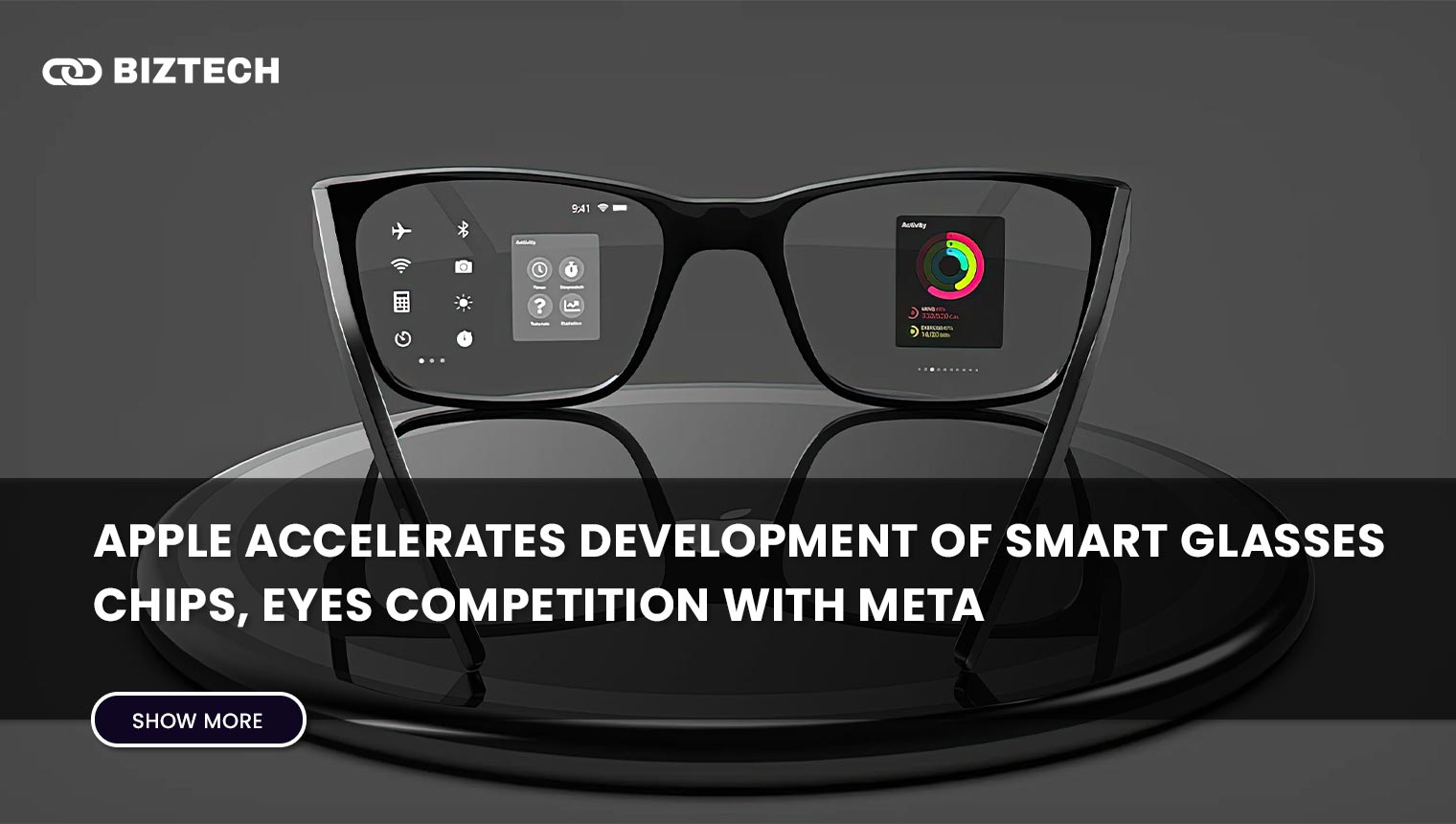
Apple is ramping up development of a new suite of chips aimed at powering its upcoming smart glasses and strengthening its position in AI and personal computing. According to a Bloomberg report, the company is working with Taiwan Semiconductor Manufacturing Company (TSMC) to bring the chips into mass production by late 2026 or 2027.
At the center of this initiative is a custom processor inspired by the low-power chips found in the Apple Watch. Designed for maximum energy efficiency, this chip will be capable of controlling multiple cameras and sensors expected in Apple’s glasses, while minimizing battery drain — a crucial factor for wearable devices.
Smart Glasses as a Strategic Priority
Smart glasses have become a strategic priority for Apple, particularly as it looks to challenge Meta’s early dominance in the space. Since 2023, Meta has sold around 2 million units of its Ray-Ban Meta smart glasses, gaining an early lead in a market Apple now appears determined to disrupt.

CEO Tim Cook is reportedly committed to overtaking Meta, with Apple exploring non-AR glasses that use cameras to scan the environment and apply AI to assist users. The initial glasses, developed under the codename N401, may not include full augmented reality capabilities, instead focusing on intelligent vision features and lightweight functionality.
Broader Chip Strategy Encompasses Macs, AI, and Wearables
Beyond the glasses project, Apple is also developing new chips for future Macs, AI servers, and wearable devices. These include upcoming iterations of its M-series chips — the M6 (codename Komodo) and M7 (Borneo) — as well as a high-performance variant known internally as “Sotra.” The M5 chip is expected to power updated iPad Pro and MacBook Pro models later this year.

Apple is also expanding into AI-specific hardware. According to reports, chips currently in development will power AI servers that run Apple Intelligence, the company’s on-device AI suite that includes notification summaries, email rewriting, and integration with OpenAI’s ChatGPT.
The expansion into AI is part of Apple’s broader strategy to maintain full control over the hardware stack. The company, under hardware chief Johny Srouji, has increasingly moved away from third-party suppliers, with recent milestones including the release of its first in-house modem chip for the iPhone 16e and a more advanced version, the C2, slated for 2026.
Future-Ready Wearables in Development
Apple is also exploring other wearables beyond glasses. Engineers are testing new hardware configurations for future AirPods and Apple Watches that could include built-in cameras. These devices, internally codenamed “Glennie” (AirPods) and “Nevis” (Apple Watch), are targeting a release window around 2027.

These innovations suggest Apple is laying the groundwork for a more interconnected ecosystem of smart devices, each enhanced with AI and supported by custom-built chips. The company’s cautious approach — focusing on power efficiency, privacy, and device integration — stands in contrast to rivals who have pushed cloud-based, always-on AI systems.
Competition With Meta, Strategic Timing
While Meta prepares to launch a premium version of its Ray-Ban smart glasses with built-in displays later this year, Apple appears content to delay its full rollout until AI software matures. Analysts say the first Apple glasses could arrive in 2027, just as Meta targets its own debut for fully AR-capable eyewear.
Apple’s emphasis on controlling hardware and software — from chips to services — may position it for long-term success, even as it plays catch-up in emerging product categories. With a robust roadmap in development, Apple seems poised to reassert itself not only in personal computing, but also in the evolving landscape of wearable AI.