Stay connected with BizTech Community—follow us on Instagram and Facebook for the latest news and reviews delivered straight to you.
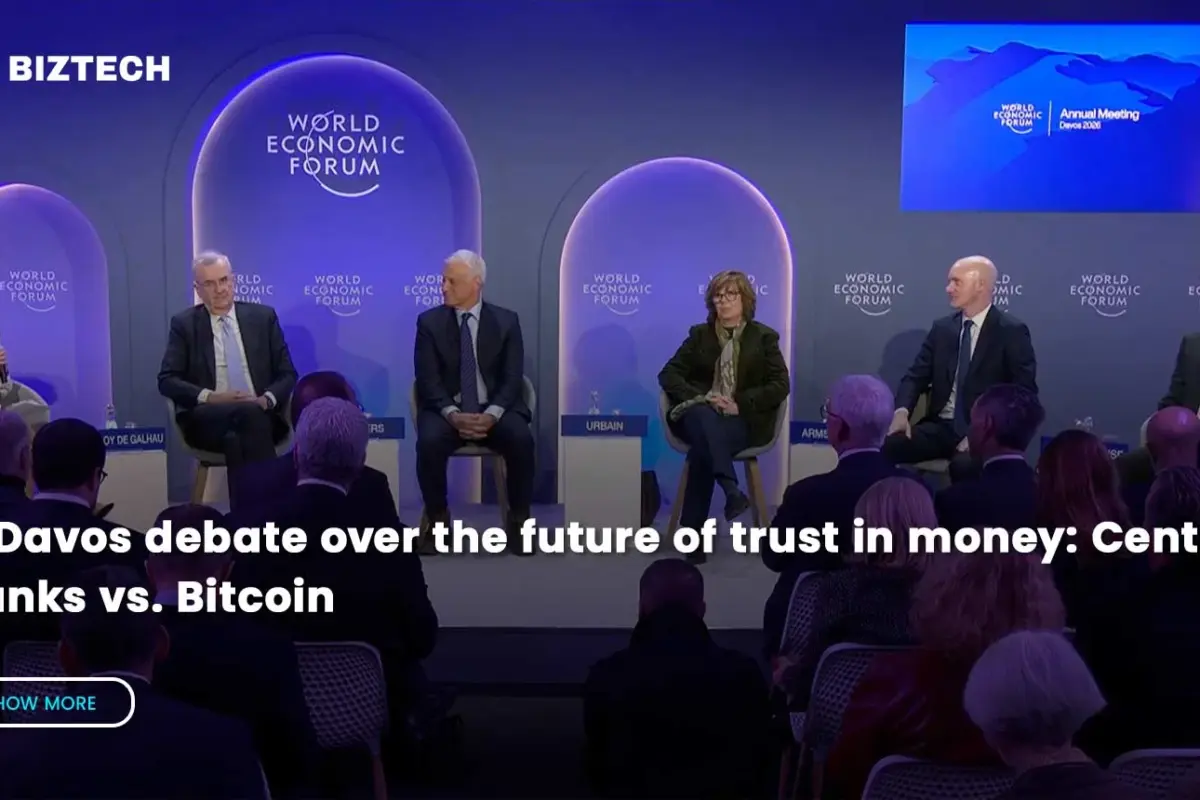
At the World Economic Forum in Davos this week, the ongoing battle between traditional banks and decentralized cryptocurrencies took center stage. French central bank Governor François Villeroy de Galhau and Coinbase CEO Brian Armstrong argued over the basic issue of trust in modern money.
On January 17, 2026, during a panel called “Is Tokenization the Future?” Galhau said that public institutions like central banks are the real custodians of monetary trust. Armstrong, on the other hand, said that Bitcoin’s decentralized structure gives people more freedom.
The exchange brought up a bigger philosophical division that is becoming more important in global policy debates: Should trust come from regulated authorities with democratic mandates, or from systems that are imposed by code and work outside of the control of any one group?
This isn’t just talk at school. As cryptocurrencies become a $4 trillion asset class and central banks around the world work to create digital equivalents of their fiat currencies, the question of “who deserves the public’s trust” becomes more important.
It affects everything, from the rules that govern the market to how consumers use it, how institutions invest in it, and even how future financial systems are built. The Davos conversation is a good reminder that trust isn’t given; it’s earned by openness, resilience, and meeting users’ demands. This is especially important in a world where digital money is becoming the standard.
Read also: European Central Bank Completes Digital Euro Preparations, Awaits Political Decision
The Main Points of the Argument
Governor Galhau started the conversation by stressing how important it is for central banks to build confidence. He said, “The guarantee for trust is independence on the central bank side.” He also took a swipe at private crypto issuers, saying, “I trust more independent central banks with a democratic mandate than private issuers of Bitcoin.”
His point of view is based on a traditional belief that monetary stability depends on institutions that are not affected by short-term political pressures but are nevertheless accountable to democratic processes. In this perspective, central banks give monetary policy the credibility it needs to be widely accepted, thanks to hundreds of years of development.
Galhau didn’t say that private companies shouldn’t be involved in digital money. He said that “money has existed for centuries as a public-private partnership,” which means that there is opportunity for collaboration as long as it stays within the law.
This fits with the European Central Bank’s current work on the digital euro, which intends to add to existing systems rather than replace them while still keeping monetary sovereignty. The ECB’s recent pronouncement that technical preparations are done and it’s now up to lawmakers to act shows how careful but forward-thinking this strategy is.
Armstrong, on the other hand, strongly disagreed, saying that Bitcoin’s confidence comes from its design, not from any institutional support. He said, “Bitcoin is even more independent than central banks because they are.” “There is no one, company, or country in the world that controls it.”
Armstrong believes that true trust comes from decentralization, which is a system where no one group can change supply, censor transactions, or lower value through inflation. He said that this code-based independence leads to “healthy competition” with central banks, as people ultimately choose which system they trust.
Armstrong’s point of view fits with the core idea of cryptocurrency: using technology to give people more control. He talked about how Bitcoin may help hold people accountable in ways that existing institutions frequently don’t, like by limiting deficit spending.
He said, “If people can choose which one they trust more, I think it’s the best way to hold people accountable for spending too much.” This made Galhau laugh, but it also highlighted a critical tension: currency systems’ flexibility versus Bitcoin’s hard scarcity.
The discussion, which was led by CNBC anchor Karen Tso and included officials from Euroclear, Ripple, and Standard Chartered, talked about bigger issues like tokenization and making finance more accessible to everyone. But the trust discussion grabbed the presentation, showing the deep conceptual divide between centralized authority and distributed ledger technology.
Historical Context: How Trust in Money Has Changed Over Time
To comprehend this division, it is beneficial to examine the historical origins of monetary trust. For hundreds of years, people trusted money because it was backed by the government, such gold standards that were linked to government vaults or fiat declarations that were enforced by laws about legal tender. In the 20th century, central banks became independent guardians who kept the economy stable while dealing with political pressures.
The 2008 financial crisis hurt some of that faith by showing how weak the system was and leading to the creation of Bitcoin as a peer-to-peer currency that doesn’t need a middleman.
Bitcoin’s trust model turns things around: It doesn’t depend on institutions; it depends on cryptographic proofs, consensus algorithms, and a fixed supply cap of 21 million coins. People in countries with significant inflation, like Venezuela or Argentina, whose central bank policies have failed time and time again, have liked this. Chainalysis says that crypto use in these areas grew by 40% in 2025, with stablecoins and Bitcoin acting as shields against currency devaluation.
Central banks say that their democratic mandates and regulatory scrutiny make them more accountable than decentralized organizations. This is clear from Galhau’s focus on “independence with a democratic mandate”: elected governments choose central bankers, who act independently but within public rules. For example, the ECB’s plans for a digital euro contain rigorous privacy protections and limits on how much money people may retain to stop bank runs. These are characteristics that are meant to promote confidence via openness.
Critics, on the other hand, say that central banks haven’t always done the right thing. After 2008, the U.S. Federal Reserve’s quantitative easing made asset bubbles bigger and inequality worse, which led to the saying “money printer go brrr.” Armstrong and other Bitcoin supporters think decentralization is better because it takes away all human choice—code can’t be influenced or corrupted.
What this means for users and markets in real life
This isn’t just an argument; it affects choices in the actual world. For regular people, central bank trust means that digital euros or dollars are supported by the same institutions that handle currency. According to BIS data, 62% of people throughout the world would rather have digital money from banks than private ones. Privacy is still a hot topic: the ECB’s offline mode promises cash-like anonymity, but some people are worried about backdoors.
People that don’t trust institutions like Bitcoin’s model: According to Chainalysis, adoption reached 716 million worldwide in 2025, with emerging markets driving the way. But the fact that Bitcoin’s price might drop by 30% while stablecoins’ prices stay the same makes it less popular.
This conflict is clear in the markets: Bitcoin’s $2 trillion cap is much more than most CBDC pilots (e.g., e-CNY’s $250 billion processed), yet stablecoins like USDT ($172B) demonstrate a mix of demand. Institutional flows favor regulated wrappers, with $175 billion in BTC/ETH ETFs. At the same time, DeFi TVL at $150 billion shows that decentralized systems are also popular.
Different views from around the world
There are similar arguments going on outside of Davos. China’s e-CNY puts the PBOC in charge, but India’s RBI likes CBDCs more than private stablecoins. Emerging economies like Nigeria (with eNaira) find a balance between inclusion and independence.
The U.S. Clarity Act could make things clearer for stablecoins, while the ECB’s decision on the digital euro is coming up. For trust, hybrids are coming out, like private stablecoins that are watched over by a central bank or ZKPs that let people keep their anonymity in regulated institutions.
In the end, it’s up to the users: Galhau’s institutions or Armstrong’s code? As digital money grows up, the best option may be a mix of both: government support and decentralized efficiency.